Introduction
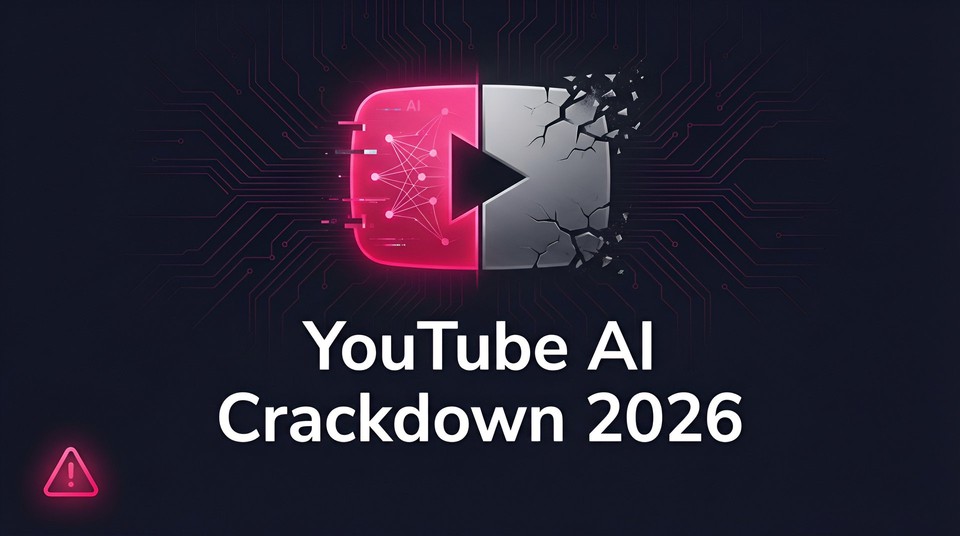
YouTube is in the middle of its largest demonetization enforcement wave ever; and AI content is at the center of it. Channels earning $30,000 a month have been stripped of monetization overnight. Others with millions of subscribers have been wiped entirely. Over 4.7 billion lifetime views were erased, 35 million subscribers were affected, and an estimated $10 million in annual creator revenue has vanished.
If you use AI in any part of your content creation workflow; scripts, voiceovers, editing, visuals; this is the most important thing you'll read all year.
But here's what most headlines get wrong: YouTube is not banning AI. It's banning laziness disguised as content. Understanding the difference is how you protect your channel and keep growing in 2026.
What's Actually Happening: YouTube's 2026 AI Crackdown
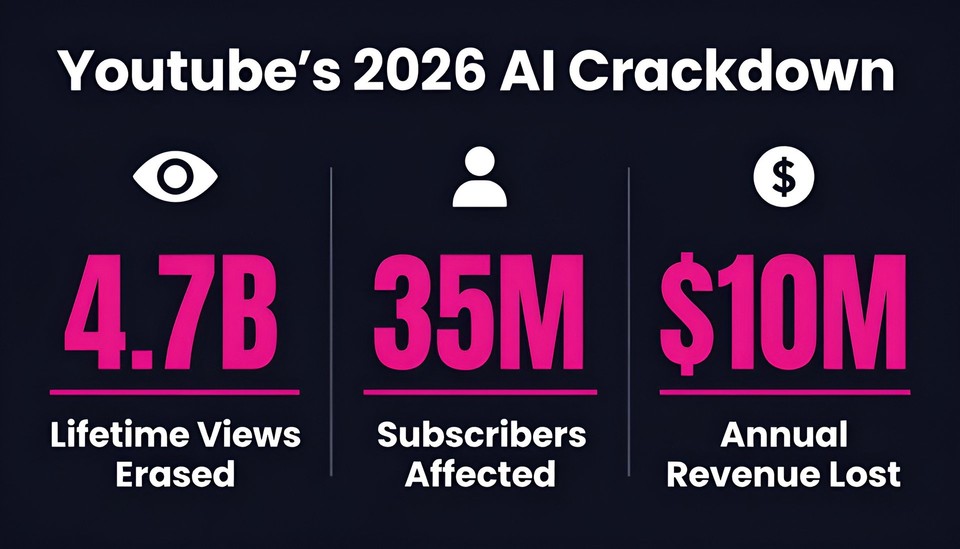
YouTube has deleted millions of channels in recent months. The headline story is about "AI slop"; super low-effort, generic content pumped out by automated pipelines. But the crackdown is reaching further than that.
Real creators with real audiences are getting caught in the enforcement net. Sean Cannell, YouTube strategist and host of the Think Media Podcast, recently shared some eye-opening case studies from creators inside his coaching community. One Bible story channel with 588,000 subscribers and $30,000 per month in ad revenue was fully demonetized. The reason YouTube gave: "inauthentic and mass-produced content." Another exam prep education channel earning $7,500 per month; content that genuinely helped people pass real estate licensing exams received the same treatment.
These aren't spam channels. They had engaged audiences, quality information, and human oversight behind the content. Yet YouTube's enforcement systems flagged them anyway.
YouTube CEO has publicly acknowledged the crackdown, pointing to the rise of low-quality, repetitive content flooding the platform. The company has made it clear: they'd rather lose ad revenue on flagged channels than let advertiser trust erode. When a channel gets demonetized, YouTube stops running ads entirely; they're not secretly keeping the money.
To understand why YouTube is being aggressive, consider what AI tools have made possible. Some operators are launching 150 new YouTube channels in a single day using automated bots. They scrape viral videos, spin the scripts through AI, generate visuals, add stock music, and publish; sometimes uploading 6-7 videos per channel per day.
Some upload multiple variations of the same video just to A/B test which thumbnail gets more clicks. This isn't content creation. It's content farming. And YouTube's platform was drowning in it.
How YouTube Detects AI and Mass-Produced Content
YouTube is using AI systems of its own to scan and monitor channels at scale. The detection happens through pattern recognition; and then humans get involved to review flagged channels and send specific feedback to creators.
Here's what YouTube's systems are looking for:
1. Upload velocity
If you're publishing at a pace no human could sustain; multiple long-form videos daily, for instance; that's an immediate red flag. AI doesn't get tired, but YouTube's algorithms know that.
2. Script fingerprinting
AI can spot AI. Just like universities use detection tools to identify AI-written student papers, YouTube can identify when scripts are recycled, spun, or generated from the same underlying content. If your script reads like a slightly reworded version of a viral video's transcript, that's a flag.
3. Pattern consistency across videos
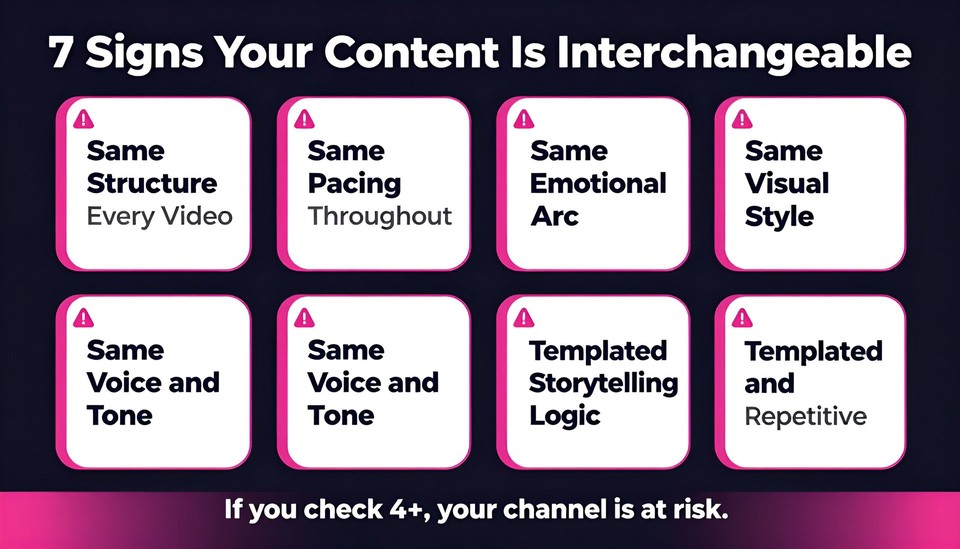
Same structure, same pacing, same emotional arc, same visual style, same voice, same storytelling logic; video after video. YouTube's systems are specifically trained to recognize this kind of templated uniformity.
4. Production pipeline analysis
YouTube appears to be evaluating not just the final video, but how it was produced. Channels where every step; from ideation to scripting to voiceover to editing to publishing; is fully automated with zero human involvement are at the highest risk.
The Word You Need to Know: Interchangeability
This is the key concept that Sean Cannell highlighted from direct communication between YouTube and the affected creators in his community. YouTube isn't anti-AI; they're anti-interchangeability.
What does that mean? If YouTube could swap your channel with a hundred others and nobody would notice, you have a problem. If your Bible stories, exam prep videos, or motivational content looks identical to thousands of other channels using the same AI tools with the same templates, YouTube considers that interchangeable; and interchangeable content is what's getting demonetized.
Think of it this way: YouTube wants creators who feel human and unique, not videos that look like they came off the same assembly line.
Real Channels That Got Demonetized: Case Studies
Case Study 1: Bible Story Channel; $30K/Month to Zero
-
Niche: Bible stories and narrative breakdowns
-
Subscribers: 588,000
-
Monthly revenue: $30,000 from YouTube AdSense alone
-
Content style: Faceless, narrative-driven, AI-assisted (not AI spam)
-
What happened: Fully demonetized. Reason given: "inauthentic and mass-produced content"
-
Current status: Under appeal with no timeline for review
The critical detail: this didn't happen because of one video. It happened because of the pattern of the channel. The same structure, same dramatic voiceover style, same visual approach across hundreds of videos.
The channel still gets nearly a million views per month. But zero ad revenue.
Case Study 2: Exam Prep Education Channel; Genuine Value, Still Flagged
-
Niche: Real estate exam preparation for specific US states
-
Monthly revenue: $7,500 (mix of ad revenue and software signups)
-
Content style: Educational, highly factual, clear user value
-
Production: Heavy automation in the pipeline, AI-assisted scripts and voice
-
What happened: Demonetized for the same pattern-based reasons
What makes this case particularly frustrating: the creator was actively involved in every video; tweaking content, fact-checking AI-generated scripts (critical for exam prep where accuracy matters), fixing pronunciation issues in AI voices, and ensuring audio quality. There was genuine human effort behind the automation.
But the production pipeline itself; the heavy reliance on automation from concept to completion; triggered YouTube's enforcement systems.
Note: These case studies were shared by Sean Cannell on the Think Media Podcast. The creators involved are members of Think Media's accelerator and coaching programs who reached out to Sean and his team after getting hit by YouTube's enforcement. Sean shared these stories (without naming the specific channels) to help the broader creator community understand what's happening and how to protect themselves. Want to watch the complete video? See below:
What's Allowed vs. What's Not: YouTube's 2026 Framework
YouTube has laid out clear guidelines. Here's the framework every creator needs to understand.
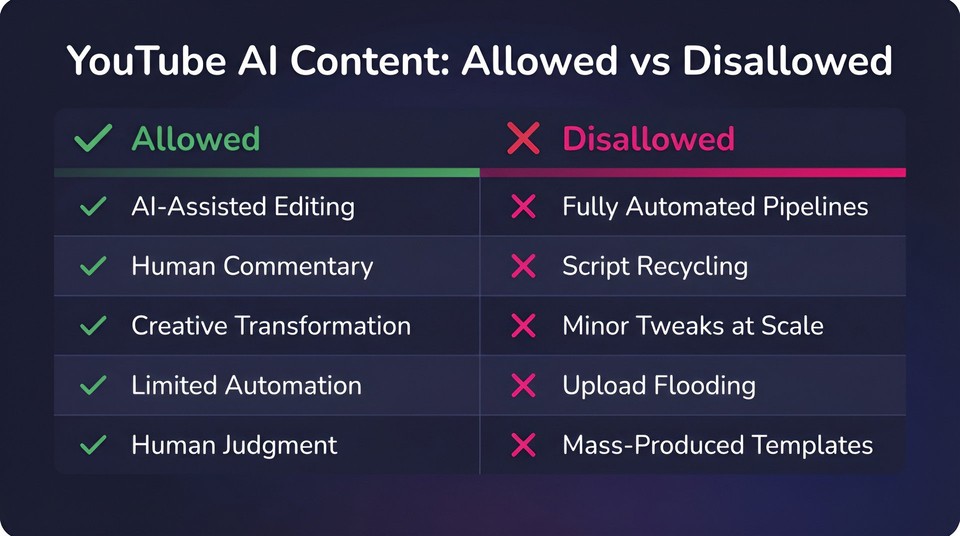
What YouTube Allows
-
AI-assisted editing. Using AI tools to help with video editing, color correction, transitions, and post-production is completely fine.
-
Human commentary and interpretation. If you're using AI for research but adding your own perspective, analysis, and opinions, that's exactly what YouTube wants to see.
-
Creative transformation. Taking AI-generated content and transforming it through your creative lens; adding unique angles, personal stories, different visual treatments.
-
Limited automation. Automating parts of your workflow is acceptable. The key word is "limited"; not zero automation, not full automation.
-
Human judgment shaping outcomes. AI can draft, but you decide. AI can suggest, but you choose. The human needs to be making the creative decisions.
What Gets You Demonetized
-
Fully automated pipelines. When the entire process; from concept to script to voiceover to visuals to publishing; runs without human involvement, that's the clearest red flag.
-
Script recycling. Finding viral videos, copying their transcripts, running them through AI to "rewrite," and publishing. YouTube's systems can detect this pattern with increasing accuracy.
-
Minor tweaks at scale. Producing dozens of nearly identical videos with small variations; different thumbnail, slightly different hook, same core content.
-
Upload flooding. Publishing at volumes that no human creator could sustain. Multiple long-form videos per day, or spinning the same content into numerous variations.
-
Mass-produced templates. Using the same rigid template for every video; same intro structure, same pacing beats, same emotional arc, same visual style. YouTube can identify when content follows an identical blueprint across an entire channel.
The summary: if a human can't clearly point to someone shaping this content, YouTube assumes a machine made it.
5 Ways Creators Can Protect Themselves in 2026
These principles apply whether you're a faceless channel, an on-camera creator using AI tools, or somewhere in between.
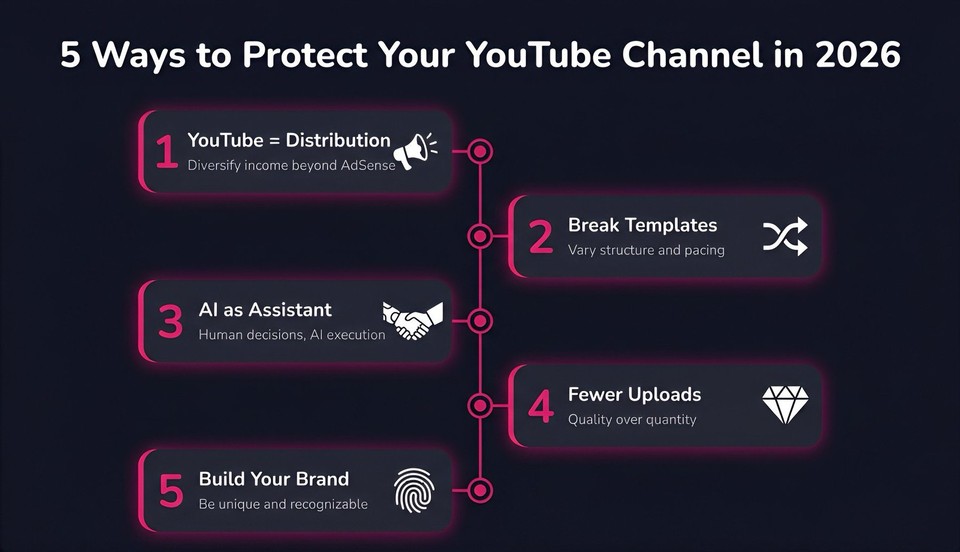
1. Treat YouTube as Distribution
The Bible story channel lost $30,000 per month in ad revenue. That's devastating. But the channel still gets almost a million views monthly; the reach didn't disappear, just the direct monetization.
This is the wake-up call every creator needs: if AdSense is your only income stream, you're one policy change away from zero revenue.
Smart creators treat YouTube as a distribution channel that drives traffic to their actual business; email lists, courses, communities, software products, brand deals, affiliate income. The channels that survived demonetization best were the ones with diversified income streams.
Build your email list. Create your own products. Develop brand partnerships. Use YouTube to drive awareness, and monetize through channels you control. Tools like Fliki's text-to-video and YouTube video maker can help you efficiently produce content for your channel while you focus on building the business around it.
2. Break Templates on Purpose
If every video on your channel follows the exact same formula; same hook structure, same pacing, same emotional beats, same visual transitions; you're painting a target on yourself.
Break the pattern deliberately. Vary your intros. Change your pacing. Mix up your storytelling structure. Allow imperfection.
This is actually liberating. The "viral template" approach; where every video follows a proven attention-hacking formula; was always a short-term play. YouTube is now actively penalizing the sameness it produces.
Does this mean you can't have a consistent brand? No. Consistency in visual identity, voice, and values is different from robotic repetition of the same video template. Think about your favorite YouTube creators; they have a recognizable style, but every video feels different.
3. Think of AI as an Assistant
This is the most critical mindset shift for 2026. AI should help you create better YouTube videos faster. It should not replace you entirely.
What this looks like in practice:
-
Use AI to brainstorm topic ideas, then choose and refine based on your expertise
-
Let AI draft a script outline, then write the actual content yourself; adding your stories, opinions, and voice
-
Use AI-powered tools for voiceover generation or video editing, but make deliberate creative choices about tone, pacing, and style
-
Use AI for research acceleration, not as the sole source of your content
-
Run your finished script through an AI detection tool; if it comes back as 99% AI-generated, you haven't done enough human work
A good benchmark: AI should save you 5-10 hours per video. But you should still be investing meaningful time; bringing your perspective, your experience, and your judgment to the final product.
Platforms like Fliki are designed around this philosophy. Rather than replacing the creator, Fliki's AI Copilot and script-to-video workflow let you maintain creative control while accelerating production. You write or refine the script. You choose the voice from 2,500+ options across 80+ languages. You review every scene before rendering. The AI handles the labor-intensive production work; but the creative decisions stay with you.
4. Fewer Uploads, Higher Distinction
In 2026, quality beats quantity. This is a fundamental shift from the "post every day" advice that dominated YouTube strategy in previous years.
Consider this: some successful channels are approaching 100,000 subscribers with fewer than 20 long-form uploads. They're going deeper, not wider. Each video is more researched, more polished, and more distinctive.
For faceless and AI-assisted channels, this is especially critical. Slowing down gives you time to:
-
Actually review and improve AI-generated content
-
Add personal insights and original research
-
Develop a distinctive visual and audio identity
-
Ensure factual accuracy (especially important in educational niches)
-
Create content that would be difficult to replicate with a one-click AI tool
Fliki's Series feature supports this approach; you can plan an entire content calendar upfront, ensuring each piece is distinct and purposeful rather than repetitive. The goal is a content operation with intentional variety, not a content factory churning out interchangeable units.
5. Build a Unique Brand; Even If It's Fully AI
This is the biggest, most important principle. And it might surprise you: YouTube is fine with fully AI channels. The issue isn't the technology; it's the genericness.
Think about Mickey Mouse. Not a real human. But an iconic, recognizable brand with a distinct personality. Think about the Bible Project; a voiceover animation channel with no person on camera, but with a completely unique illustration style and storytelling approach that took significant investment to develop.
If you want to run a faceless AI channel in 2026, here's the playbook:
-
Create a unique AI avatar or character. Not a different stock avatar for each video; one consistent character that becomes your channel's face. Tools with realistic AI avatars and character consistency can maintain the same face, outfit, and style across every video.
-
Develop a distinctive voice. Don't use the default AI voice that everyone else uses. Clone your own voice or create a unique voice identity using voice cloning technology. Fliki's expressive voices can convey emotion; laughing, whispering, sarcasm; which makes your content sound less robotic and more distinctly yours.
-
Define your visual brand. Colors, typography, thumbnail style, transition patterns, B-roll aesthetic. YouTube's AI thumbnail maker can help you create CTR-optimized thumbnails, but make sure they have a consistent, recognizable look that's uniquely yours.
-
Have a point of view. Generic "Top 10 Facts About Warren Buffett" videos are interchangeable. "Warren Buffett Repeated His Worst Investment Decision. Here’s Why?" is a perspective. Your angle is your brand.
The bottom line: brand is the only differentiator left. In a world where anyone can generate AI content in minutes, the creators who build a recognizable, distinctive brand will thrive. The ones who don't will be indistinguishable from the millions of other channels; and YouTube will treat them accordingly.
Where YouTube Is Headed: What to Expect Next
YouTube's pattern-based enforcement isn't going away; it's going to get smarter. Here's what to expect:
AI detection will improve continuously. Just as AI content generation tools get more sophisticated, so do detection systems. Trying to "game" the system with tools that claim to be "YouTube detection-proof" is a losing strategy. YouTube's AI will always be better at spotting AI than your tools are at hiding it.
The enforcement will get more precise. Right now, there's clearly overreach; quality channels with real human involvement are getting caught in the net. YouTube will refine its systems, and the appeal process will likely improve. But waiting for that refinement is a risk.
Content farms are finished. Channels operating as automated content factories; high volume, low effort, template-based, interchangeable; have no future on the platform. This is permanent.
Human-AI collaboration is the winning model. The creators who will dominate YouTube in 2026 and beyond are those who use AI as a powerful assistant while bringing genuine human creativity, perspective, and brand identity to their content.
As one veteran creator put it: "Creators who outwork, outlearn, outstrategize, and outlast everyone else win." AI is a tool that helps you do all four; but it can't do any of them for you.
How to Use AI Responsibly for YouTube Content in 2026
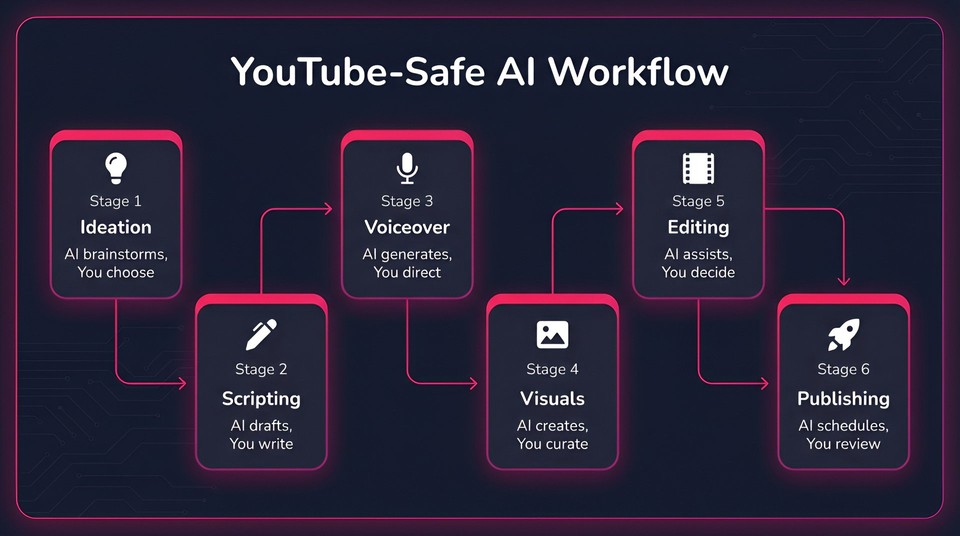
Here's a practical framework for integrating AI into your YouTube workflow without putting your channel at risk:
|
Production Stage |
AI's Role |
Your Role |
|---|---|---|
|
Ideation |
Brainstorm topics, research trends |
Choose topics where you’ve expertise and which are based on your audience |
|
Scripting |
Generate outlines, draft sections |
Write your perspective, add stories, refine voice |
|
Voiceover |
Generate professional audio from your script |
Select voice style, adjust emotion, review delivery |
|
Visuals |
Generate images, suggest B-roll, create thumbnails |
Direct the visual style, ensure brand consistency |
|
Editing |
Auto-subtitles, transitions, sound effects |
Make creative decisions on pacing, structure, flow |
|
Publishing |
Schedule, optimize metadata |
Final review, strategic timing decisions |
This is where platforms like Fliki shine. Fliki's entire design philosophy is built around this human-AI collaboration model. You start with your idea; type it into the AI Copilot or paste your script; and Fliki handles the production-heavy lifting: generating voiceover, selecting visuals, creating AI-generated video clips, adding automatic sound effects, and producing thumbnails optimized for clicks. But every creative decision passes through you first thanks to the Smart Script Review step, where you can edit every layer before a single frame renders.
The result: content that's produced efficiently but doesn't look, sound, or feel like it was mass-produced. That's exactly what YouTube wants to see in 2026.
If you're exploring AI-powered video creation and want to experiment with different visual styles, voices, and formats, Fliki's Playground lets you test AI image and video models; including Veo 3.1, Kling 2.5, and FLUX Pro; before committing to a full production.
The Bottom Line
YouTube's 2026 AI crackdown isn't the end of AI-powered content creation. It's the end of lazy AI content creation.
The creators who treat AI as a replacement for effort will lose their channels. The creators who treat AI as a tool that amplifies their unique voice, perspective, and brand will build bigger audiences than ever before.
The rules are clear. The tools exist. The only question is whether you'll use them with the craft and intention that YouTube; and your audience; now demand.
FAQs
No. YouTube has explicitly stated that AI-assisted content is allowed. What they're cracking down on is fully automated, low-effort, and interchangeable content that could be produced by anyone using the same AI tools with the same templates. If your content has genuine human creativity, perspective, and oversight, AI tools are welcome.
Yes, but you need a distinctive brand. A faceless channel with a unique AI character, consistent visual identity, distinctive voice, and genuine creative perspective is fine. A faceless channel that looks identical to thousands of others using the same AI pipeline is at risk. Build a brand identity; think Mickey Mouse, not generic stock footage.
There's no official limit, but volume is a signal YouTube watches. If you're publishing more content than a human could reasonably produce with quality; even with AI assistance; that's a red flag. For most creators, 2-4 quality videos per week is a sustainable pace that doesn't trigger upload flooding flags.
No. Using AI voiceover is allowed. The risk comes when AI voiceover is combined with fully automated scripting, generic visuals, templated structure, and mass production. If you're writing original scripts and using AI voiceover as a production tool (like you'd use a camera or editing software), you're fine. Choosing a distinctive AI voice; or cloning your own; adds an extra layer of protection because it differentiates your content from everyone using the same default voice.