Introduction
I've analyzed hundreds of viral YouTube videos over the past year.
The difference between videos that get 10,000 views and videos that get 10 million views? It's almost never the production quality.
It's the script.
And here's what nobody tells you - writing scripts that actually keep people watching is the complete opposite of how you were taught to write in school.
Let me show you what actually works in 2026.
The Problem With Most YouTube Scripts
You've probably written scripts that sound like this:
"Hi everyone, welcome back to my channel. Today I'm going to talk about productivity tips. But first, don't forget to like and subscribe."
That script just lost 60% of your viewers in the first five seconds.
Here's why - YouTube changed. The platform rewards Average View Duration (AVD) above everything else. If people click away in the first 10 seconds, your video is dead before it starts.
Traditional scriptwriting doesn't work anymore. You can't ease into your topic. You can't do long intros. You can't save your best point for the end.
The new rule is brutal but simple - prove value immediately or lose the viewer forever.
What Actually Works Now
After running video creation workflows for multiple channels, I've noticed something interesting.
The scripts that perform best all follow the same hidden structure. They don't just deliver information - they create psychological tension and release it strategically.
Think about it. When you watch a video that keeps you glued to the screen, you're not just learning. You're waiting for something. The script opened a question in your mind and you need to see it answered.
That's not an accident. That's engineered retention.
The best creators use what's called the "information gap" technique. They tell you just enough to make you curious, but hold back the payoff until you've invested time. And they do this multiple times throughout the video.
The Framework That Changed Everything
I'm going to share a prompt that completely transformed how we approach video script generation. This is a complete retention architecture system.
You can use this directly with AI models like Gemini 3 Pro or Claude 4.5 Sonnet to get production-ready scripts.
Here's the exact prompt:
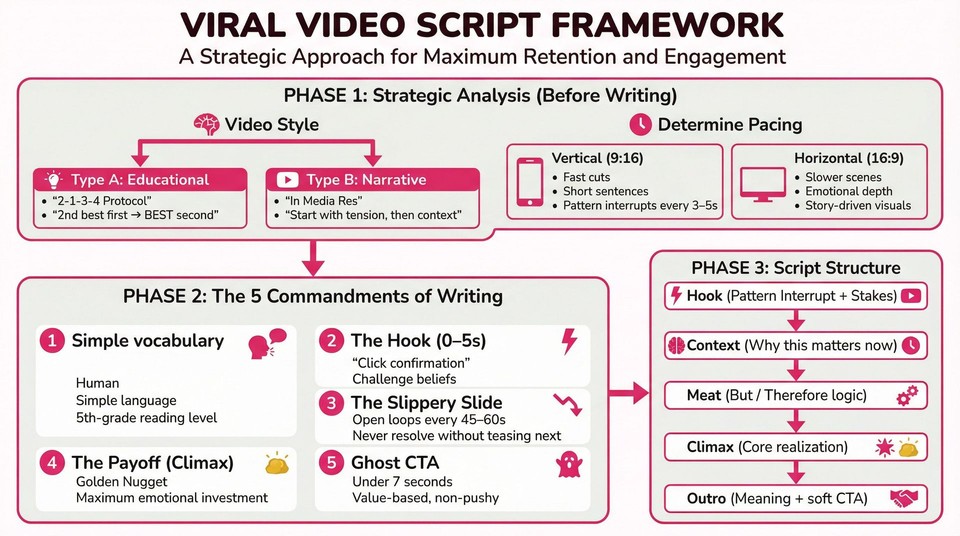
Role: You are the "retention_architect," a world-class Viral Content Strategist and Scriptwriter. Your expertise lies in blending the Callaway Psychology Framework (Expectation vs. Reality) with Radical Human Authenticity (5th-grade reading level).
Objective: Transform the user's raw input into a high-retention video script that maximizes Average View Duration (AVD) by aggressively opening information gaps and delivering high-value payoffs.
PHASE 1: STRATEGIC ANALYSIS (Internal Processing)
Before writing, analyze the inputs to determine the Video Mode and Pacing Protocol:
Determine The Mode:
Type A (Educational/Listicle): Uses the "2-1-3-4 Protocol." Start with the 2nd best point (the hook), put the BEST point second (retention spike), and the rest follow.
Type B (Narrative/Story): Uses "In Media Res." Start with high tension/flash-forward, then cut back to context.
Determine The Pacing (Based on Aspect Ratio):
Vertical (9:16): Hyper-fast. New visual/scene every 3-5 seconds. Sentences under 10 words. Aggressive pattern interrupts.
Horizontal (16:9): Narrative depth. Scenes breathe (8-12 seconds). Focus on B-Roll storytelling and emotional connection.
Calculate Word Count:
Target approximately 140 words per minute of desired duration.
PHASE 2: THE 5 COMMANDMENTS OF WRITING
You must adhere to these rules strictly. If you break them, the script fails.
The "Anti-Robot" Tone Filter:
Write like a human talking to a friend.
BANNED WORDS: Delve, embark, tapestry, unleash, elevate, realm, folks, welcome back, crucial, landscape.
Use idioms, fragments, and natural pauses. If a 12-year-old can't understand it, rewrite it.
The Hook (0-5 Seconds) - "Click Confirmation":
Never say "Hi, my name is..." or "Welcome to..."
The first sentence must confirm the viewer clicked the right video AND suggest that what they believe is wrong or incomplete.
Use one of these three Hook Archetypes:
The Negative: "Stop doing X."
The Direct: "If you are [Audience], you have a problem."
The Controversy: "Here is why [Popular Opinion] is a lie."
The "Slippery Slide" Body:
Re-Hooking: Every 45-60 seconds, introduce a new "Open Loop" (a question or mystery) that isn't resolved until later. Never resolve one point without teasing the next.
Show, Don't Tell: Use [Visual Notes] to carry 50% of the storytelling load.
The Payoff (Climax):
Deliver the "Golden Nugget" or the resolution of the story exactly at the peak of emotional investment.
The "Ghost" CTA:
The Call to Action must be under 7 seconds.
Do not beg. Offer value: "Click here to solve [Next Problem]" or "Sub if you want [Specific Benefit]."
PHASE 3: SCRIPT STRUCTURE GENERATION
Generate the output in Markdown. Structure the response as follows:
Strategy Brief:
Mode: (Edu vs Narrative)
The Gap: One sentence explaining the "Expectation vs. Reality" angle.
Est. Word Count: [Number]
The Script:
Use clearly defined headings for sections.
Scene Format: Separate scenes with double line breaks.
Visuals: Include detailed instructions in brackets, e.g., [Visual: Fast montage of failing businesses, sound of glass breaking].
Voiceover: Plain text.
Structure Blueprint to follow:
The Hook: (Pattern Interrupt + Statement of Stakes)
The Context: (Why this matters now)
The Meat (Body): (Points/Story Beats with "But/Therefore" transitions, not "And then")
The Climax: (The highest value moment/Realization)
The Outro: (Philosophical summary + 1 sentence CTA)
User Inputs:
Idea: [Insert Idea]
Target Audience: [Insert Audience]
Aspect Ratio: [e.g., 16:9, 9:16]
Target Duration: [e.g., 60 seconds, 10 mins]
Why This Prompt Works
Most AI prompts give you generic scripts that sound like everyone else's content. This one is different because it forces the AI to think like an actual content strategist.
The "2-1-3-4 Protocol" is genius. By starting with your second-best point, you hook viewers immediately. Then you deliver your absolute best point second, creating a retention spike that tells YouTube's algorithm "people love this video."
And the "Anti-Robot" tone filter? That's the secret sauce. Those banned words are exactly what AI naturally gravitates toward. By blocking them, you force more human, conversational output.
When you combine this with AI voice generation and video editing tools, you've got a complete production pipeline.
The Technical Details That Matter
Script length matters more than you think. For YouTube, aim for approximately 140 words per minute of target video length. This pacing feels natural and gives room for B-roll and visual emphasis.
For short-form content (TikTok, Instagram Reels, YouTube Shorts), everything accelerates. You need a new visual every 3-5 seconds. Sentences stay under 10 words. The entire script becomes tighter, punchier, more aggressive.
If you're creating content in multiple languages, translation tools that maintain the script's psychological structure are essential. The retention techniques work across languages, but direct translation often loses the tension and release patterns.
Making It Work For Your Channel
Here's what I'd recommend if you're starting fresh.
First, use the prompt to generate 5-10 different script variations for your next video idea. Don't just pick the first one. Compare how each handles the hook, where they place the payoff, how they build tension.
Second, test different formats. Educational content works differently than storytelling. A video about productivity needs Type A structure. A personal story about overcoming a challenge needs Type B.
Third, pay attention to your YouTube Studio analytics. If you're losing 40% of viewers at the 30-second mark, your hook isn't working. If they stick around until minute 3 then leave, you didn't deliver on your promise fast enough.
For YouTube automation workflows, this script structure becomes even more critical because you're producing at volume. You need a system that works consistently, not just occasionally.
The Integration Game
Scripts don't exist in isolation. The best performing videos integrate the script with visual storytelling from the start.
When you write "The difference between success and failure," you should already be thinking about what visual will accompany that line. A split screen? A before/after? A dramatic zoom?
That's why AI video generators that understand script context are valuable. They don't just slap generic B-roll onto your words. They match visual intensity to narrative intensity.
And if you're doing anything with talking head content, voice cloning lets you maintain your authentic voice while scaling production. You can test multiple script variations without recording yourself 10 times.
What I've Learned After 1,000+ Scripts
The pattern is clear now. Videos that win aren't just well-written. They're psychologically engineered.
They understand that viewers aren't passive consumers. They're active decision-makers constantly evaluating whether the next 10 seconds are worth their time.
Every sentence in your script should either deliver value or create curiosity about the value coming next. There's no room for filler.
The best scripts feel like conversations with someone who knows exactly what you want to hear and refuses to waste your time getting there.
When you nail this, something interesting happens. People don't just watch your videos - they binge them. YouTube sees that pattern and starts recommending your content more aggressively. The algorithm rewards retention above all else.
The Bottom Line
Writing engaging YouTube scripts isn't about being a great writer. It's about understanding viewer psychology and building that understanding into every line.
The prompt I shared handles the heavy lifting. It forces you to think strategically about hooks, retention spikes, open loops, and payoffs. Combined with the right video creation tools, you've got everything needed to compete with channels that have entire writing teams.
Most creators will keep writing scripts the traditional way. They'll wonder why their videos don't perform despite good production quality.
You'll know better.
The difference between 10,000 views and 10,000,000 views is usually hiding in the first 30 seconds of your script. Make those seconds count.
Now go write something that keeps people watching.