
First, do not panic: the scary number is for new applicants only
If you have seen headlines screaming that YouTube is "doubling" its monetization requirements for 2027, take a breath. The change is real, YouTube announced it on its official blog in August 2026 and it takes effect on February 1, 2027, but almost every viral summary is getting the most important detail wrong.
Here is the accurate version, and it changes everything: the higher bar applies only to brand-new creators applying for ad revenue for the first time. If you are already in the YouTube Partner Program, your status does not change. And the lower 500-subscriber tier that unlocks fan funding is not changing at all. So before we get into the numbers, hold onto this: for most people reading this, the sky is not falling.
This guide breaks down exactly what YouTube requires to monetize right now in 2026, precisely what changes on February 1, 2027 and who it affects, and what all of it means if you are creating with AI, since that is where a lot of the confusion (and a lot of Fliki's audience) lives. Every requirement here is drawn from YouTube's own Help pages and announcement.
The current YouTube monetization requirements (2026)
YouTube monetization runs through the YouTube Partner Program (YPP), and it has two tiers. Let us start with the full one, the one that turns on ads.
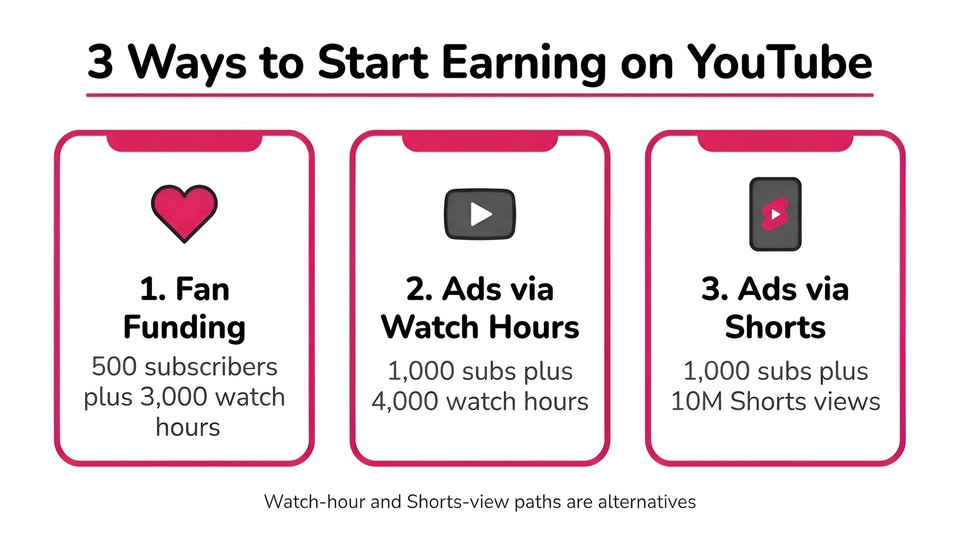
To earn ad revenue and a share of YouTube Premium revenue, your channel must meet the baseline requirements below plus one of these thresholds (YouTube Help):
1,000 subscribers and 4,000 valid public watch hours in the past 12 months, or
1,000 subscribers and 10 million valid public Shorts views in the past 90 days
One detail people constantly get wrong: those 4,000 watch hours must come from your public long-form videos. Views on Shorts in the Shorts feed do not count toward the watch-hour threshold (they have their own 10-million-views path). Private, unlisted, and deleted videos do not count either.
Alongside a threshold, every channel must meet these baseline requirements:
Live in a country or region where the YouTube Partner Program is available
Have no active Community Guidelines strikes
Follow YouTube's channel monetization policies
Turn on 2-Step Verification for your YouTube (Google) Account
Link an active AdSense for YouTube account (you set this up inside YouTube Studio)
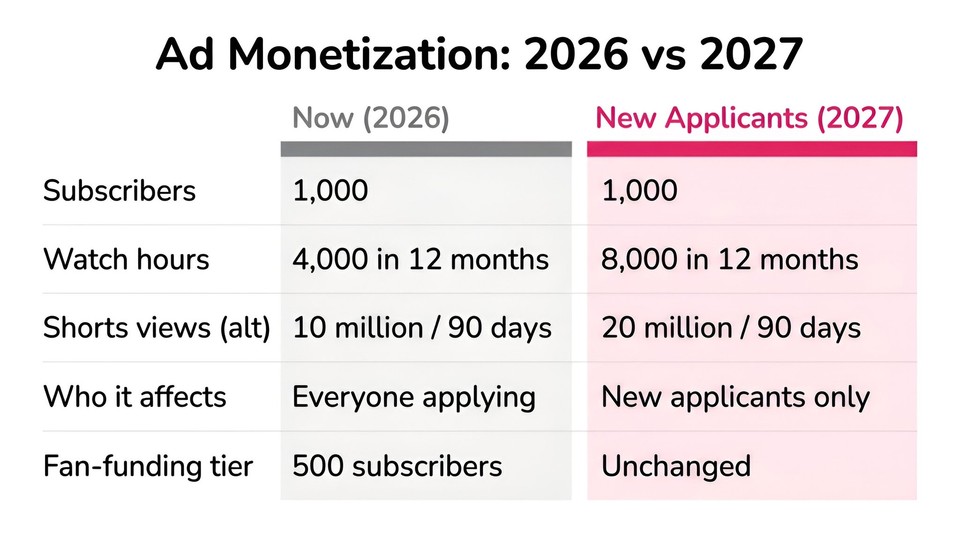
The full ads tier (2026) | Requirement |
|---|---|
Subscribers | 1,000 |
Watch hours (or) | 4,000 valid public watch hours in 12 months |
Shorts views (alternative) | 10 million valid public Shorts views in 90 days |
Also required | YPP country, no active strikes, follow policies, 2-Step Verification, AdSense for YouTube |
The 500-subscriber tier (fan funding), and it is not changing
Before you hit the ads thresholds, YouTube lets smaller channels in supported countries start earning through fan funding. This "expanded" tier requires (YouTube Help):
500 subscribers, and
3 public uploads in the last 90 days, and
3 million public Shorts views in the past 90 days or 3,000 public watch hours in the last 12 months.
At this tier you can turn on channel memberships, Super Thanks, Super Chat and Super Stickers, and Shopping. What you do not get yet is ad revenue or Premium revenue share, those still require crossing the 1,000-subscriber thresholds above. This tier is available in a specific list of roughly 90-plus countries, not everywhere, so check whether yours is included. And importantly for this article: YouTube has confirmed the 500-subscriber fan-funding thresholds are staying exactly the same in 2027.
What actually changes on February 1, 2027
Now the headline. In August 2026, YouTube announced a set of Partner Program updates that take effect on February 1, 2027 (YouTube Blog, YouTube Help). Here is each one, in plain terms.
1. Higher entry thresholds, for new applicants only. New creators applying for ad and Premium revenue sharing will need 8,000 valid public watch hours in the last 365 days, or 20 million public Shorts views in the last 90 days, still on top of 1,000 subscribers. That doubles the current 4,000-hour and 10-million-view bars. The critical caveats, straight from YouTube: if you are already in YPP, this does not affect you, and the 500-subscriber fan-funding tier does not change. This is a higher front door for new applicants to the ads tier, not a purge of existing creators.
2. A Shorts earning floor. From February 1, 2027, to earn from the Shorts Creator Pool in a given month, you will need to maintain 10 million valid public Shorts views over the trailing 90 days. Miss it and you are not removed from YPP and your long-form earnings are untouched, Shorts revenue simply pauses and resumes automatically once you cross 10 million again. YouTube is also adding new Shorts incentive programs and a targeted Shorts ads option that pays a larger direct revenue share.
3. Premium Lite expansion. YouTube is expanding Premium Lite to more countries, with its own revenue pool that creators share from.
4. Updated activity rules. The old "inactive for six months" rule is being modernized. A channel counts as active if it hits any one of: 1,000 watch hours in the last 365 days, 1 million Shorts views in the last 90 days, or 2 long-form videos or 5 Shorts uploaded every 90 days, with a 90-day window to restore status if you fall below.
The one deadline to remember: to keep monetizing without interruption, accept the updated Partner Program terms in YouTube Studio by January 31, 2027.
What this means for you
The honest answer depends on where you are, so find yourself below.
You are already monetized. Nothing about your eligibility changes. Your only action item is to accept the updated terms in YouTube Studio before January 31, 2027. Keep an eye on the new activity rules if you post infrequently, and note the Shorts earning floor if a big share of your income is Shorts.
You are close to the current 4,000-hour bar. This is the group with a real, time-sensitive decision. Based on YouTube's announcement, the higher 8,000-hour threshold applies to new applicants from February 1, 2027, so if you can reach the current 1,000 subscribers and 4,000 watch hours and get accepted into YPP before that date, you come in under today's threshold. If you are within striking distance, it is worth a focused push over the coming months rather than coasting into the higher bar.
You are starting from scratch. Do not let the 8,000-hour number discourage you, because you have a gentler on-ramp. Aim first for the 500-subscriber fan-funding tier (unchanged), start earning from your community, and build toward the ads tier from there. The requirements were never really the hard part anyway. Getting consistent views is, which is a separate problem we break down in why your YouTube video is not getting views.
You are Shorts-focused. Note both the 20-million-view entry path for new applicants and the ongoing 10-million-views-per-90-days floor to keep earning from the Shorts pool. Consistency of output matters more than ever.
The AI question every creator is asking
Because a growing number of creators, and most Fliki users, make videos with AI, the natural worry is whether any of this puts AI content at risk. The short answer is no, as long as you are adding real value, and YouTube has been unusually clear about it.
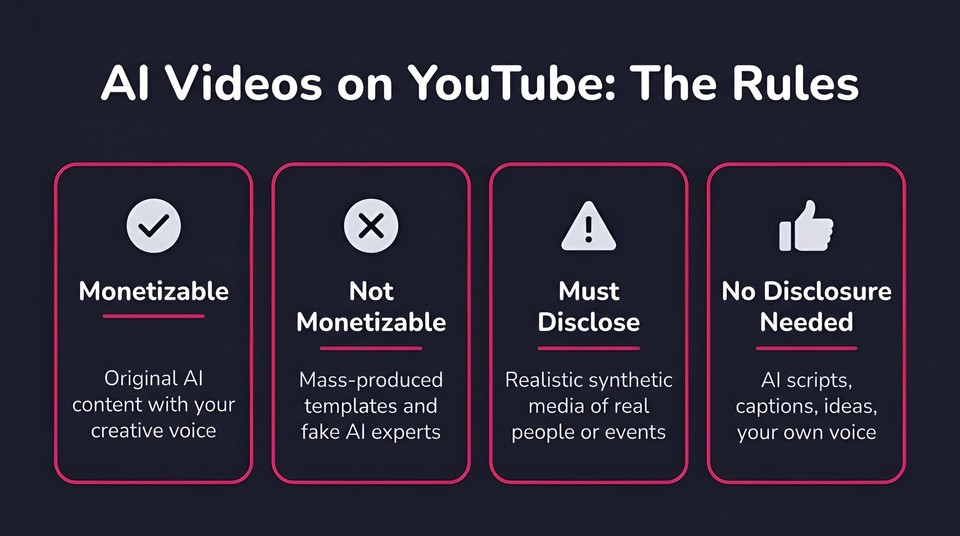
AI-assisted and AI-generated content is fully allowed and fully monetizable. YouTube's monetization policy explicitly permits things like "using AI to visualize a unique character and narrative you invented" and "using AI to edit your video scripts or generate a unique background visual" (YouTube Help). What is not eligible is mass-produced, templated content, in YouTube's words, "AI-generated content made with generic or unoriginal templates giving the impression of mass production without adding the creator's original, authentic insights or perspective." This is the same "inauthentic content" rule YouTube clarified back in July 2025 (a relabel of an existing policy, not a new ban). There is also one AI-specific line worth flagging: AI "personas" posing as human experts giving health, financial, legal, or political advice are not monetizable, so steer clear of the fake-AI-doctor genre.
On disclosure, there is a lot of needless anxiety. You only need to disclose AI when you create realistic synthetic media, for example making a real person appear to say something they did not, or generating a realistic scene of an event that never happened. You do not need to disclose using AI for your script, outline, thumbnail, title, captions, idea generation, or cloning your own voice for a voiceover (YouTube Help). And YouTube states plainly that disclosing AI content "won't limit a video's audience or impact its eligibility to earn money." We go deeper on this in our guide to whether AI-generated videos get monetized in 2026.
The practical takeaway for anyone building with a tool like Fliki: keep a human in the driver's seat. Bring your own idea, angle, and voice, use AI to produce it faster and at a consistent cadence, and avoid churning out interchangeable, templated videos. Do that and you are firmly on the right side of every rule above.
Common myths, corrected
"AI content is banned from monetization." False. Original, human-directed AI-assisted content is monetizable; only mass-produced templated content and fake-expert AI personas are excluded.
"You need a million views to get monetized." False. The thresholds are subscribers plus watch hours (or Shorts views), not a raw total-view count.
"Shorts cannot be monetized." False. Shorts count toward eligibility and earn through the Shorts Creator Pool, with new incentives arriving in 2027.
"You have to disclose every use of AI." False. Disclosure applies only to realistic synthetic media, not to scripts, ideas, captions, or your own cloned voice.
"The 2027 changes will kick current creators out or raise everyone's bar." False. The higher thresholds are for new applicants only; existing members and the 500-subscriber tier are unaffected.
Getting monetized faster (the legitimate way)
The requirements are rarely the real obstacle. Views are. The fastest honest path to any of these thresholds is the same as the path to growth: pick one clear niche so YouTube can find your audience, package each video with a title and thumbnail that earns the click, hook viewers in the first thirty seconds, and publish consistently so the algorithm and your audience both learn what your channel is. Shorts are worth leaning into as a discovery engine and as a route to the views-based thresholds.
This is also exactly where AI earns its keep, not as a shortcut around the rules, but as a way to keep the consistent cadence that new channels almost always fail at. You can turn ideas into finished videos with an AI video generator, spin up Shorts to feed discovery, add captions for sound-off viewers, and reach new audiences with translation and dubbing, all while keeping your own creative direction front and center.
The bottom line
The "new YouTube monetization requirements for 2027" are real, but they are far less dramatic than the headlines suggest. If you are already monetized, accept the new terms by January 31, 2027 and carry on. If you are close to the current bar, qualify before February 1, 2027 to come in under today's threshold. If you are starting out, aim for the 500-subscriber fan-funding tier first and build from there. And if you create with AI, you are welcome in the program as long as your work carries your own original value.
The requirements were never the hard part. Consistent, genuinely watchable videos are. If keeping that cadence is your bottleneck, you can start creating with Fliki for free and give YouTube the steady stream of quality videos that every one of these thresholds ultimately rewards.
FAQs
For new applicants from February 1, 2027, the ads tier requires 1,000 subscribers plus 8,000 valid public watch hours in the last 365 days, or 1,000 subscribers plus 20 million valid public Shorts views in the last 90 days. Creators already in the Partner Program are not affected by the higher thresholds, and the 500-subscriber fan-funding tier is unchanged.
No. YouTube has confirmed that if you are already in the YouTube Partner Program, the new entry thresholds do not change your status. You only need to accept the updated terms in YouTube Studio by January 31, 2027.
In 2026, the ads tier requires 1,000 subscribers plus 4,000 watch hours in 12 months, or 1,000 subscribers plus 10 million Shorts views in 90 days. You can start earning through fan funding earlier, at 500 subscribers with 3,000 watch hours or 3 million Shorts views (in supported countries).
Yes. AI-assisted content that adds your original creative value is fully monetizable. Only mass-produced, templated content and AI "personas" giving expert advice on sensitive topics are excluded, and you only need to disclose AI when the content is realistic synthetic media.
If you are close to the current 4,000-hour bar, it is worth pushing to qualify and get accepted before then, since new applicants after that date face the higher 8,000-hour threshold. If you are just starting, focus on the 500-subscriber fan-funding tier first.
YouTube does not publish a universal per-view rate, and earnings vary widely by niche, country, and format. What is fixed is the revenue share: creators keep 55 percent of long-form watch-page ad revenue and 45 percent of Shorts ad revenue via the Creator Pool. Treat any specific per-view dollar figure you see online as a rough third-party estimate, not an official number.