Introduction
If your Reels reach jumps from 40,000 views one week to 800 the next, it is tempting to blame the Instagram Reels algorithm and assume everything changed overnight. In most cases it did not. Instagram's head Adam Mosseri has said small ranking changes ship every day, that big swings are more often the world changing (a holiday, school break or news event) than the ranking system, and that you should judge patterns across posts rather than one bad Reel.
The harder problem is that almost everything written about this topic mixes three very different kinds of claims: things Instagram or Meta has confirmed, things credible press has reported, and things creators believe because a video went viral. This guide separates them. I read the sources Instagram has published, checked Meta's October 2026 earnings call, and watched videos of four top creators on the algorithm, including Mosseri's own long interview, so you can see where the advice holds up and where it does not.
By the end you will know how Reels ranking works, which signals Instagram has actually named, what keeps a Reel out of recommendations, how Trial Reels and the Your Algorithm control fit in, which popular numbers are unverified, and what is likely to matter most as we head into 2027.
How does the Instagram Reels algorithm work?
The short answer: there is no single Reels algorithm. Instagram runs several ranking systems that pull candidate Reels, predict how each viewer will react (watching, liking, sending, visiting the audio page), and order the results, with originality and eligibility rules applied on top. Mosseri has named watch time, likes and sends as the three signals that matter most.
That matters because Reels is now the center of the app. Instagram's own creator page says Reels makes up over 50% of all time spent on Instagram, and its ranking post says most Reels a person sees come from accounts they do not follow. In other words, your Reel is competing in a recommendation engine, not just showing up for your followers.
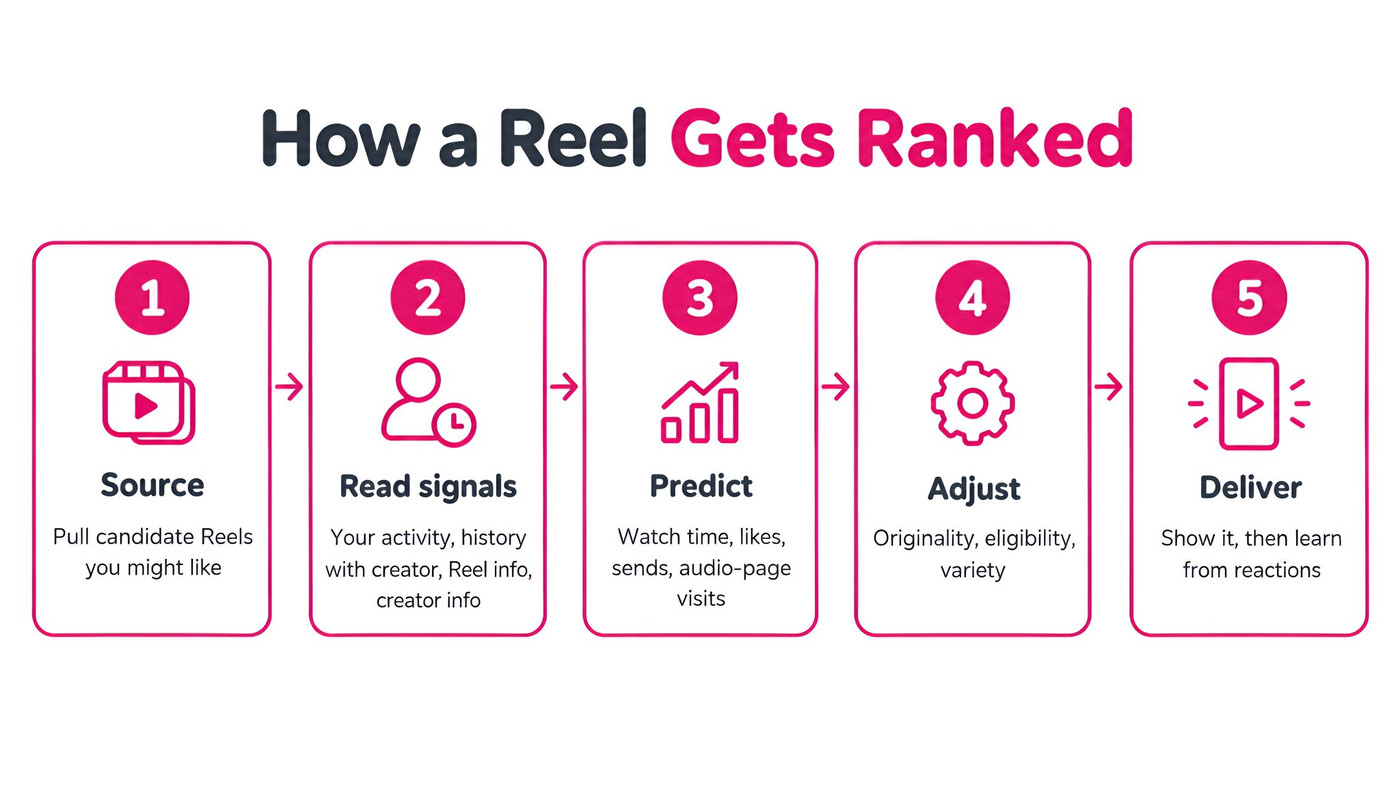
Instagram's ranking explainer describes the generic pipeline in four moves: find candidates, read signals, predict reactions, then order and adjust. Reels follows that structure, which is why the same Reel can do very differently for two viewers who have different histories on the app.
What Instagram has actually confirmed about Reels ranking
The four kinds of signals
In its May 2023 post "Instagram Ranking Explained", Instagram lists the Reels signals roughly in order of importance. First is your activity, meaning what you like, save, reshare, comment on and engage with. Second is your history with the poster, third is information about the Reel itself (audio, visuals, popularity), and fourth is information about the poster, such as how people engage with their content.
Instagram says there are thousands of signals in total and that each part of the app has its own ranking. The practical takeaway is that the most important input is the viewer, not you. You cannot control a viewer's history, but you can make a Reel that a lot of different viewers react to.
What the system predicts
For Reels, Instagram says it estimates how likely a person is to reshare the Reel, watch it all the way through, like it, and visit the audio page (a sign they might want to make their own Reel). It also surveys viewers on whether a Reel was worth their time or entertaining and feeds that back into ranking. Those are predictions about behavior, which is why hooks, pacing and a reason to send the Reel to a friend matter more than any hidden trick.
Watch time, likes and sends
In January 2025 Mosseri named the top three signals as watch time, likes and sends, and advised creators to track average watch time, likes per reach and sends per reach, as reported by Social Media Today. He added that likes matter slightly more for connected content (your followers) and sends matter slightly more for unconnected content (people who do not follow you). Notice the wording: slightly. Instagram has never published weights, so any claim that a send is worth a precise multiple of a like is invented.
In his long interview with the Build Your Tribe channel, Mosseri explained why sends get attention. A send puts a post in front of another human being, and he said a message to one friend and a share to a Story are valued about equally, because a personal recommendation is a stronger signal than a broadcast.
Watch time versus watch rate
In the same interview he clarified that the signal is watch time (the seconds people spend), not only the percentage watched, and that Instagram looks at both. Twenty seconds of a 21-second video and twenty seconds of a ten-minute video are not treated as equal. He also pushed back on the idea that Instagram simply optimizes for time spent, saying it is also a place to connect with friends, which is part of why short video is the focus.
Followers versus non-followers
Instagram's Insights split reach into connected (followers) and unconnected (everyone else). They behave differently, so it is worth checking both before you decide a Reel flopped.
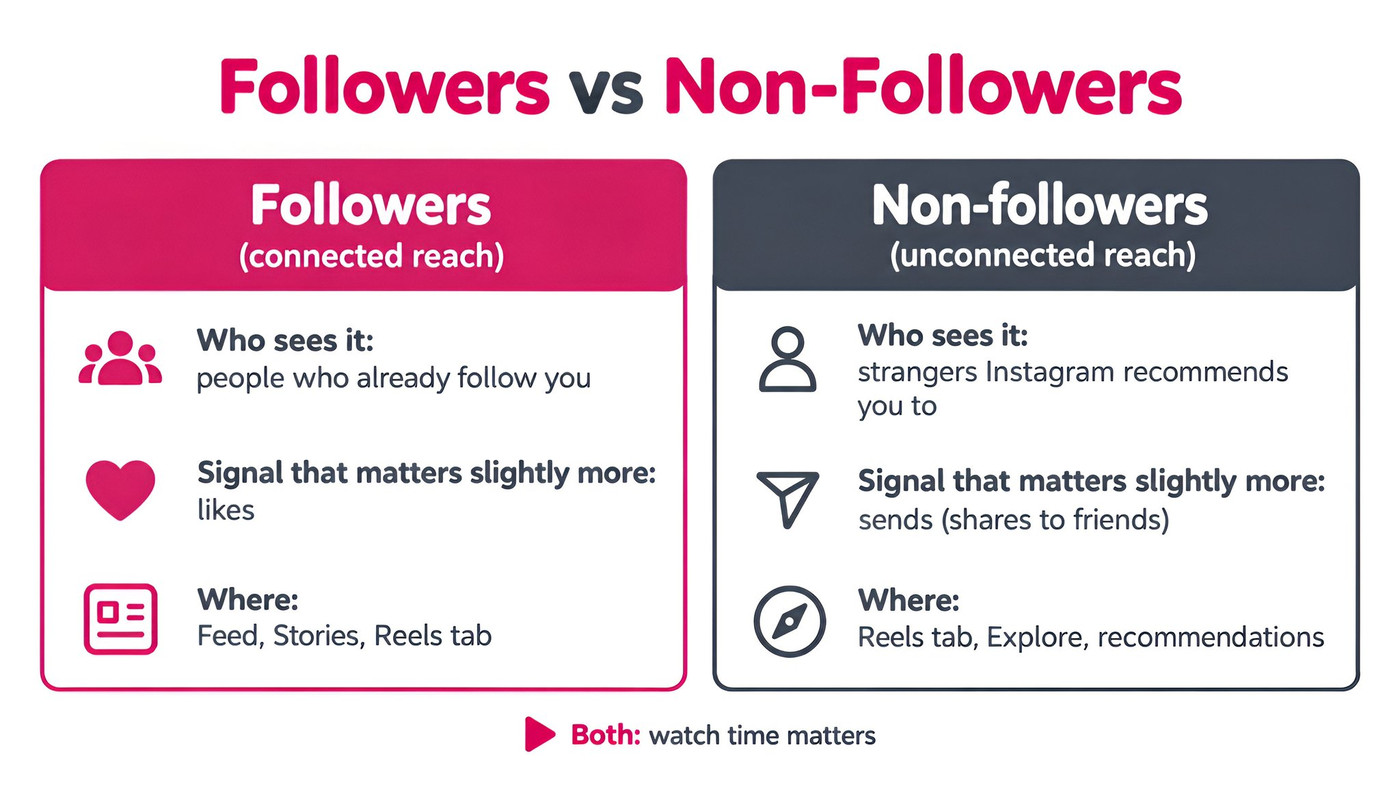
A useful pattern from one of the creator videos I read: a team saw posts first go only to followers, and when followers reacted strongly, unconnected reach started to climb. That matches Mosseri's explanation that engagement rate (the share of people who saw it and then did something) explains reach better than reach itself does.
Freshness and sequences: what Meta said in October 2026
The most recent hard evidence comes from Meta's Q3 2026 earnings call, where the CFO said relevance launches raised Reels time spent by over 4%. Part of the gain came from a model that ranks sequences of Reels together instead of scoring each one on its own, plus richer watch-time signals. She also said nearly 45% of recommended Instagram Reels are now less than one day old, up more than 11 points from the previous quarter.
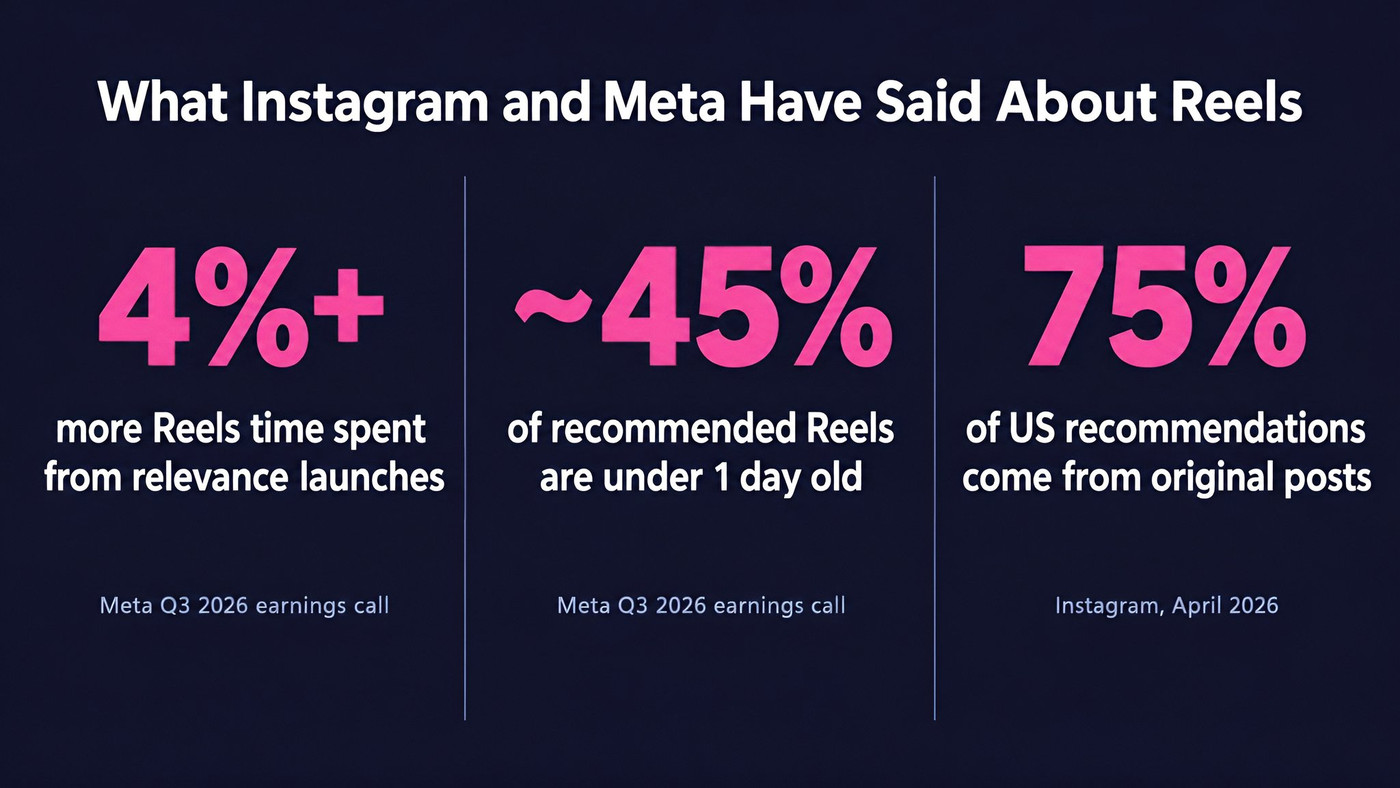
Two cautions. These are company-wide figures, not a guarantee for any one account, and Meta did not give launch dates. Still, they point in a consistent direction: newer Reels get more of the recommendation pool, and ranking is moving from judging each Reel alone to judging how a run of Reels feels to a viewer. You can read the call yourself in Meta's published transcript.
Captions, audio and what Instagram "reads"
Mosseri said in the interview that, when Instagram works out what a piece of content is about (he was discussing search), it currently leans on the caption most, then the video, the audio and the comments, in that order, and that this balance will shift as the models improve. For you, that means a descriptive caption is not filler. It is one of the clearest ways to tell Instagram what your Reel is about, alongside on-screen text and spoken words.
What the top creators say, and how it compares
I watched four videos: Mosseri's interview on Build Your Tribe (recorded in early 2025), a marketing agency's 2026 breakdown of a reach drop, a creator's six-tip "viral" guide, and a popular October 2026 algorithm update video. The first is a primary source. The rest are interpretation, and some of it is useful and some of it goes further than Instagram has.
Where creators and Instagram agree
Everyone converges on the same core: the first few seconds decide whether people stay, retention and shares drive distribution, and you should check engagement rate and connected versus unconnected reach before panicking about raw views. All four also lean on the same practical point, which is to give people a reason to send the Reel to someone. That lines up with what Instagram has said about sends.
The agency, BAD Marketing, added a data point worth testing in your own account. After its reach dropped in early 2026, it compared formats and found carousels reaching several times more people per post than its Reels, and then tried a hybrid: a hook slide, then the Reel, then a call-to-action slide. Their experience is one account's, and Buffer's analysis of over four million posts reports the opposite average (Reels reaching more than carousels), so treat it as a test to run, not a rule.
Where creators go beyond what Instagram has said
Claim in the videos | What Instagram has said | My read |
|---|---|---|
A shadowban is why your Reels are stuck, and a help-center request fixes it | Mosseri says the real mechanism is eligibility shown in Account Status, with only rare edge cases hidden | Check Account Status first. Be wary of anyone selling a secret prompt in DMs |
Comments are the most powerful signal | The top three named signals are watch time, likes and sends | Comments help indirectly, but are not on the named list |
Aim for a skip rate under 30% and completion above 50% | No such benchmarks published | Useful as personal targets, not as Instagram rules |
Each comment, save, like and share is worth a fixed number of extra views | No weights published | A figure attributed to a third-party study in one video; I could not verify it |
Post a Trial Reel first, then the same video to your main feed | Instagram describes Trial Reels as shown to non-followers first | Reasonable workflow, but the sequencing advice is the creator's own |
Trends only last 24 to 48 hours | Mosseri said he wants Instagram to be faster at trends | Speed matters, but the exact window is an estimate |
One more note on sourcing. The October 2026 update video promotes a paid analytics tool, and the six-tip video funnels viewers into DMs. That does not make their points wrong, but it is a reason to weigh claims that happen to sell something more carefully than claims that cost the creator nothing.
Originality, eligibility and what keeps a Reel out of recommendations
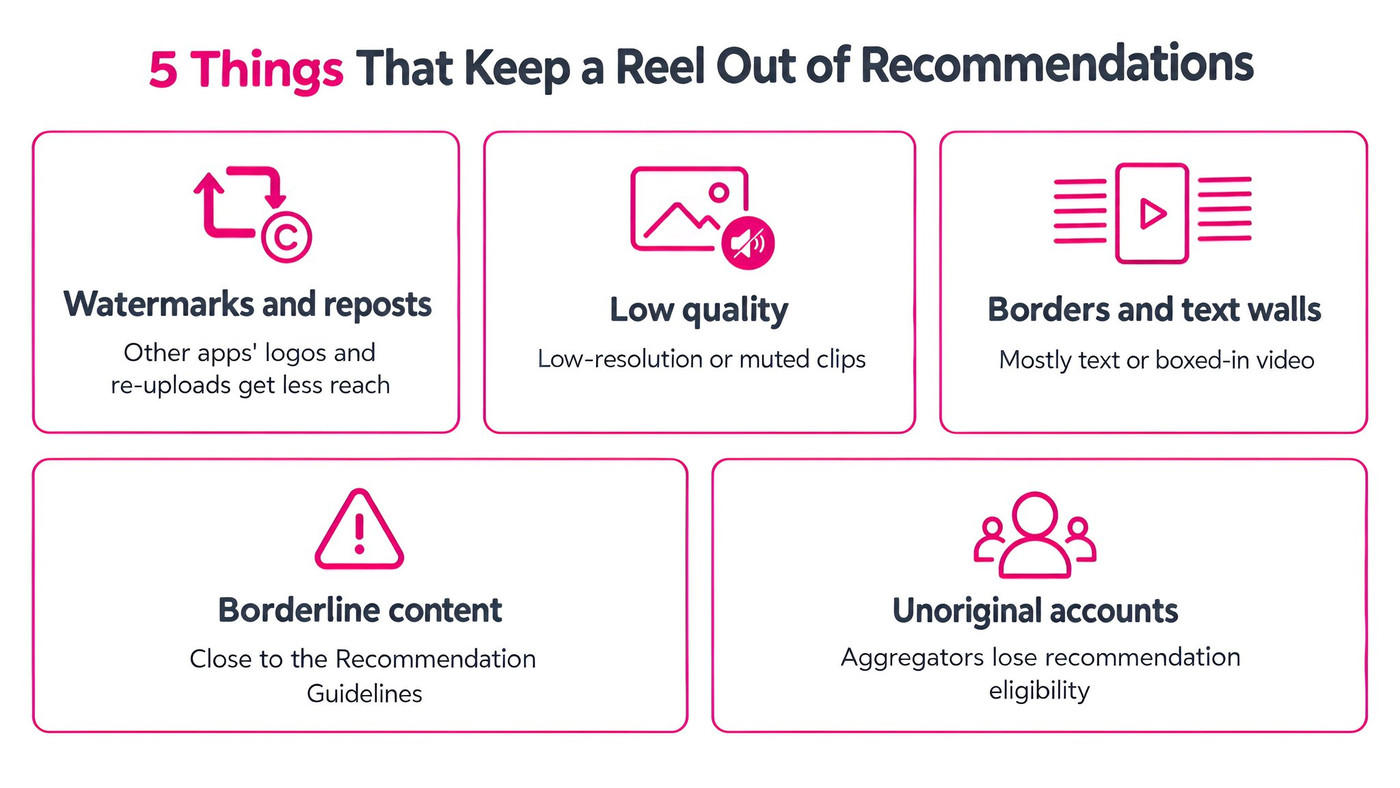
Recommendations are not automatic. Instagram has recommendation guidelines that are stricter than its community rules, and content that breaks them can still reach your followers but will not be recommended to strangers. Mosseri was direct about the logic: Instagram does not downrank content from people you follow because it might be offensive, but it takes more care with what it recommends to people who did not choose to follow you.
The original-content rules
Reels got originality protections in 2024, and on April 30, 2026 Instagram extended them to photos and carousels. Accounts that mainly post unoriginal content are no longer shown in places where Instagram recommends content, though their followers still see the posts. Instagram also said 75% of recommendations in the US now come from original posts.
The details matter if you make Reels from other people's footage. Instagram says adding only a border, watermark, subtitles or a caption credit does not make something original, and TechCrunch reported that changing a clip's speed or screenshotting someone's post also does not count. Material you substantially transform, with real commentary, new voiceover or a remix, can qualify. To regain eligibility, most of your recent posts need to be original over a rolling 30 days, and you can review this in Account Status.
Format basics Instagram has published
Instagram's recommendation tips for creators say a Reel has to be three minutes or less to be recommended, should be vertical 9:16 with no borders, high resolution, free of watermarks, and with text that does not cover most of the screen. They also say to hook viewers in the first three seconds and to put keywords in the caption rather than the comments. These are the closest thing to an official checklist, and they were last updated in 2023, so confirm them on the current page. Buffer reports longer Reels are possible but not recommended to new audiences, though I could not find an Instagram help page stating that.
The AI-generated profile label
On August 31, 2026 Instagram renamed its AI creator label to "AI-generated profile". Profiles that feature an AI-generated person should apply it, and Instagram says unlabeled profiles it detects may see limits to their reach and lose recommendation eligibility. Creators who only use AI tools in their process do not need the label, according to Instagram's announcement. This is a real 2027 consideration for faceless and avatar-led accounts.
Shadowbans and Account Status
Mosseri's answer to the shadowban question was that Instagram wants people to know the rules, so nearly everything at the account level shows up in Account Status, where you can see eligibility and appeal. He also said that a single piece of content can be limited without the account being affected. If your reach collapsed, check Account Status before you assume a hidden penalty.
Trial Reels: how to test before you commit
Trial Reels, announced on December 10, 2024, let you share a Reel to non-followers first. It does not show on your grid or in your followers' Feed or Reels tab, although followers can still find it through shares or pages grouped by audio. About 24 hours after sharing you can see views, likes, comments and shares, plus a comparison with your earlier trials. You can then share it with everyone or let Instagram automatically share it if it does well in the first 72 hours, per Instagram's announcement.
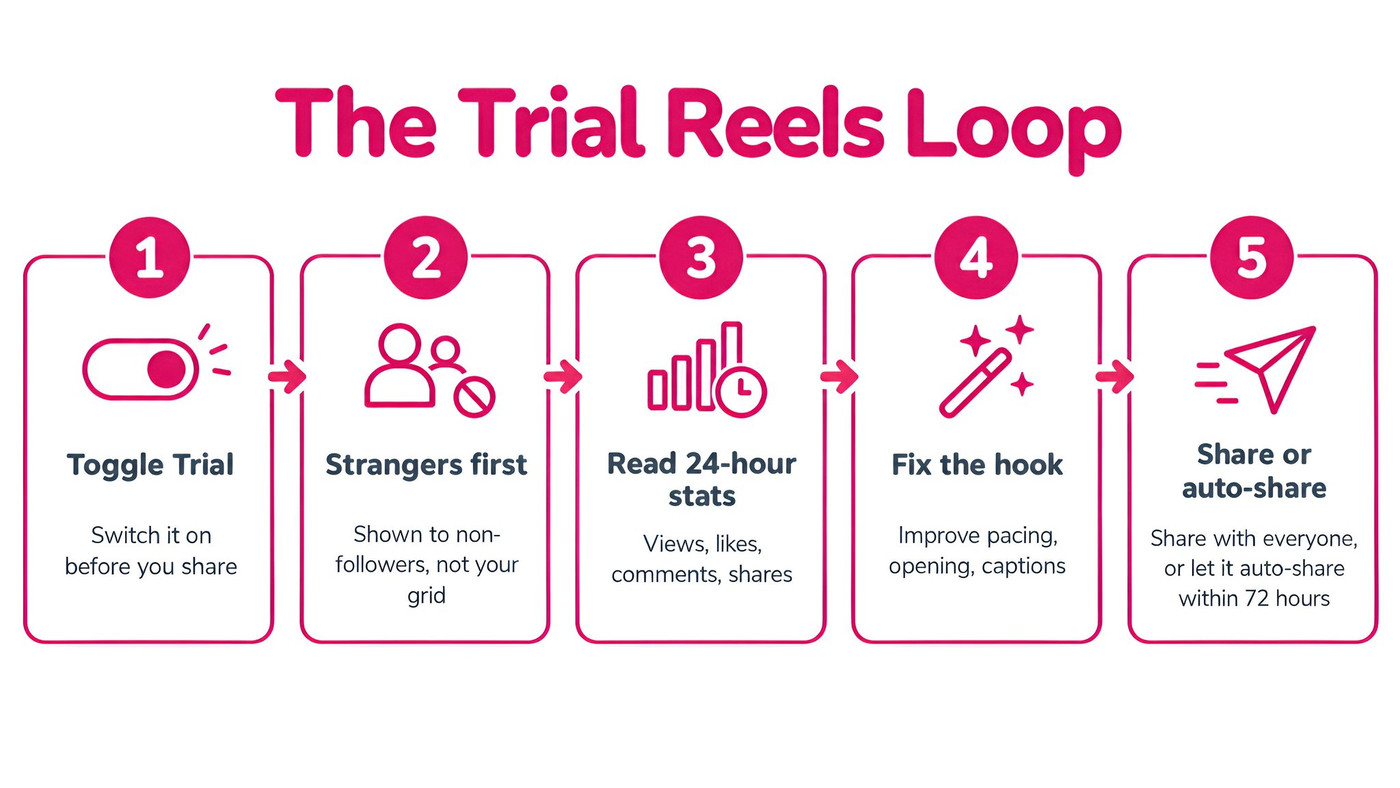
Two of the creator videos used Trial Reels as an A/B test: post a version, read the drop-off, improve the hook or pacing and try again. That is a sensible use because the audience is strangers, which is the audience Instagram's recommendations are trying to reach anyway. I could not confirm Instagram's current eligibility rules for Trial Reels from the primary pages, so check the feature in your own account.
Your Algorithm: the control viewers now have
On December 10, 2025 Instagram launched Your Algorithm in the US. Open Reels, tap the icon at the top right, and you see an AI-written summary of the topics shaping your recommendations, where you can choose topics to see more or less of, add your own, and share the summary to your Story. TechCrunch reported that Instagram planned to extend it to Explore and other surfaces, and Social Media Today later reported a rollout to all English-speaking users in January 2026.
For creators this changes the framing. Viewers can now steer their own interests, so a Reel that is clearly about one topic, with a caption and on-screen text that say so, is easier for the system to match to people who asked for it. Vague, mixed-topic Reels are harder to place.
Hashtags, keywords, length and timing
Hashtags
Instagram capped hashtags at five per post or Reel on December 19, 2025, announced through its Creators account and reported by Business Today. Mosseri has also said hashtags do not significantly increase reach. Use a few relevant ones if you like, and spend your effort on the caption, on-screen text and the first three seconds instead.
Search and keywords
Instagram is investing in content search, and Mosseri said he wants content to resurface instead of getting nearly all its value in the first 24 to 48 hours. Press reports say public professional content became indexable by Google in July 2025. I would treat that as a reason to write natural, keyword-rich captions, but not as a guarantee of placement.
Length, posting time and frequency
Instagram has not published a best time to post or an ideal posting frequency for Reels. Mosseri said that being active around the time you post only helps indirectly, if it leads people to engage with the post. He also said that after a long break (he suggested roughly a month or more) your account has fewer recent signals, so the first posts back may underperform. Any best-time chart you see comes from a third party's data on a specific set of accounts.
Myths and unverified numbers to ignore
Claim | Status |
|---|---|
A send is worth three to five likes | Not published by Instagram. Mosseri only said sends matter slightly more for non-followers |
Instagram shadowbans accounts in secret | Mosseri says nearly everything shows in Account Status, with rare exceptions |
You need 30 hashtags | Capped at five since December 2025, and Mosseri says they do not drive reach |
Skip rate under 30% is a ranking threshold | Unverified. I found no Instagram statement that confirms it as a signal |
Instagram optimizes only for time spent | Mosseri said it does not, and looks at watch time and watch rate |
What you watch affects how your own Reels perform | Mosseri said consumption patterns are not used as a signal of how interesting your content is |
A fixed best time to post exists | No official guidance; third-party studies only |
What to expect in 2027
Nobody outside Meta can promise how Reels ranking will look next year, so here is a clean split. Confirmed direction: originality enforcement is expanding (Reels in 2024, photos and carousels in April 2026), AI-generated profiles are now labeled and can lose recommendation eligibility, Reels ranking is moving toward sequence-level models, fresher Reels are a growing share of recommendations, and Meta is using language models to understand public posts for search.
Reasonable inference: as AI video becomes easy to produce, originality, a clear point of view and real human context will matter more, which is also the argument in Mosseri's year-end memo as summarized by Om Malik, where he says authenticity is becoming infinitely reproducible. I could not read the memo itself, so treat that summary as secondary.
Speculation: any specific new ranking metric, weighting or threshold you read about for 2027 that no source ties to Instagram. Plan for the confirmed direction, and test the rest on your own account.
A practical 2027 Reels playbook
Start with originality. Make Reels that are yours: your footage, your voiceover, your take. If you remix someone else's clip, add real commentary or transformation, not just a border, subtitles or a credit.
Design the first three seconds. Open on the payoff or the question, put the key idea in on-screen text, and make sure it works with sound off.
Build for sends. Ask yourself who someone would send this to, and make that obvious in the content, not just in a caption.
Write the caption like a search result. One clear sentence about what the Reel is, a few natural keywords, and up to five relevant hashtags at most.
Test with Trial Reels. Try two hooks, read the 24-hour numbers, then share the stronger one with everyone.
Review patterns, not single posts. Compare average watch time, likes per reach and sends per reach across at least ten Reels, and look at connected versus unconnected reach separately.
Check Account Status monthly. It is the official place to see recommendation eligibility and to appeal.
Label AI profiles correctly. If your account features an AI-generated person, apply the label rather than risk limited reach.
Where Fliki fits
No tool changes how Instagram scores a Reel, and I have not tested whether any one editor gets more reach. What a tool can do is cut the production time so you can ship more original tests. With Fliki's AI reel generator you can turn a script or idea into a vertical Reel, generate it with text to video, add auto captions for people watching with the sound off, and add a voiceover as covered in the guide to text to speech for Instagram Reels.
If you want ideas on the production side, the guides on how to make AI Reels, faceless Reels and making a Reel from photos cover the workflow, and the Instagram video maker page shows the formats. Keep the originality rules in mind: your angle, script and examples are what make the Reel yours, and if you use an AI avatar as the presenter of the account, apply Instagram's AI-generated profile label.
Bottom line
The Instagram Reels algorithm rewards what people do with your Reel: how long they watch, whether they like it, and above all whether they send it to someone. Around that sits a set of rules that favor original, high-quality, clearly labeled content, and a growing set of viewer controls such as Your Algorithm. Most of the "hacks" in viral videos are either unverified or sell something, so test them against Account Status and your own insights before you change your whole strategy.
If you want to ship more original Reels without a big production setup, you can try Fliki free and run your own Trial Reels tests.
Written by Shivam Aggarwal, who works on content and marketing at Fliki and watched the creator videos cited above. Statistics and policy dates were current as of November 2026. Instagram changes its rules often, so verify the details on Instagram's own help pages before you rely on them.
FAQs
Instagram uses several ranking systems rather than one formula. It pulls candidate Reels, predicts how you will react (watch, like, send, visit the audio page), and orders them, then applies originality and eligibility rules. Adam Mosseri has named watch time, likes and sends as the top three signals.
Open Reels and tap the Your Algorithm icon at the top right. You can pick topics to see more or less of, add your own topics, and review the AI summary of your interests. You can also tap Not interested on individual Reels. Instagram does not offer one button that wipes your history.
Instagram has not published weights, but Mosseri named watch time, likes and sends as the top three. Likes matter slightly more for followers, and sends matter slightly more for people who do not follow you. Treat claims that a send is worth a fixed multiple of a like as unverified.
Instagram has not published an official best time to post. Mosseri said activity around posting time only helps indirectly if it leads people to engage. Third-party best-time charts come from specific sets of accounts, so test your own audience using Insights instead of trusting a single universal time.
Only a little. Instagram capped hashtags at five per post or Reel in December 2025, and Mosseri has said hashtags do not significantly increase reach. Put your effort into a descriptive caption, on-screen text, and a strong first three seconds, and use a few relevant tags at most.
Mosseri says nearly everything at the account level shows up in Account Status, where you can see recommendation eligibility and appeal. A single post can be limited without the account being affected. If your reach dropped, check Account Status before assuming a hidden penalty or paying for a fix.