Your video is not failing. A signal is.
You spend hours on a video, hit publish, and then watch it crawl to 30 views and stop. It feels personal, like YouTube looked at your channel and decided to bury it. I have felt exactly that, and I have talked to a lot of creators who have too.
Here is the reframe that changes everything: YouTube is not a judge deciding whether you deserve views. It is a matching system trying to connect each video with the viewers most likely to enjoy it. When a video gets few views, it almost never means "the algorithm hates you." It means one specific handoff in the chain broke, and the video never reached, or never satisfied, the right people. The good news is that the chain is short and every link is fixable.
This guide walks through that chain stage by stage, so instead of guessing, you can look at your own analytics, find the exact link that broke, and fix it. It is grounded in how YouTube itself says the system works, plus the hard-won tactics creators use to grow small channels. And because a lot of you are making videos with AI now, there is an honest section on whether that helps or hurts (short answer: it helps, if you do it right).
First, kill the myth: the algorithm is not against small channels
Before the diagnosis, clear out the belief that quietly sabotages most struggling creators, the idea that YouTube is suppressing you for being small. It is not, and believing it keeps you blaming the platform instead of fixing the fixable.
YouTube is unusually direct about this. Its own guidance says the recommendation system's job is to "help each viewer find videos they want to watch" and to "maximize long-term viewer satisfaction," and that creators should stop asking "does the algorithm like my content?" and start asking "does my audience like this?" (YouTube Help). Crucially, the system recommends videos to viewers, not channels to viewers, and it evaluates each video individually. YouTube states plainly that "an individual video's underperformance does not penalize a channel overall" and that it "aims to give as many videos as possible a chance to be discovered" (YouTube Help). There is no size-based shadowban.
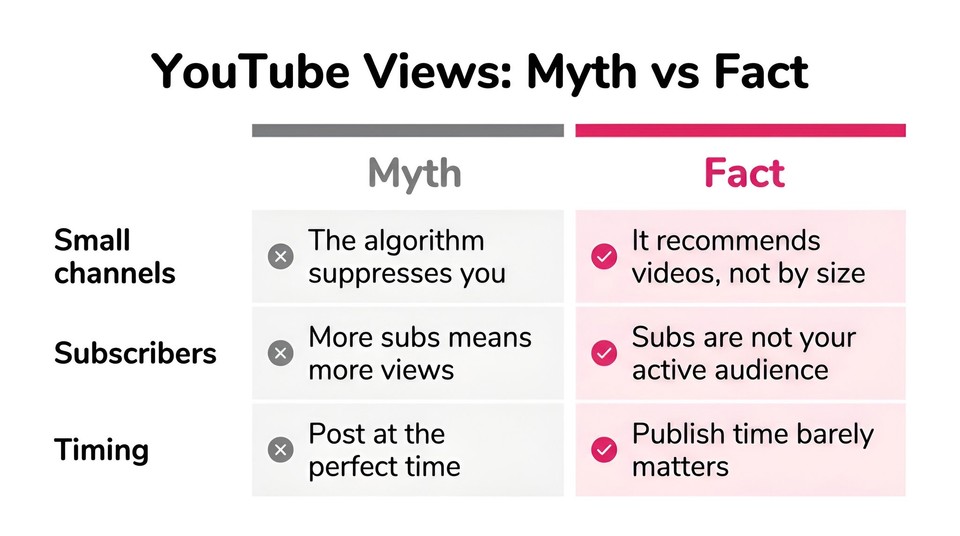
Two related myths worth retiring in the same breath. First, subscribers do not guarantee views: YouTube notes that subscriber count "reflects the number of times people have subscribed, not necessarily the size of its current active audience," and that viewers skip most of what is in their subscription feeds. Second, posting at a magic time will not save a video, since YouTube says publish time "is not known to impact a video's long-term performance." The lever is not timing or luck. It is the funnel.
The views funnel: where views actually come from
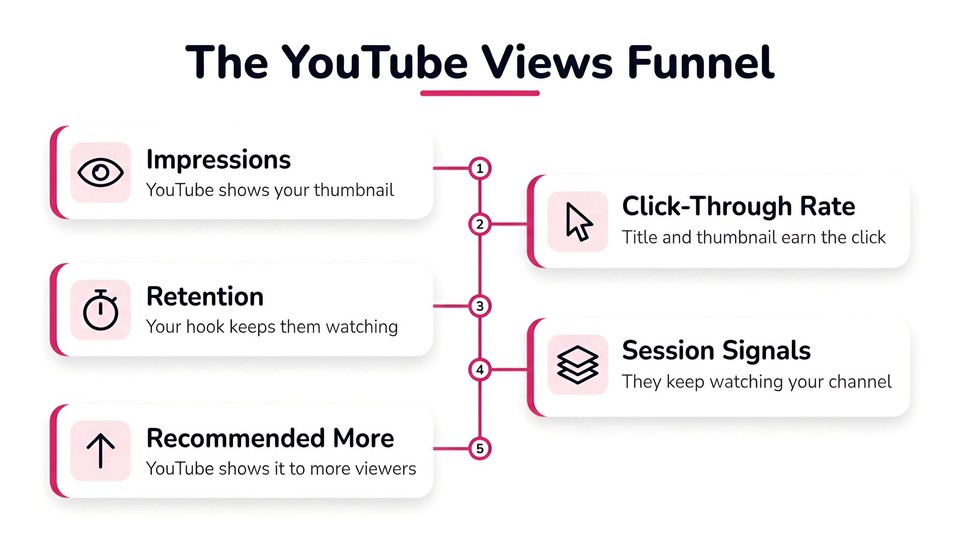
Every view your video earns passes through the same short funnel, and a "no views" problem is really a "which stage is leaking" problem.
-
Impressions. YouTube offers your thumbnail to viewers it thinks might be interested, mostly on the Home feed (driven by their watch history) and in Suggested or Up Next (driven mainly by the video they are watching now). No impressions, no views.
-
Click-through rate (CTR). Of the people who see your thumbnail, some click. Your title and thumbnail decide this.
-
Average view duration (retention). Of the people who click, some stay. Your hook and pacing decide this. This is the make-or-break stage, because YouTube says it "will recommend a video to viewers if the video is relevant to them and if the video's average view duration indicates that viewers find it interesting," and that "clickbait videos tend to have low average view duration and therefore are less likely to get recommended" (YouTube Help).
-
Session and channel signals. After your video, do viewers keep watching (yours or YouTube's), and does your channel read as a clear, consistent thing the system can match to an audience?
-
Search (a separate path). For query-driven views, YouTube ranks on relevance, engagement, and quality (YouTube Help).
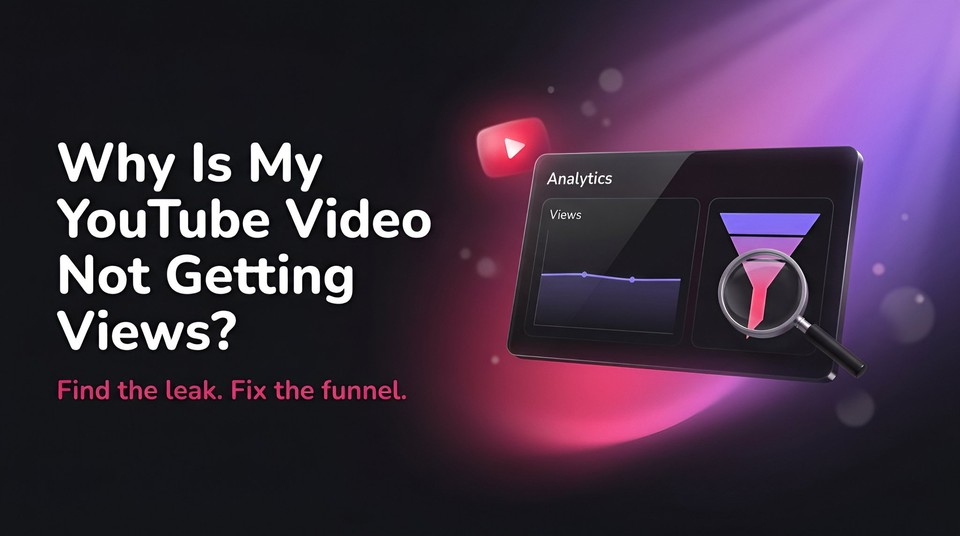
Open YouTube Studio, look at a stalled video, and you can usually tell which stage failed: very few impressions, or lots of impressions but a low CTR, or a decent CTR but a retention curve that falls off a cliff. Let us go stage by stage.
Reason 1: Barely anyone is being shown your video (low impressions)
If your impressions are tiny, the system has not figured out who to show your video to. This is the most common problem for new and stalled channels, and it usually traces to one thing: the algorithm cannot tell what your channel is about or who it is for.
YouTube learns your audience by pattern recognition. When you publish consistently around one topic, it starts to understand "this creator makes this kind of video for these kinds of viewers," and it shows each new upload to the audience that engaged with your last ones. When every video is a different topic, a weight-loss video, then a travel vlog, then a gaming clip, you break that pattern, and the system (and your existing subscribers) get confused about who your channel is for. New channels have it hardest because there is "no significant prior watch history" for the system to match against, and building that track record takes a library of related videos (YouTube Help).
The fix is to define your audience, then stay consistent. A tactic experienced creators swear by is writing a one-paragraph "audience avatar": exactly who this video is for, their age, their situation, the specific struggle they came to YouTube to solve. When you make videos for that specific person instead of "everyone," your titles, thumbnails, and topics get sharper, and the algorithm finally has a clear signal about where to send your video. Pick one niche for your early videos, build a cluster of related content, and give the system the consistency it needs to find your people.
Reason 2: People see it but do not click (low CTR)
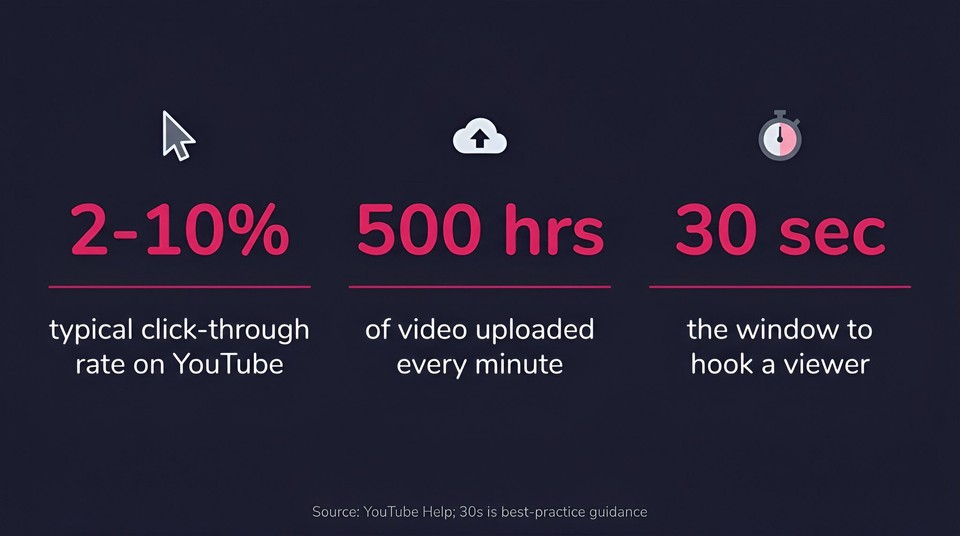
If your impressions are healthy but views are not, the problem is packaging. Your title and thumbnail are competing on a crowded screen against videos that may have hundreds of thousands of views, and viewers make a snap decision. For context, YouTube says "half of all channels and videos on YouTube have an impressions click-through rate that can range between 2 percent and 10 percent" (YouTube Help), and it explicitly advises changing your title and thumbnail when CTR and impressions are low.
Think of the title and thumbnail as one unit that tells a single story, a promise of what the viewer will get. If they contradict each other or feel generic, people scroll past no matter how good the video is. This is also where small channels have a secret weapon. Because some viewers assume high-view videos are automatically better, a brand-new video can lose the click purely on numbers. But a meaningful slice of viewers will happily click a low-view video if the promise is compelling enough, and a proven way to reach them is the personal-story angle. Titles built around a genuine first-person result or transformation, the "how I did X" framing, work unusually well for small creators because they signal a unique, personal story a big faceless channel cannot offer. Instead of competing head-on with the giants, you lean into being the newcomer with something real to share.
Two guardrails. Do not cross into clickbait, because a click your video does not deliver on tanks your retention and, per YouTube's own statement above, makes the video less likely to be recommended. And when you want to compare options, use YouTube's built-in thumbnail test feature rather than swapping images manually, which muddies the data.
Reason 3: They click but leave in seconds (low retention)
A good CTR with a collapsing retention curve is the most fixable problem of all, and the most common. Viewers gave you the click. You lost them in the opening.
YouTube does not publish a magic retention number, and anyone who quotes you a precise "aim for 50 percent" figure is sharing a rule of thumb, not an official stat. What YouTube does say is to watch your audience retention curve in Analytics, find where people drop off, and avoid slow intros and "artificially stretching content." In practice, the first 30 to 60 seconds decide the video. If a large share of viewers leave in the first half minute, fix that before anything else, because everything after it is wasted.
The usual culprit is a weak opening: twenty seconds of "hey guys, welcome back to my channel, don't forget to subscribe" before anything happens. Modern viewers will not wait. Open by immediately restating the promise your title made and giving the viewer a concrete reason to stay. A trick that works well is to pull a genuinely interesting moment from later in the video and tease it in the first few seconds as a mini-highlight. Then, through the body, follow the "every second earns the next" rule: each moment should either teach something or create an emotion. If you catch yourself padding a four-minute idea into ten minutes for watch time, cut it. Real viewers feel their time being wasted and leave, which sends exactly the wrong signal.
Reason 4: Nothing carries viewers deeper (weak session signals)
YouTube rewards videos that keep people watching, on your channel or anywhere on the platform, because its goal is long-term satisfaction. If viewers finish your video and leave, you are missing easy signal.
The fixes are simple and underused. End screens and a clear "if you liked this, watch this next" point viewers to your other videos and extend the session. Playlists and content series make binge-watching natural. And consistency compounds: YouTube says a substantial library of related, quality videos "signals to the algorithm that your content is valuable" and makes your whole channel more likely to be recommended. One more measurement tip from YouTube itself: judge your real reach by the Unique Viewers metric, not raw subscriber count, since subscribers are not the same as your active audience.
Reason 5: You are counting on search, but not matching what people search
If you expected search traffic and it never came, remember that YouTube search is a separate system that ranks on relevance, engagement, and quality. If your title, description, and spoken content do not match the actual phrases people type, and your video does not earn watch time for those queries, it will not surface. Write for real queries, cover the topic thoroughly enough to earn engagement, and demonstrate genuine expertise. And do not bother stuffing tags or hashtags, which does nothing for ranking and, in some contexts, is treated as a low-quality signal.
Separately, do not overlook Shorts as a discovery engine. YouTube notes the Shorts feed tunes toward recent content, which makes it good for getting brand-new videos in front of new viewers. A short can introduce people to your channel who then find your long-form work, even if that cross-over is not automatic.
Reason 6: The unglamorous reasons (niche size, patience, and expectations)
Sometimes the video is fine and the expectation is off. A hyper-saturated topic means you are ranked against stronger videos, so packaging has to be excellent to break through. A tiny niche has a small ceiling by nature. And a new channel simply needs time and a library before the system has enough to work with, YouTube frames building credibility and an audience as something that "takes time." None of this is a reason to quit. It is a reason to define a clear audience, stay consistent, and let the compounding happen. Every video is an asset, and a strong new upload can even revive views on your older, related videos.
"But I make AI videos, does that hurt my views?"
This is the question a lot of creators, and a lot of Fliki users, are quietly worried about, so let me be clear and accurate about it.
Using AI to make your videos does not hurt your reach or your ability to monetize, as long as the video has real human creative input and genuine value. YouTube spelled this out in a monetization policy update on July 15, 2025, when it renamed its "repetitious content" rule to "inauthentic content" to clarify that mass-produced and repetitive videos are what is ineligible for monetization (YouTube Help). Its own policy explicitly says you can monetize "content that expresses your unique creative voice, like using AI to visualize a unique character and narrative you invented" or "using AI to edit your video scripts or generate a unique background visual." What is not allowed is "AI-generated content made with generic or unoriginal templates giving the impression of mass production without adding the creator's original, authentic insights or perspective." In plain terms: original AI-assisted content is fine, interchangeable "AI slop" is not.
There is also a disclosure rule that is separate from monetization. YouTube requires you to flag realistic content made with altered or synthetic media (for example a real person's likeness or voice, or realistic footage of events that did not happen). It does not require disclosure for using AI on the production side, like generating scripts, ideas, or automatic captions. We cover this in more depth in our guide on whether AI-generated videos get monetized in 2026.
Here is the part that matters for your views: AI is genuinely useful for fixing the exact funnel problems above, not for gaming them. It lets you publish consistently around one niche instead of going dark for two weeks, which is the single biggest thing new channels get wrong. A tool like Fliki's AI video generator turns a script or idea into a finished video, its AI thumbnail maker helps you package for CTR, its Shorts generator helps you feed the discovery engine, and its captions and translation and dubbing extend your reach to viewers who watch on mute or in other languages. What AI does not do is remove the need for a defined audience, honest packaging, and a real hook. It makes producing good videos faster; it does not make bad packaging work.
A quick diagnostic checklist
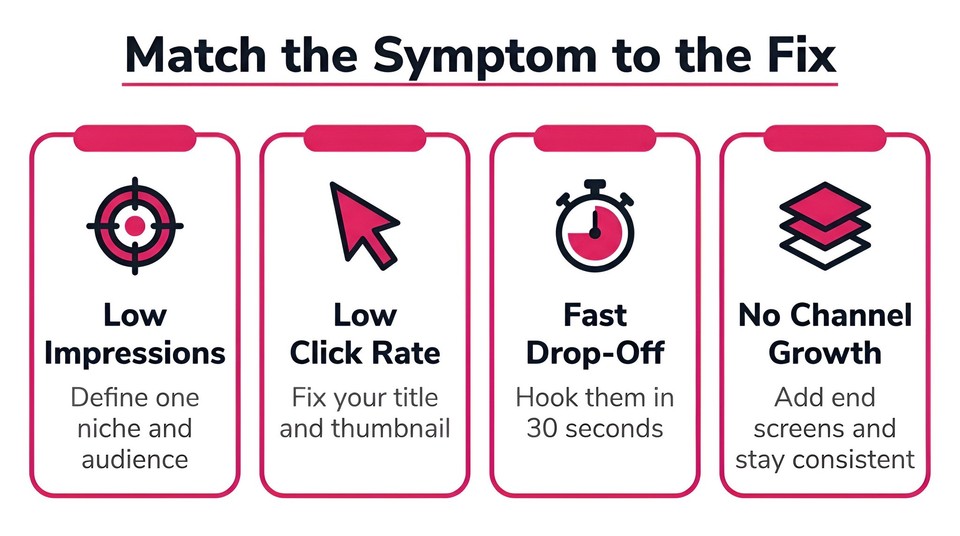
Open YouTube Studio and match your symptom to the fix:
-
Very low impressions? Your niche and audience are unclear. Define one audience, pick one topic lane, and build a consistent library.
-
Good impressions, low CTR (well under 2 to 10 percent)? Your title and thumbnail are not earning the click. Sharpen the promise, try a personal-story angle, and test thumbnails.
-
Good CTR, retention drops fast in the first minute? Your hook is weak. Cut the intro, restate the promise immediately, and open with something interesting.
-
Decent retention but no channel growth? Weak session signals. Add end screens, playlists, and a clear next video, and track Unique Viewers.
-
Expected search traffic that never came? Match real queries and cover the topic well, and use Shorts for discovery.
-
Everything looks okay but views are still low? It may be a saturated or tiny niche, or simply too early. Stay consistent and give it time.
The bottom line
Your video is not getting views because one stage of the funnel is leaking, not because YouTube decided against you. Find the stage, impressions, CTR, retention, or session, and fix that specific thing. Define exactly who your videos are for, package them honestly enough to earn the click, hook viewers in the first thirty seconds, and stay consistent in one niche so the system can learn your audience. Do that, and the views follow, because that is literally what the algorithm is built to reward.
If producing consistently is the part that keeps stalling you, that is exactly where AI helps. You can turn your next idea into a video with Fliki in minutes, package it, caption it, and keep a steady cadence in your niche, which is the habit that quietly beats almost everything else.
FAQs
A brand-new channel has no watch history for YouTube to learn from, so the system cannot yet match your videos to an audience. Fix it by choosing one clear niche, defining exactly who your videos are for, publishing consistently to build a library, and investing heavily in your titles and thumbnails. Views tend to come once the algorithm has enough consistent data to find your audience.
No. YouTube says it recommends videos to interested viewers rather than favoring channels by size, evaluates each video individually, and does not penalize a channel for one underperforming video. Small channels struggle because the system has less data about them and because packaging matters more when you are up against established videos, not because of suppression.
Not directly. YouTube notes that subscriber count is not the same as your active audience and that viewers skip most videos in their subscription feeds. Focus on the Unique Viewers metric and on making videos people actually finish, not on the subscriber number alone.
There is no fixed number, and it varies enormously by niche and topic. A more useful benchmark than views is your click-through rate (YouTube says half of channels and videos sit roughly between 2 and 10 percent) and your audience retention curve. Diagnose those before worrying about a view count.
No, as long as it has genuine human creative input and value. YouTube allows and monetizes AI-assisted content that expresses your original voice, and only restricts mass-produced, templated, repetitive content. Disclose realistic synthetic media where required, and treat AI as a way to produce good videos faster, not as a shortcut around good packaging.
It depends on your niche, consistency, and packaging, but it usually takes a library of videos and some months for the system to learn your audience. Treat every upload as an asset that keeps working over time, stay consistent in one lane, and improve your titles, thumbnails, and hooks with each one.