The honest answer, and why it is useless on its own
Ask "how much does an explainer video cost?" and every studio gives you the same infuriating non-answer: "it depends." They are not wrong. A finished 60-second explainer can cost anywhere from zero to fifty thousand dollars, and both ends of that range are real. But "it depends" helps nobody budget.
So this article does the thing those pages avoid: it gives you the actual number for your specific situation. You will see real 2026 price ranges by tier, by animation style, and by length, the exact things that push a quote up or down, the hidden costs almost nobody puts in the proposal, and a simple way to estimate your own video before you talk to a single vendor. By the end you will know not just what an explainer costs, but what yours should cost, and how to spend the least to get the most.
Let us start with the fast answer.
The quick answer: explainer video cost by tier
Here is the range for a standard 60-second animated explainer, from cheapest to priciest way to make it. These are the four real routes.
How you make it | Typical cost (60 seconds) | Turnaround |
|---|---|---|
DIY with AI software | Roughly $0 to $100 per month (subscription) | Minutes to hours |
Freelancer (Upwork, Fiverr) | About $500 to $5,000 | 1 to 4 weeks |
Mid-market studio (most of the market) | About $5,000 to $15,000 | 6 to 8 weeks |
Premium or high-end agency | About $15,000 to $50,000 and up | 8 to 12+ weeks |
For a sense of the "typical" custom explainer, the most-cited industry benchmark is Wyzowl's cost survey, which found a median price of 5,400 dollars, with quotes ranging from 600 dollars all the way to 250,000 dollars. One honest caveat that most articles skip: that survey's data was collected back in late 2022, even though the page is re-dated, so treat 5,400 dollars as a reasonable mid-market benchmark rather than a fresh 2026 measurement. The same survey's trimmed average was about 8,457 dollars, which is where the widely-repeated "around 8,000 dollars" figure comes from. Lead your budgeting with the median.
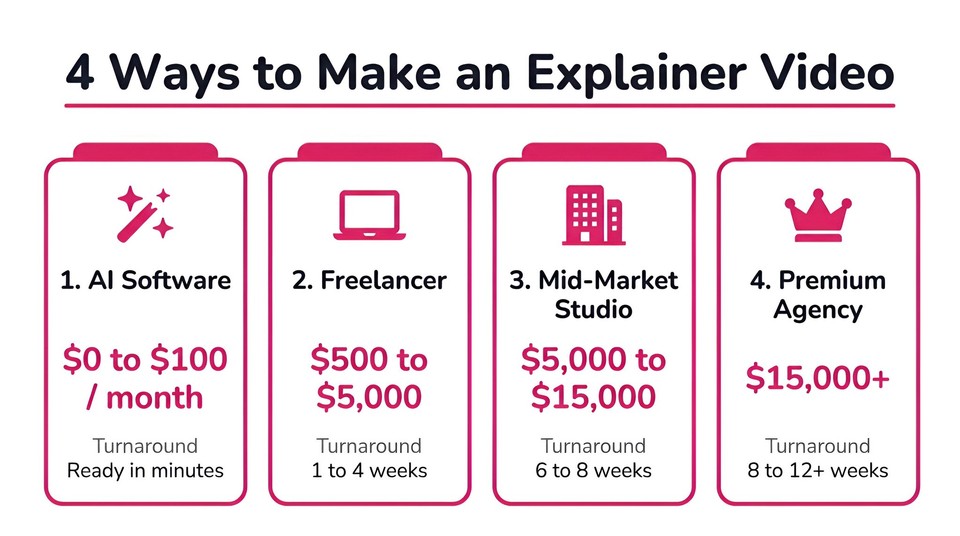
Those four routes explain the width of the range. Now let us break down what actually moves the number inside each one.
Why the range is so wide: what you are actually paying for
An explainer is not one thing you buy, it is a dozen line items bundled together. Understanding the bundle is how you read a quote and spot where your money goes. Studios typically split a project budget roughly a quarter to pre-production, half to production, and the rest to post-production. In dollars, per vendor price guides like Vidico's animation cost breakdown, the individual pieces of a custom explainer look like this:
Scriptwriting: roughly 500 to 3,000 dollars
Storyboarding and style frames: about 1,000 to 5,000 dollars
Character design: around 500 to 3,000 dollars per character
Voiceover talent: about 300 to 1,000 dollars per finished minute, depending on the talent tier
Music and sound design: roughly 500 to 3,000 dollars for custom, less for licensed tracks
Animation: the biggest single cost, and the one that swings the most by style
That last point is the key to the whole topic. Change the animation style and you can double or halve the total. So the single most useful way to answer "how much does an explainer video cost" is to answer it by style.
Explainer video cost by animation style
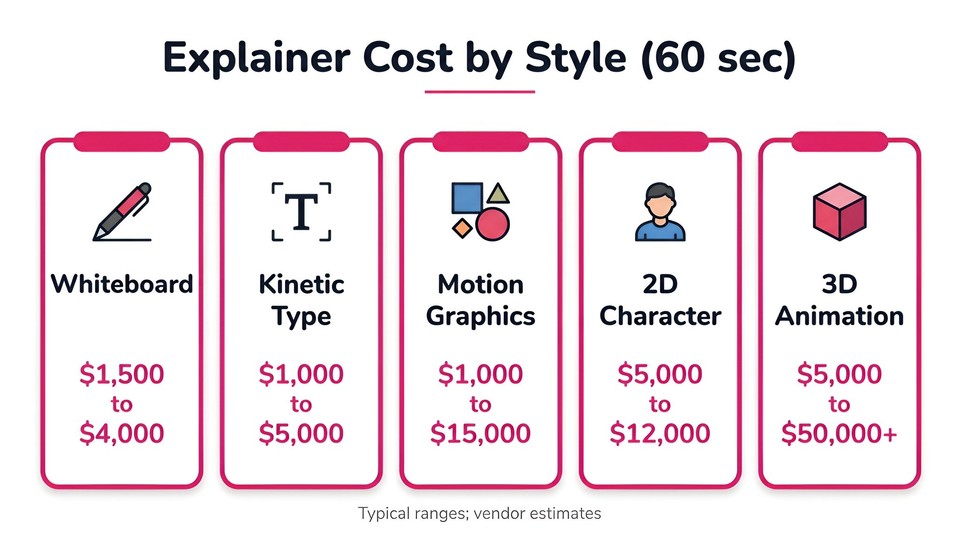
This is the table to bookmark. These are typical ranges for a 60-second video in each style, cheapest to most expensive, drawn from studio price guides (treat them as vendor estimates, since studios set them around their own offering).
Animation style | Typical cost (60 seconds) | Why |
|---|---|---|
Kinetic typography (animated text) | About $1,000 to $5,000 | No characters or illustration, fast to produce |
Whiteboard animation | About $1,500 to $4,000 | Simple hand-drawn look, the most budget-friendly |
Motion graphics | About $1,000 to $15,000+ | Icons, shapes, and data, scales with polish |
2D character animation | About $1,500 to $20,000+ | The default explainer style, most B2B lands $5,000 to $12,000 |
Mixed media (live action + animation) | About $2,000 to $30,000+ | Filming plus compositing adds real production cost |
3D animation | About $5,000 to $50,000+ | Modeling, rigging, and rendering by specialists, the priciest |
The rule of thumb is simple: kinetic typography, whiteboard, and template-based motion graphics are the cheapest, 2D character and custom motion graphics sit in the middle, and mixed media and 3D are the premium tier.
If budget is tight and your story does not truly need characters or 3D, a clean motion-graphics or whiteboard explainer delivers most of the value for a fraction of the cost. For a deeper look at which style fits which message, our guide on making animated explainer videos with AI covers the styles in detail.
Explainer video cost by length (and why 30 seconds is not half of 60)
People assume a 30-second video costs half of a 60-second one. It does not, because a big chunk of the cost, the script, storyboard, character design, and setup, is fixed no matter the length. A studio prices per finished minute, and the first minute carries the heaviest per-second rate. Here is roughly how full-project cost scales, using Vidico's ranges for the three common styles.
Length | Motion graphics | 2D character | 3D |
|---|---|---|---|
30 seconds | $500 to $2,500 | $2,000 to $10,000 | $5,000 to $15,000 |
60 seconds | $1,000 to $5,000 | $5,000 to $15,000 | $10,000 to $25,000 |
2 minutes | $2,000 to $8,000 | $8,000 to $25,000 | $15,000 to $40,000 |
5+ minutes | $5,000 to $30,000 | $20,000 to $60,000 | $30,000 to $100,000+ |
The practical takeaways: a 30-second cutdown is cheaper but not proportionally, and each additional minute typically adds only 50 to 80 percent of the base rate because the setup is already paid for. This is also why "explainer video cost per minute" is the way studios actually quote, and why a tight, short script is one of the biggest cost savers you have.
The hidden costs nobody puts in the quote
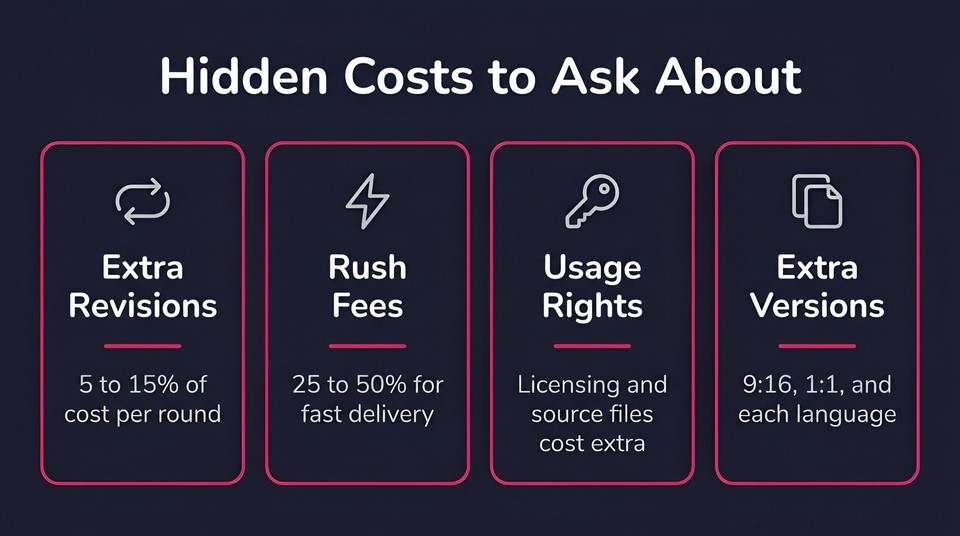
Here is where budgets blow up, and where knowing the game saves you real money. These items are frequently billed separately or added later:
Revisions beyond the included rounds. Most studios include two or three, then charge roughly 5 to 15 percent of the project cost per extra round. Nail the script and storyboard before animation starts, because changes are cheap on paper and expensive in pixels.
Rush fees. Need it in under two weeks? Expect a 25 to 50 percent surcharge, sometimes more.
Usage and licensing rights. Music licensing and commercial usage for paid campaigns are often add-ons, not defaults.
Source files. The editable working files are frequently not included unless you ask for them in the contract. If you ever want to update the video in-house, negotiate this up front.
Extra aspect ratios and cutdowns. A 9:16 vertical and 1:1 square version for social are usually priced per version, not thrown in.
Translations and localization. Each additional language means new voiceover and re-timing, often 300 to 1,000 dollars per minute per language.
None of these are scams, they are standard line items. But they are the difference between the quote you accepted and the invoice you pay, so ask about every one before you sign.
Turnaround time is a cost too
If you need a video for a launch in three weeks, price is not your only constraint. Custom animation is slow. A common 60 to 90 second 2D explainer typically takes 6 to 8 weeks end to end, per studio timelines like Hocus Pocus Studio's. A one-minute 3D piece can take 8 to 12 weeks.
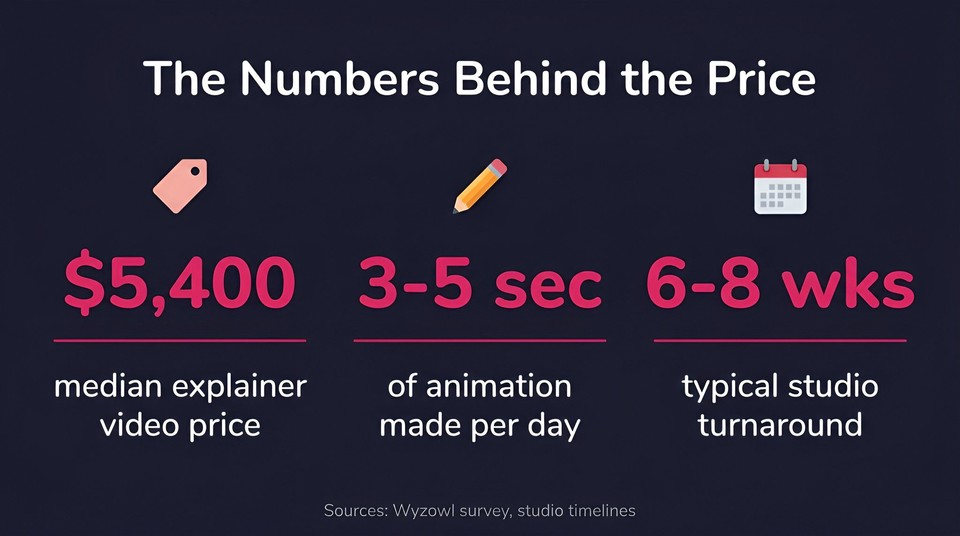
Here is the fact that makes the timeline click: for traditional frame-by-frame 2D, a single animator produces only about 3 to 5 seconds of finished animation per day. That means one minute of video is roughly 12 to 20 days of pure animation labor, before script, storyboard, voiceover, and revisions. When you understand that, the 6-to-8-week timeline and the four-figure price stop looking unreasonable. You are buying weeks of skilled human hours.
The AI option: what it actually costs
The reason "how much does an explainer video cost" has a very different answer than it did a few years ago is AI. Tools that generate a narrated, captioned, animated explainer from a script now cost a monthly subscription rather than a per-project fee. Fliki, for example, has a free plan (a few minutes of video per month, watermarked) and paid plans that run from roughly 20 to 70 dollars a month depending on features (check the pricing page for the current numbers). Comparable tools like Synthesia and Vyond sit in a similar monthly range.
Let me be honest about the comparison, because the "AI is 500 times cheaper" claims you will see are not supportable. The real trade-off is a subscription versus a project fee. If you make several videos a month, an AI tool drives your marginal cost per video down to a few dollars and a few minutes of work, which is transformational for social content, product updates, internal training, and testing. What it does not replace is bespoke, fully custom character craft and creative direction. Even agencies concede the split: AI-assisted studios advertise around 1,500 to 3,000 dollars per minute, sitting between pure DIY and full custom. And adoption is real, Wyzowl's 2026 survey found 63 percent of marketers now use AI video tools.
The sensible framing: use AI for volume, speed, iteration, and anything where "good and fast" beats "bespoke and slow," and commission a studio for the one flagship brand film that has to be perfect. Many teams do both. If you want to see which tools fit which job, our best explainer video software roundup compares them, and you can turn a script into a first cut yourself with Fliki's text to video or explainer video maker.
Build your own estimate in five questions
You do not need a quote to ballpark your cost. Answer these and you will land within range:
Which route? DIY/AI (subscription), freelancer (hundreds to low thousands), mid studio (5,000 to 15,000 dollars), or premium (15,000 dollars and up).
Which style? Whiteboard or motion graphics (cheapest), 2D character (mid), 3D or mixed media (priciest). This is your biggest lever.
How long? Remember the base cost is fixed, so shorter saves money but not proportionally. Aim for 60 to 90 seconds.
How custom? Custom characters, complex animation, and lip-sync each add real money. Templates and simpler motion save it.
What extras? Add for extra revision rounds, rush delivery, licensing, source files, extra aspect ratios, and each additional language.
Multiply the style range by your length, then add the extras. That is your realistic budget.
How to get the most for your budget
You can cut cost dramatically without cutting quality if you spend in the right places:
Perfect the script first. It is the cheapest thing to change and the most expensive thing to fix later. A tight script also means a shorter, cheaper video. Steal the framework in our explainer video script template.
Pick the style your story actually needs. Do not pay for 3D when clean motion graphics would land the message.
Keep characters and scenes to a minimum. Every extra character and animated background adds 15 to 50 percent.
Use AI for the drafts, volume, and social versions, and save studio budget for the hero video. This one habit stretches a budget the furthest.
Negotiate revisions, source files, and usage rights into the base price rather than paying for them as surprises later.
Batch and localize smartly. Producing several videos or all your language versions together is cheaper per unit than one-offs.
Is an explainer video worth the money?
Given the price, the fair question is whether it pays off. The demand side is strong: in Wyzowl's 2026 data, 96 percent of people have watched an explainer to learn about a product, 63 percent say a short video is their most-preferred way to learn about one, and 85 percent say a video has convinced them to buy. Video is not a nice-to-have, it is often how the purchase decision gets made. The math only works, though, if the video is genuinely good, which is why spending on the script and the right style matters more than spending on raw production polish.
The numbers to ignore
While researching cost you will bump into "stats" that sound authoritative and are not. Do not let them shape your budget. The claim that "viewers retain 95 percent of a message from video versus 10 percent from text" comes from an old vendor survey, not research. The "eight-second attention span, shorter than a goldfish" line is a debunked myth. And "video on a landing page boosts conversions 80 to 86 percent" traces to a defunct dataset repeated endlessly. Real results vary enormously by execution. Budget on the real cost ranges above, not on folklore.
The bottom line
An explainer video costs anywhere from a monthly software subscription to fifty thousand dollars, and the honest answer for you comes down to four things: the route you choose, the animation style, the length, and the extras. Most custom explainers land in the mid four to five figures, the median is around 5,400 dollars, and the biggest lever you control is style. Spend the money where it matters, on a sharp script and the right style, and skip the premium production you do not need.
If your budget is closer to a subscription than a studio invoice, you can make your first explainer with Fliki for free, write a tight script, pick a style, and have a draft in minutes, then decide where a bigger budget is actually worth it.
FAQs
A custom 60-second animated explainer typically costs about 5,000 to 15,000 dollars from a mid-market studio, with a median around 5,400 dollars industry-wide. Freelancers run roughly 500 to 5,000 dollars, premium agencies 15,000 dollars and up, and AI software costs a monthly subscription of roughly 0 to 100 dollars instead of a per-project fee.
Studios price per finished minute, and it varies by style: roughly 1,000 to 5,000 dollars per minute for motion graphics, 5,000 to 15,000 for 2D character animation, and 10,000 to 25,000 or more for 3D. The first minute carries the highest per-second rate because setup costs are fixed, so each additional minute usually adds only 50 to 80 percent of the base.
3D requires specialist skills, modeling, rigging, lighting, and rendering, and far more hours per second of finished video. Whiteboard and kinetic typography are simple, fast styles with no characters to build, which is why they are the most budget-friendly options.
Freelancers on platforms like Upwork and Fiverr typically charge about 500 to 5,000 dollars for a short animated explainer, with most mid-scope projects landing between 500 and 2,500 dollars. Quality and reliability vary widely, so review portfolios and confirm revisions and source files before hiring.
Yes, meaningfully, if you make videos regularly. An AI tool is a monthly subscription of roughly 20 to 70 dollars rather than a several-thousand-dollar project fee, and it produces a first cut in minutes. The trade-off is that AI does not replace bespoke custom character craft, so many teams use AI for volume and a studio for one flagship video.
A custom 60 to 90 second 2D explainer usually takes 6 to 8 weeks, and 3D can take 8 to 12 weeks, because a frame-by-frame animator produces only about 3 to 5 seconds of finished animation per day. An AI tool can produce a draft in minutes, which is part of why it costs so much less.