Introduction
The most profitable YouTube niches are not simply the ones with the highest advertiser rates. In the best public dataset built from real YouTube Studio numbers that I could find (AIR Media-Tech, 300 channels), education and science channels had a median RPM of $10.22 per 1,000 views, while business and finance sat at $2.01 and health and sport at $1.23. What you keep also depends on views, policy risk and how much each video costs you to make.
That gap is why most "highest paying niches" lists mislead. They quote advertiser CPM ranges that no creator actually receives, then rank niches as if CPM were income. This guide does the unglamorous version: it separates sourced evidence from vendor guesses, explains the 2026 and 2027 YouTube rules that decide whether any niche pays, and gives you five narration-led niches with a working playbook for each.
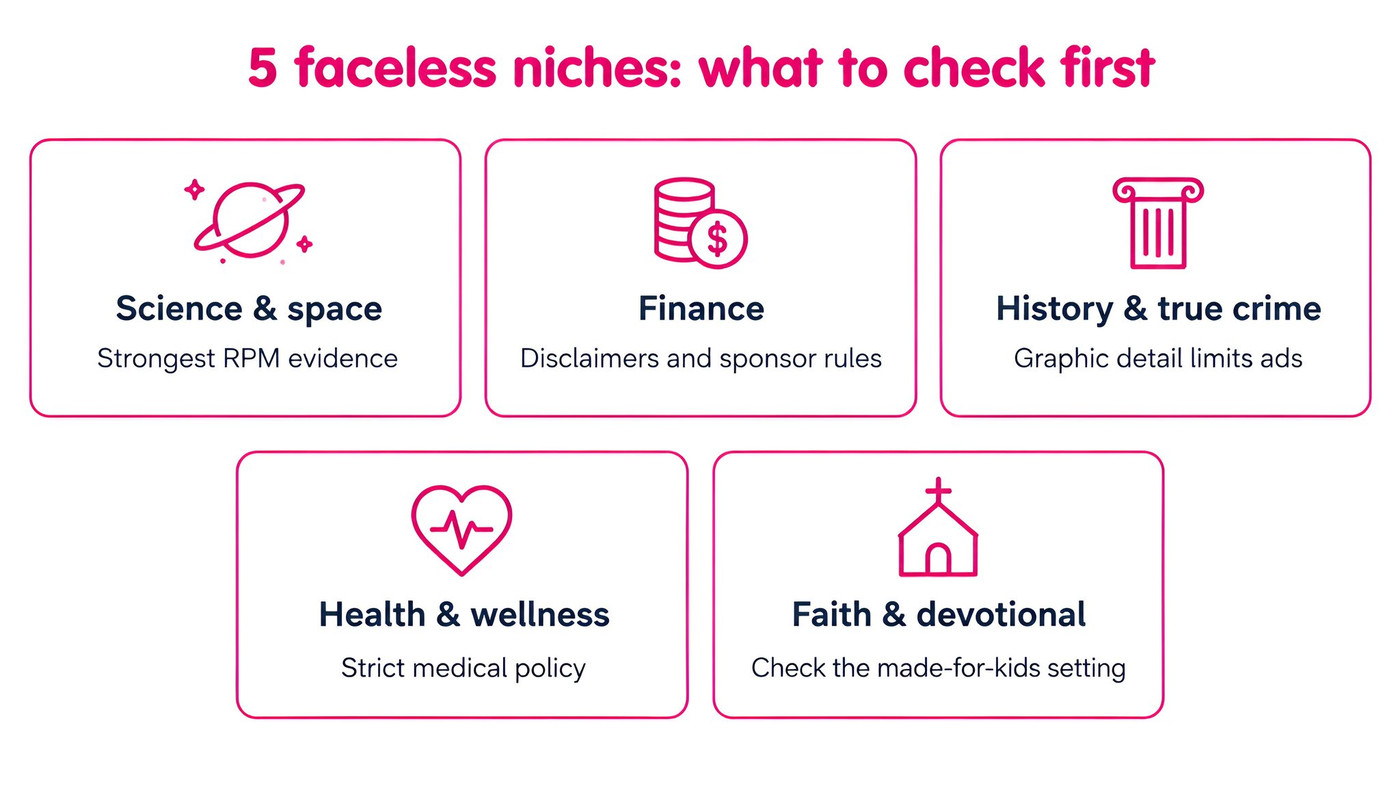
The five are science and space explainers, finance, history and true crime, health and wellness, and faith and devotional series. For each one you will get the earnings evidence (and where there is none, I say so), the format that fits, the policy trap to avoid, and how to build it in Fliki. If you only want a long brainstorm of topics, our broader list of faceless niche ideas is the better starting point; this article is about which ones are worth your next 100 hours.
What "profitable" actually means on YouTube
A niche is profitable when views multiplied by RPM, minus production cost and the cost of getting demonetized, is a number you are happy with. Each part of that sentence behaves differently, so it helps to define them before comparing niches.
CPM is what advertisers pay per 1,000 ad impressions, before YouTube takes its share. RPM is what you earn per 1,000 views after that share, and YouTube calculates it over all views, including ones that never showed an ad. Per YouTube's own definitions, that is why RPM usually lands well below the CPM headline, and why a niche with a $30 CPM can pay far less than $30 per thousand views.
The split matters too. On long-form videos YouTube pays creators 55% of net revenue from watch-page ads, while Shorts are paid from a pool at 45% of the revenue allocated to you, according to YouTube's revenue-share page. Mid-roll ads only become an option on monetized videos that run 8 minutes or longer, which is one reason long-form tends to out-earn Shorts by a wide margin. vidIQ reports that most creators earn roughly $0.03 to $0.10 per 1,000 Shorts views, a vendor estimate backed by one of its own channels.
Finally, audience geography changes everything and almost nobody quantifies it honestly. I did not find a trustworthy public number for how much more a US viewer pays than a viewer elsewhere, so treat any such multiplier you read online as unverified. The reliable move is to open your own analytics and break revenue down by country once you are monetized.
What the data says about the most profitable YouTube niches
YouTube does not publish RPM by niche. Even OutlierKit, which sells niche research, states that RPM is only visible inside each creator's own Studio and that every niche table online is either self-reported figures or a model. So the useful question is not "what does this niche pay" but "how good is the evidence, and what is it actually telling me".
The one independent dataset worth anchoring on
The strongest evidence I found is AIR Media-Tech's 2026 RPM study, published 1 July 2026. It covers 300 channels (10,000 to 50 million subscribers), 3,595 channel-months from May 2025 to May 2026, and uses real YouTube Studio data rather than advertiser estimates. All figures are medians, and the overall median across niches was about $2.30 per 1,000 views.
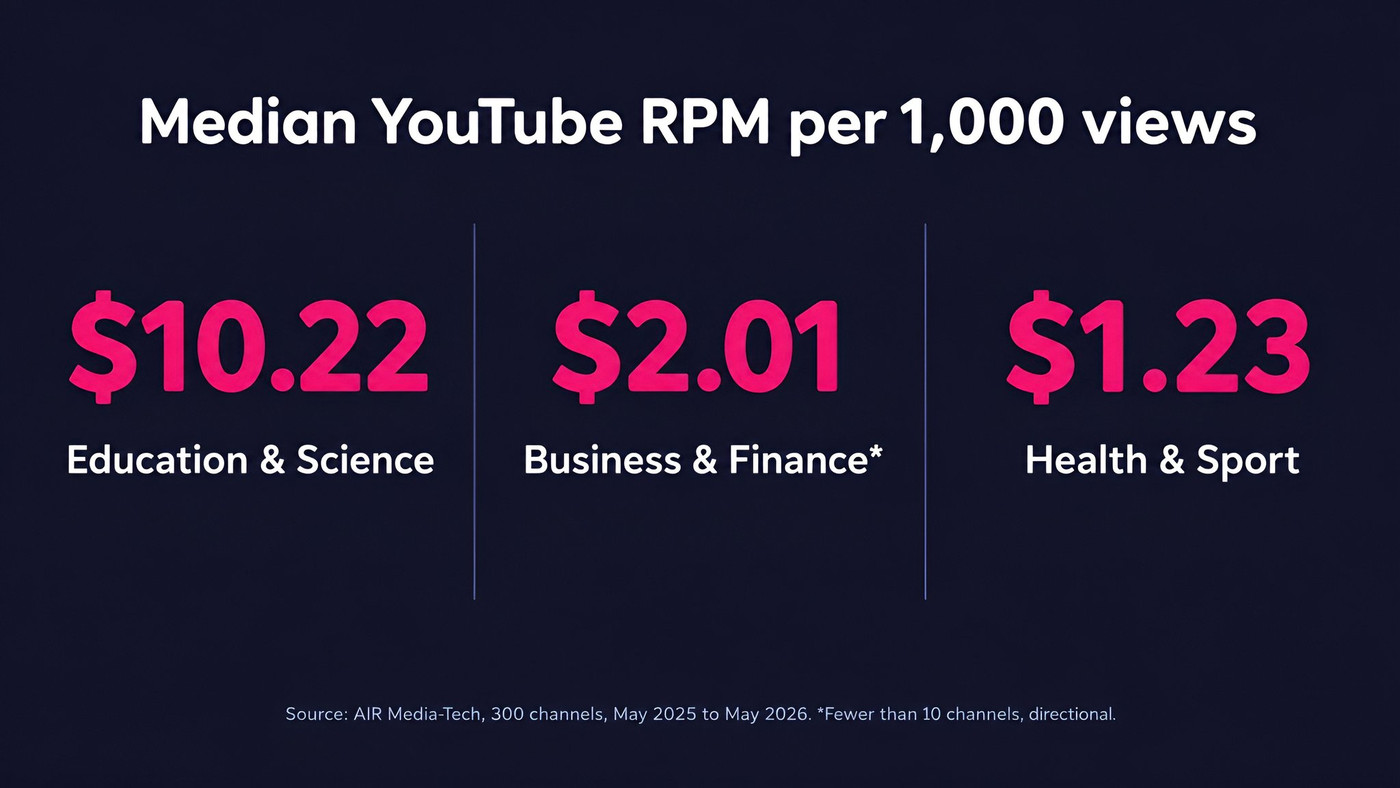
Two cautions before you quote that image. The sample comes from channels AIR works with, so it is not a random slice of YouTube, and the business and finance group had fewer than ten channels, which AIR itself labels directional. Even so, it contradicts the popular claim that finance automatically pays the most, and it shows something more important: inside education and science, the middle half of channels ranged from $2.31 to $19.50. The spread within a niche is bigger than the gap between most niches, so your execution matters more than your category.
The study also found seasonality: median RPM rose about 60% in the fourth quarter for business and finance and about 12% for health and sport. If you are reading your first RPM in December, do not extrapolate it to March.
What those medians mean in dollars
To make the numbers concrete, here is plain arithmetic: monthly views divided by 1,000, times RPM. This is ceiling math on medians, before tools, taxes and any Shorts, not observed earnings for any real channel, and it assumes every view is monetized at that median.
Monthly views | Health and sport ($1.23) | Business and finance ($2.01) | Education and science ($10.22) |
|---|---|---|---|
50,000 | $62 | $101 | $511 |
100,000 | $123 | $201 | $1,022 |
500,000 | $615 | $1,005 | $5,110 |
The lesson is not that science always wins. A quarter of education and science channels in the study sat at or below $2.31, which is $231 at 100,000 views, so the bottom of the best niche looks like the middle of the worst. Ad revenue is also only one stream: sponsorships, affiliate links and your own products often matter more once an audience trusts you, but those depend on you, not on the niche label.
Vendor estimates: useful for direction, not for planning
Other sources publish tidier ranges. vidIQ's guide (updated March 2026) lists finance and investing at roughly $4 to $12 RPM, education and how-to at $2 to $6, health and fitness at $2 to $5, and kids at $0.50 to $1. Those are compiled estimates, and they disagree with AIR: vidIQ puts education well below AIR's $10.22 median, while placing health above AIR's $1.23.
The wilder numbers, such as "$30 RPM for finance" or "$15 to $50 CPM", usually trace back to advertiser rate cards or to unnamed creator surveys, not to a published sample. When two reputable sources disagree by 2x to 5x, the honest reading is that nobody can promise you a niche rate, and that you should plan for the low end of every range.
Where there is no reliable data at all
I found no credible RPM data for true crime, for faith content, or for history as a separate category. There are plenty of blog posts quoting precise ranges for them, but none that traces to a named sample. I flag that on purpose: if an article gives you a confident true-crime RPM, ask where it came from.
The rules that decide whether any niche pays in 2026 and 2027
Before comparing niches, you need to be eligible to earn at all, and you need to avoid a few policies that hit narration-led channels harder than face-on ones. These are the rules that matter, taken from YouTube's own pages and read in November 2026.
Partner Program thresholds are rising for new applicants
Today, joining the ad-revenue tier of the YouTube Partner Program takes 1,000 subscribers plus either 4,000 qualified public watch hours in the last 12 months or 10 million qualified Shorts views in the last 90 days, per YouTube's eligibility page. YouTube's announcement of 10 August 2026 says that from 1 February 2027 new applicants will need 8,000 qualified watch hours in the last 365 days or 20 million qualified Shorts views in the last 90 days.
Path | Today (until 31 Jan 2027) | New applicants from 1 Feb 2027 |
|---|---|---|
Long-form | 1,000 subscribers + 4,000 watch hours (12 months) | 8,000 watch hours (365 days) |
Shorts | 1,000 subscribers + 10M Shorts views (90 days) | 20M Shorts views (90 days) |
Two details that most summaries miss. The change applies to new applicants; YouTube says it will not affect creators already in the program. And separately, from February 2027, sharing in Shorts ad and subscription revenue requires 10 million qualified Shorts views over 90 days, though channels below that keep their partner status and long-form earnings. The practical lesson: if you are planning a monetized channel, apply before the deadline if you can, and treat long-form as the income engine.
Inauthentic content is the policy that matters for AI-assisted channels
In July 2025 YouTube renamed "repetitious content" to "inauthentic content" and clarified it. YouTube's policy page says this type of content was already ineligible, and its examples of what fails are telling: slideshows, templated storylines and scrolling text with minimal narrative, commentary or educational value, and AI content made from generic templates that gives the impression of mass production. What passes is a final product that still shows your creative vision, even if automated tools helped make it.
So an AI voice over original visuals is not banned. A channel that pushes the same template through 300 near-identical videos is exactly what the policy describes. Reporting in 2026, such as this Tubefilter piece from January, describes AI-slop channels being deleted or having their videos hidden, so treat enforcement as live. Our guide to YouTube AI demonetization goes deeper, and this explainer on whether AI-generated videos get monetized covers the basics.
The policy page also lists a category that matters for three of our five niches: AI personas delivering information on sensitive topics. Channels that use an AI-generated persona, such as an AI "doctor" giving health advice, are not allowed to monetize. A narrated explainer with no fake expert persona is a different thing, but it shows how YouTube thinks about health and similar topics.
AI disclosure is narrower than people think
YouTube requires disclosure when content is altered or synthetic and could be mistaken for real, such as a realistic scene of an event that never happened or a realistic likeness of a real person. According to YouTube's disclosure page, you do not need the label for clearly non-realistic content, animation, using AI for scripts or captions, or cloning your own voice. A plain AI voiceover over illustrations or stock footage does not need a label on a literal reading, but cloning someone else's voice or fabricating realistic footage of real events does. When unsure, label it; YouTube says disclosure does not limit eligibility to earn.
Made for kids changes the economics
If a video is classed as made for kids, YouTube does not serve personalized ads on it and restricts features such as comments, according to its made-for-kids guidance. In AIR's data, the kids and teens niche had the lowest median RPM of any group, $0.33. If you make animated stories that children are likely to watch, do not assume they are exempt.
How I chose these five niches
I used four filters. The niche had to work with narration over visuals, so you never need to appear on camera. It had to have at least some public evidence about earnings or, failing that, clear policy rules I could verify. It had to show up repeatedly in the kinds of channels people build with Fliki, based on what I see across our most active creators. And each niche had to carry a different risk profile, so the guide teaches you to judge risk rather than just copy a topic.
I left out fiction and horror, kids content, and news. Kids content has the weakest RPM evidence and the strictest ad rules, as above. Fiction and news are real businesses, but they are more volatile and less comparable, and I did not find enough sourced data to write a fair playbook. For a wider brainstorm, the ideas article linked in the introduction covers more ground.
The five niche playbooks
The order below follows the strength of the earnings evidence, not a promise that the first niche beats the last. For each niche I cover why it can pay, what the format looks like, where channels get into trouble, and a practical way to build it in Fliki.
1. Science and space explainers
This is the niche with the best public evidence behind it. AIR's education and science group had the highest median RPM in the study at $10.22, and it is also where the within-niche spread is widest. A strong channel in this category can earn several times what a weak one does with the same subject matter.
The format that works is a single question answered with a real structure: "what if" scenarios, how everyday things work, and scale comparisons. Videos tend to land between about 8 and 18 minutes, which also clears the 8-minute line for mid-roll ads. A short that teases the same topic is a good companion, but treat the long video as the product.
Real example: Kurzgesagt
Kurzgesagt had about 25 million subscribers and 421 videos on its YouTube channel page on 23 November 2026. It is a human-made studio with designers and researchers, so it is a quality benchmark, not a template for an AI shortcut. The lesson it offers is that explainers win on accuracy and clarity of idea, and that is the part you cannot automate away. Its size-comparison video below is a good picture of the format: one clear question, a strong visual idea and no filler.
Where this niche goes wrong is factual drift. AI scripts invent plausible-sounding numbers, and a science channel lives or dies on being right. Verify every figure against a primary source and put the source in your description. In Fliki, a workable flow is to write your own outline, draft the script with the text-to-video tool, replace every number you cannot verify, then pair a natural AI voiceover with original illustrated scenes rather than generic stock clips.
Verdict: Best evidence, highest ceiling, highest bar for accuracy. Choose it if you will actually research each video.
2. Finance and market explainers
Finance is the niche everyone assumes is the richest, and the evidence is more mixed than the reputation. AIR's business and finance median was $2.01 (a directional figure from fewer than ten channels), vidIQ's vendor range runs from $4 to $12, and the inflated "$30 RPM" claims have no traceable sample behind them. What finance does have is a strong seasonal lift: AIR saw median RPM rise about 60% in the fourth quarter.
The formats that suit narration are company rise-and-fall stories, market-crash explainers, earnings recaps and money-habit lessons. Charts and timelines carry these videos, so a slides-to-video workflow fits earnings and data recaps well.
Real example: MagnatesMedia
MagnatesMedia, which tells the stories of how companies rose and fell, had about 1.86 million subscribers, 194.8 million views and 255 videos on vidIQ's channel page on 18 November 2026. OutlierKit describes its format as animated maps, archive footage and narration. That is roughly 760,000 views per video on average, which shows the economic logic: fewer, deeper videos with high retention, not a daily feed. Here is one of its shorter, popular episodes, on how a Louis Vuitton fortune began.
The risks are legal, not just editorial. If you use affiliate links or sponsorships, the FTC expects clear disclosure of the material connection, per its endorsement guidance. Keep content educational, avoid individualized recommendations, and add a plain "this is not financial advice" note. I am not a lawyer, so get proper advice before building a business on it.
Verdict: Good, not magic. Pick it for the sponsor and affiliate potential and the Q4 lift, not because a table said finance pays $30.
3. History, mysteries and true crime
This pair behaves like one niche for production, because both are story-led documentaries, and like two niches for monetization. History is a classic narration format with strong evergreen demand. True crime has loyal audiences and the least reliable RPM data of anything in this guide: I found no sample-backed figure at all.
The strongest format is the long documentary of roughly 8 to 35 minutes, built from maps, archive imagery and a clear timeline, plus short teaser clips. Series structure helps here, because viewers who finish one episode want the next.
Real example: The Armchair Historian
The Armchair Historian had about 2.54 million subscribers and 336 videos on its YouTube channel page on 23 November 2026, built on animated maps and scripted narration. The format is the point: maps do the visual work that stock footage cannot, and every video has a distinct subject. This episode on life in occupied France shows how a heavy subject can be handled without graphic imagery.
The trap is advertiser-friendliness. YouTube's advertiser-friendly guidelines limit ads on content centred on graphic violence or injury without context, while educational and historical treatment with non-graphic depictions can still earn. A January 2026 report from Uppbeat suggests YouTube loosened its treatment of discussion-led coverage of sensitive topics, but that is a secondary source, so check the live guidelines. For true crime, stick to documented facts, avoid naming unproven suspects, and talk to a lawyer if a story involves living people.
Verdict: History is a safe, evergreen format. True crime has demand but unproven RPM and real editorial and legal risk.
4. Health and wellness education
Health is the lowest-paying of the five on the evidence: AIR's health and sport median was $1.23 (middle half $0.72 to $1.53), though that group includes sport, so it is a rough proxy at best. vidIQ's vendor range is higher at $2 to $5. Either way, this is a niche you choose for audience trust and durability, not for headline RPM.
The strongest formats are long explainers of 7 to 22 minutes, guided audio such as meditation and sleep, and short practical tips. The creators I see building here often aim at older viewers and caregivers, which means slow pacing, large readable on-screen text and a calm voice matter more than flashy editing.
Health carries the strictest rules of the five. YouTube's medical misinformation policy bars content that contradicts health authority guidance on prevention and treatment, with room for educational and documentary context. And as covered above, channels that use an AI persona to give health advice, like an AI "doctor", cannot monetize. I could not find a verified faceless medical-education channel with a public audience count, so I will not name one for that format.
Real example: Jason Stephenson - Guided Sleep Meditation
For guided audio, the clearest example is Jason Stephenson's sleep channel, which showed about 5.72 million subscribers in YouTube's own search results on 23 November 2026. It is voice-led relaxation over calming visuals, so it sells calm rather than diagnosis, which keeps it well away from the medical-advice rules above. This 27-minute talk-down is a typical episode.
The safe build: cite credible sources on screen, have a qualified person review scripts, use a narrator with no pretend credentials, and add a plain disclaimer. A calm AI voice from the voiceover library is fine for narration; inventing a fake expert is not.
Verdict: Low evidence-based RPM and the strictest rules. Choose it only if you can bring real expertise or a reviewer.
5. Faith and devotional series
There is no sample-backed RPM figure for faith content, so I will not invent one. What does exist is evidence of large audiences. Faith channels often grow in several languages at once, and the largest example I could verify is Brazil-based, which matters because geography changes what an audience pays.
Real examples: three stages of the same niche
Unraveling the Scriptures, a Brazil-based channel, had about 852,000 subscribers and 566 videos on its YouTube channel page on 23 November 2026. Historias Biblicas had about 512,000 subscribers, 65.9 million views and 209 videos on 18 November 2026, having started in March 2024. At the other end, Bible Truths Animated had about 36,300 subscribers and 3.2 million views across 59 videos on 8 November 2026, and 41 of its 48 recent uploads were Shorts. vidIQ's model puts its income at about $68 over 28 days, a modelled estimate rather than reported income, but a useful illustration of why a Shorts-only strategy pays so little. Below is one of the larger channel's recent short films; note the long, story-led format.
The formats are two-speed: 30 to 60 second verse and prayer videos, and 10 to 18 minute teaching or saint-story episodes. The long episodes are where mid-roll ads and deeper viewer loyalty become possible. If you serve several languages, an AI video translator can carry a finished episode into other languages, but have a native speaker check doctrine and phrasing, because a single mistranslated line can damage trust.
Two policy points matter here. Animated Bible stories aimed at children may be classed as made for kids, which removes personalized ads and limits comments. And faith content is not restricted as a category, but hateful or derogatory content about other groups is not ad-friendly.
Verdict: Large, loyal audiences and no reliable RPM data. Build long episodes, check your country split, and do not rely on Shorts.
The five niches compared
Niche | Public RPM evidence | Format that fits | Main risk | Production effort |
|---|---|---|---|---|
Science and space | Best: AIR median $10.22 (education and science) | 8 to 18 minute explainers | Factual errors | High: research and original visuals |
Finance | Mixed: AIR $2.01 (directional), vidIQ $4 to $12 | Company stories, recaps, charts | Sponsor disclosure, advice claims | Medium to high |
History and true crime | None separated out | 8 to 35 minute documentaries | Graphic content limits ads, defamation | Medium: maps and archives |
Health and wellness | Low: AIR $1.23 (includes sport), vidIQ $2 to $5 | 7 to 22 minute explainers, guided audio | Medical policy, AI personas | Medium plus expert review |
Faith and devotional | None found | Short verses plus 10 to 18 minute episodes | Made for kids, translation accuracy | Medium, lighter per episode |
How to choose the niche that fits you
Ask four questions in order. First, can you add something a template cannot: expertise, sources, a point of view, original visuals? If not, the policy and the audience will both punish you. Second, which risk can you actually manage, whether that is factual accuracy, legal exposure, medical rules or translation quality? Third, can you keep a sustainable production pace, remembering that a deep 12-minute video is a very different workload from a 40-second short? Fourth, which audience countries are you aiming at, because that will shape revenue more than the niche label.
Then test instead of guessing. You will not see an RPM until you are in the Partner Program, so a 30-day test judges audience signals, and you use the evidence above as your prior.
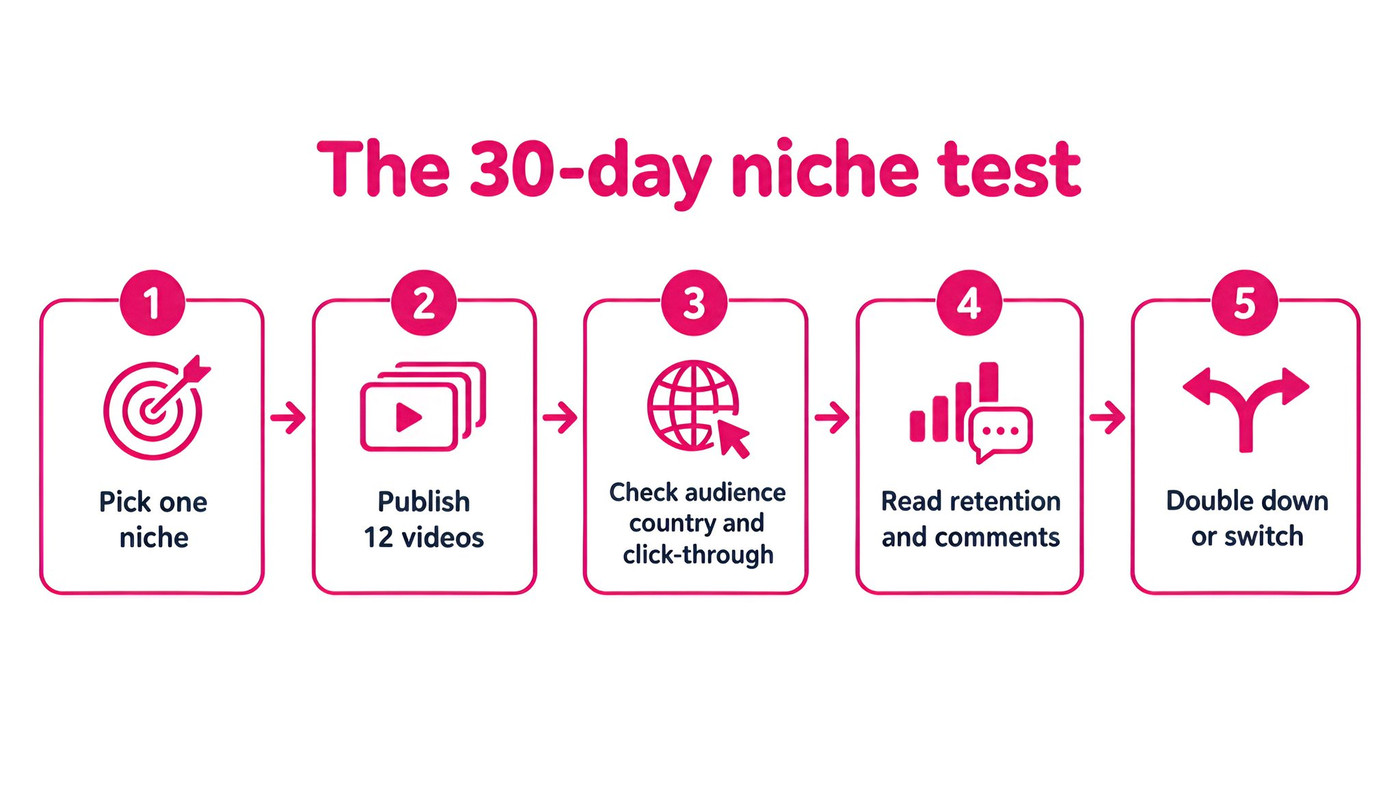
Publish about 12 videos in a month in one niche, with different topics and different scripts so you are not feeding the template problem. Check where your viewers come from and which thumbnails and titles get clicked, then read retention curves and comments for what people wanted more of. At the end, double down on the format that kept people watching or switch niches; a month of data beats three months of debating.
Where Fliki fits, and where it does not
Fliki is useful for the production work in all five niches: scripts from an idea, natural voiceovers, matched visuals, captions, thumbnails, translation, and Shorts cut from long videos. For repeated formats, the Series feature can write scripts, make videos and post them on a schedule on paid plans, which saves real hours. You can try the free plan first; paid plans remove the watermark and include commercial rights, so check the pricing page for current plans.
Here is the honest caveat. A fully hands-off pipeline is exactly the pattern YouTube's inauthentic-content policy warns about, so I would never run a channel without reading each script, adding your own research and checking facts. Use automation for the repetitive parts (voice, captions, formatting) and keep the judgment, sources and ideas human. Our YouTube automation guide shows where to draw that line.
Common mistakes that kill profit
The first is choosing a niche from a CPM table. A $40 CPM headline is not your income, and as AIR's spread shows, a weak channel in a good niche can earn less than a strong one in an average niche. The second is publishing one template at volume, which is the policy's own example of mass production. The third is a Shorts-only strategy in the hope of income, given the pool economics and the thresholds above.
The fourth is skipping disclosure and sources: label realistic synthetic content, cite your figures, and never clone a real person's voice without permission. The fifth is making health, finance or true crime claims you cannot support, and the sixth is ignoring country data, which is where a lot of surprise RPM comes from.
Bottom line
If you want the safest bet on the evidence, start with science and space explainers, and be ready to research properly. If you want a business model beyond ads, finance and faith reward depth and community, while history gives you a durable format with lighter risk and health demands real expertise. Whatever you pick, plan for the low end of every RPM range, apply for the Partner Program before the February 2027 change if you are close, and treat long-form as the engine. You can start building any of these in Fliki for free.
Written by Shivam Aggarwal, who works on content and marketing at Fliki. Statistics, thresholds and policies were current as of November 2026. Verify YouTube's current rules and any pricing before you rely on them.
FAQs
There is no single answer. In AIR Media-Tech's 2026 study of 300 channels, education and science had the highest median RPM at $10.22 per 1,000 views, but the spread inside every niche was wider than the gap between most niches. Your views, audience country, video length and policy compliance usually matter more than the category label.
Vendor tables usually put finance, investing and business at the top, but those are advertiser estimates, not creator earnings. YouTube does not publish CPM or RPM by niche. CPM is also not what you take home, because RPM is calculated after YouTube's share. Use CPM lists for direction and your own Studio data for decisions.
Yes, if they qualify for the YouTube Partner Program and avoid mass-produced content. YouTube does not ban AI voices or faceless formats, but its inauthentic content policy rules out templated, repetitive videos with little original value. Unique scripts, real research and a clear point of view are what keep a faceless channel eligible.
Today you need 1,000 subscribers plus 4,000 public watch hours in 12 months or 10 million Shorts views in 90 days. From 1 February 2027, new applicants need 8,000 watch hours in 365 days or 20 million Shorts views in 90 days. YouTube says existing partners are not affected on entry.
Not for a plain AI voiceover over illustrations or stock footage, according to YouTube's disclosure page. You must disclose realistic altered or synthetic content, such as fabricated footage of real events or a realistic likeness of a real person, and cloning someone else's voice. If you are unsure, add the label; YouTube says it does not limit eligibility.
Both draw large audiences, but I found no sample-backed RPM data for either, so any exact figure you read is a guess. True crime can face limited ads if it dwells on graphic detail, and faith content aimed at children may be made for kids, which removes personalized ads. Test with your own channel analytics.