Introduction
The TikTok algorithm is a recommendation system that ranks every video for every viewer based on how likely that person is to enjoy it. It learns from what you watch, like, share, comment on and follow, from the video's own details such as captions, sounds and hashtags, and, with less weight, from your device and account settings. Your follower count is not a direct factor.
That is the part TikTok has said in public. Almost everything else you read about the algorithm, from the "300 views" tier to the "first hour" rule, is a community model rather than a published fact. In this guide I separate what TikTok confirms, what large datasets show, and what creators merely claim, then turn it into a plan you can use in 2027.
You will get the official signals, how a video is most likely distributed, what changed in 2025 and 2026 (including the US joint venture and the EU's November 2026 findings), a myths table, what four creator videos agree and disagree on, and a diagnosis checklist for any video that stalls.
How I researched this, and how to read the evidence labels
I started with TikTok's own newsroom and transparency pages, the Monolith recommendation paper from ByteDance researchers, and the regulator and press coverage of 2026. Then I added the biggest recent datasets I could verify: Metricool's study of 2.3 million posts, Socialinsider's analysis of 8 million TikTok videos, and Buffer's study of 7.1 million posts. I read the top-ranking guides for this topic to see what they cover and where they cite nothing.
I also researched and watched four 2026 videos (from Metricool, an e-commerce agency, a growth creator and an affiliate-tool reviewer), and I used them only for claims I could sort into agreement, disagreement or myth. Most of these channels are small to mid-sized, so treat this as a sample of creator opinion, not a census of the biggest names.
Throughout the article, claims carry a label in italics. (Confirmed by TikTok) means TikTok said it on an official page. (Dataset) means a large study measured it, with its limits stated. (Creator claim) means people repeat it but nobody has published evidence. Where a number comes from a vendor, I say so.
How the TikTok algorithm works
It is a feed built for each viewer, not a leaderboard
TikTok does not rank videos globally and then show you the top of the list. The For You feed is assembled per person: for every viewer, the system estimates how likely each candidate video is to interest them and ranks accordingly. TikTok describes it this way in its official explainer. (Confirmed by TikTok, 2020.)
That is why a video with a few hundred views can still be a hit for the right audience, and why the same video can flop with a broad one. Your job is less "beat the algorithm" and more "be an easy, obvious match for one specific kind of viewer".
What TikTok says it looks at
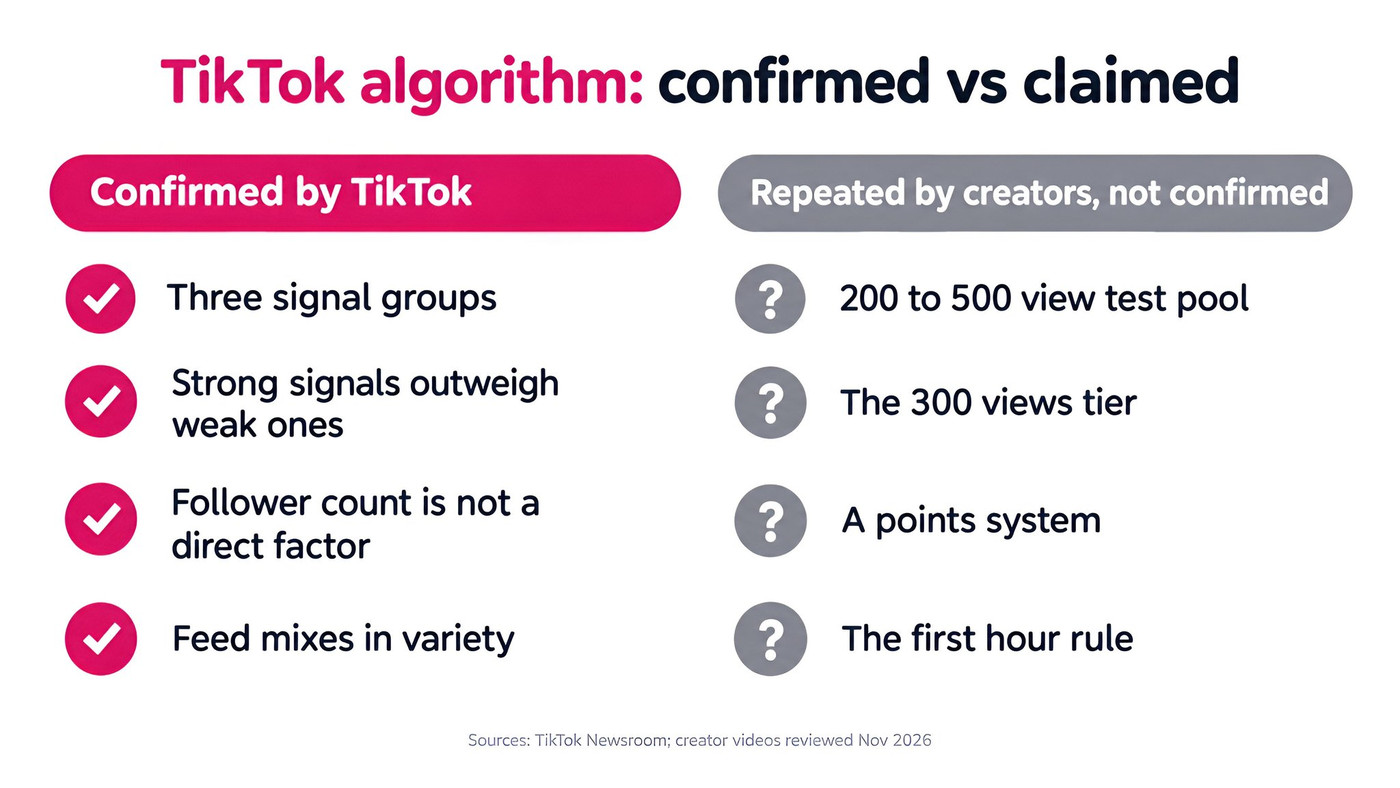
TikTok groups its signals into three buckets. User interactions cover things like the videos you like or share, the TikTok accounts you follow, the comments you post and the videos you create. Video information covers captions, sounds and hashtags. Device and account settings cover language, country and device type, and TikTok says these get lower weight because users do not actively choose them as preferences. (Confirmed by TikTok, 2020.)
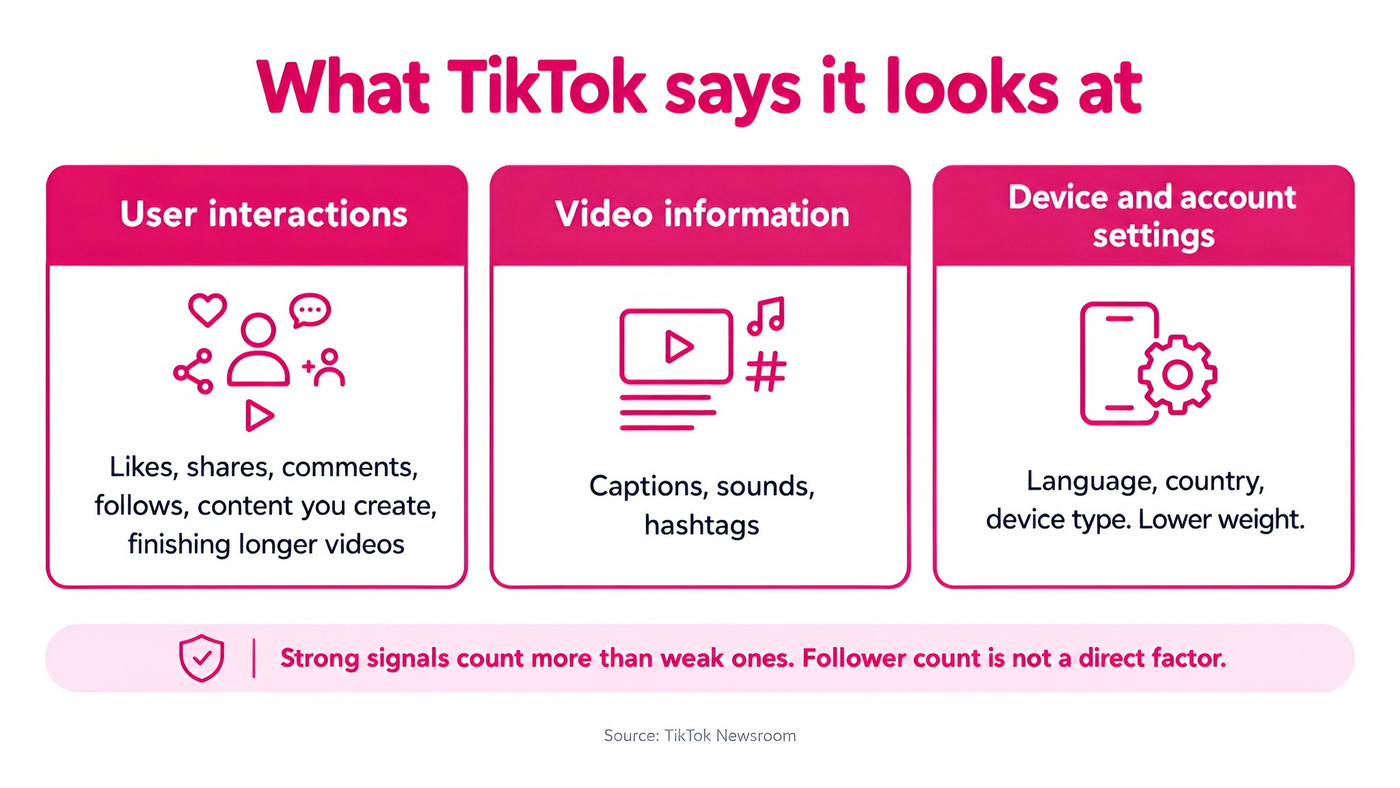
Two more official statements are worth remembering. Strong signals count for more than weak ones, and TikTok's own example is that finishing a longer video outweighs the viewer and creator sharing a country. And neither follower count nor a previous hit is a direct factor, although bigger accounts tend to get more views simply because more people see their posts. (Confirmed by TikTok, 2020.)
TikTok has never published numeric weights. Any article that gives you an exact "points" ranking of likes versus shares is guessing, and the better ones say so.
The feed keeps learning while you scroll
ByteDance researchers described the engine behind their recommendation products in the Monolith paper, which covers online training so the model can update from user feedback in real time. The paper describes ByteDance's commercial recommendation system, not TikTok's ranking weights, so it supports the idea of a fast-learning system but does not tell you how to rank. (Research paper, 2022.)
TikTok has also said it deliberately mixes in variety. The feed generally avoids showing two videos in a row with the same sound or from the same creator, and it works to avoid repeating content you have already seen. (Confirmed by TikTok, 2020 and 2023.) In its 2023 safeguards update, TikTok also said it replaces some runs of very similar sad or extreme-diet videos with other topics.
How a video is most likely distributed
Here is the honest answer on distribution: TikTok has not published how many people see a new video first, how big the next wave is, or what passes a threshold. What creators describe is a repeatable pattern, and it is a reasonable working model, so I show it with a clear label.
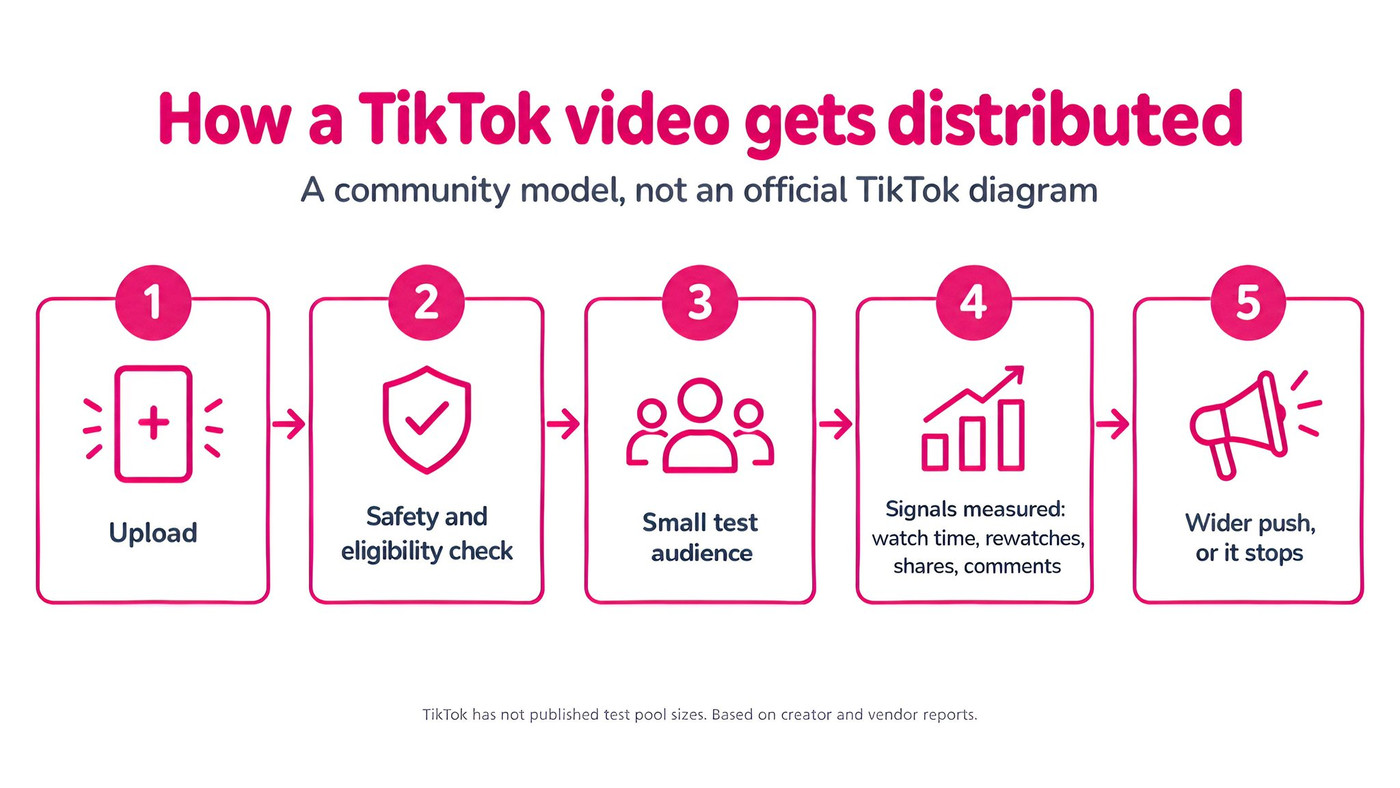
In this model a video passes a safety and eligibility check, goes to a small test group, and has its watch time, rewatches, shares and comments measured. Strong results earn a wider push and weak results stop. One creator in my sample puts the test group at 200 to 500 cold viewers, another says followers see it first. They disagree, TikTok has confirmed neither, and the official "follower count is not a direct factor" statement fits the first version better. (Creator claim.)
What changed in 2026, and what to watch in 2027
US ownership and the promise to retrain the algorithm
On Jan 23, 2026, TikTok announced the TikTok USDS Joint Venture. Oracle, Silver Lake and MGX are managing investors holding 15% each, and ByteDance retains 19.9%. TikTok said the joint venture "will retrain, test, and update the content recommendation algorithm on U.S. user data" and that the algorithm will be secured in Oracle's US cloud environment, with Oracle as Trusted Security Partner. (Confirmed by TikTok, Jan 23, 2026; read the announcement.)
What I could not find is a public statement that retraining is finished or a description of what changed in ranking. If you see a video claiming "the new US algorithm" works a specific way, ask for a TikTok source. Re-check the newsroom before acting on anything about this topic, because it is the single biggest unknown for US creators going into 2027.
The EU says the For You feed has a "rabbit hole" problem
On Nov 6, 2026, the European Commission issued preliminary findings that TikTok's For You feed breaches the Digital Services Act through a harmful "rabbit holes" effect, with users shown endless similar content, including about sadness, isolation or body image. Regulators said TikTok must change the algorithm and can face fines of up to 6% (under the DSA, a share of worldwide annual turnover) unless it fixes the problem. TikTok called the findings "fundamentally inaccurate". (Reported by Al Jazeera; preliminary, not a final decision.)
My expectation, and it is only that, is that variety and well-being controls will keep growing in 2027, and that what you can do in Europe may start to differ from what you can do elsewhere. For creators, the practical lesson is to avoid building a strategy on narrow, repetitive shock content.
AI labels, AI controls and more transparency
TikTok requires creators to label realistic-looking AI-generated content, auto-labels content made with its own AI effects, and also labels content from other platforms that carries C2PA Content Credentials. It prohibits AI content that misleads about real-world events, falsely shows public figures, or uses the likeness of anyone under 18 or of private adults without permission. (Confirmed by TikTok's transparency page.)
On Nov 19, 2025, TikTok said it had labeled over 1.3 billion videos, and that it would soon test an AI-generated content control inside Manage Topics so viewers can adjust how much AI content appears in For You. It also said it was testing invisible watermarking. (Confirmed by TikTok Newsroom; I could not confirm the control's current rollout, so check your own app.)
Smaller changes that affect reach
In July 2025, TikTok announced a US pilot of Footnotes, where users add context to videos, plus Content Check Lite, a tool that lets creators check whether a post is likely ineligible for the For You feed before publishing. (Confirmed by TikTok Newsroom, Jul 30, 2025.) That is the closest thing to an official answer to "why did my video stall", and it is worth using on anything borderline.
The Creator Rewards Program also matters if you want to be paid. As last described on Metricool's guide (updated Dec 24, 2025), it requires 10,000 followers, 100,000 views in 30 days, original content and videos longer than one minute, in supported regions. Check TikTok's own terms before you plan around it, because these rules change.
What the data says
Because TikTok will not publish its weights, the best evidence is large datasets. They all describe correlation, usually on brand accounts or on tool users, so I use them as direction rather than proof.
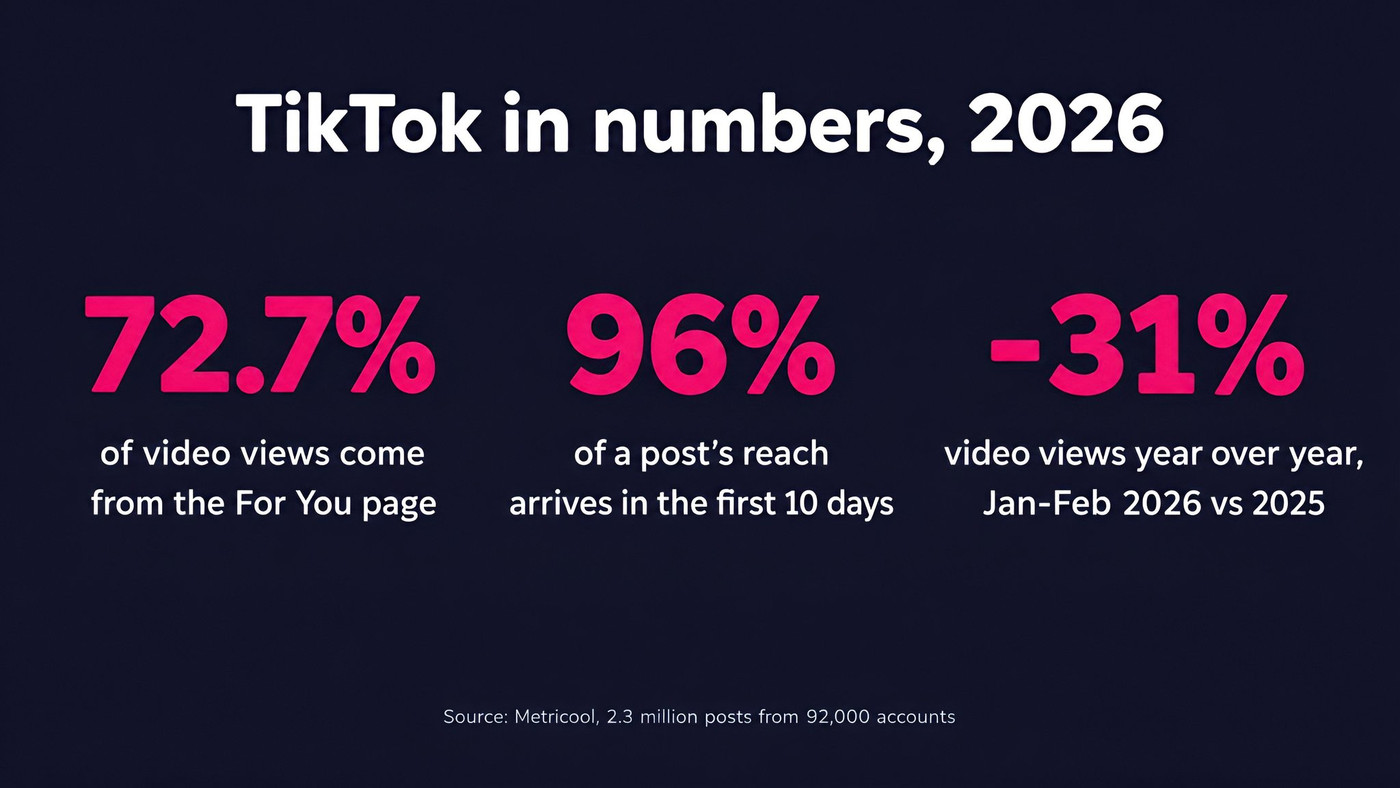
Metricool analyzed 2,314,756 posts from more than 92,000 accounts, comparing Jan-Feb 2025 with Jan-Feb 2026. Video views fell 31.30% and reach fell 28.73%, while video posting rose 72.10% and image and carousel posting rose almost 140%. The For You page drove 72.70% of video views, and 96% of a post's reach arrived within 10 days. (Dataset: Metricool, 2026; vendor study with its own account base.)
The same study found videos delivered about 5x the reach and 6x the interactions of images or carousels, hashtag-driven traffic up 114%, and posts that ask a real question earning 26.19% more comments. In plain terms: more people are posting, each post gets less, and a single post has a short window to prove itself.
Longer videos win more views, but that is not a reason to pad
Socialinsider's analysis of 8,021,416 TikTok videos from 145,546 accounts (Jan-Jun 2026) shows average views climbing sharply with length. Videos of 45-60 seconds averaged 3,300 views, while 60-90 seconds averaged 8,000 and 120-180 seconds averaged 12,000. (Dataset: Socialinsider, Aug 21, 2026; brand accounts.)
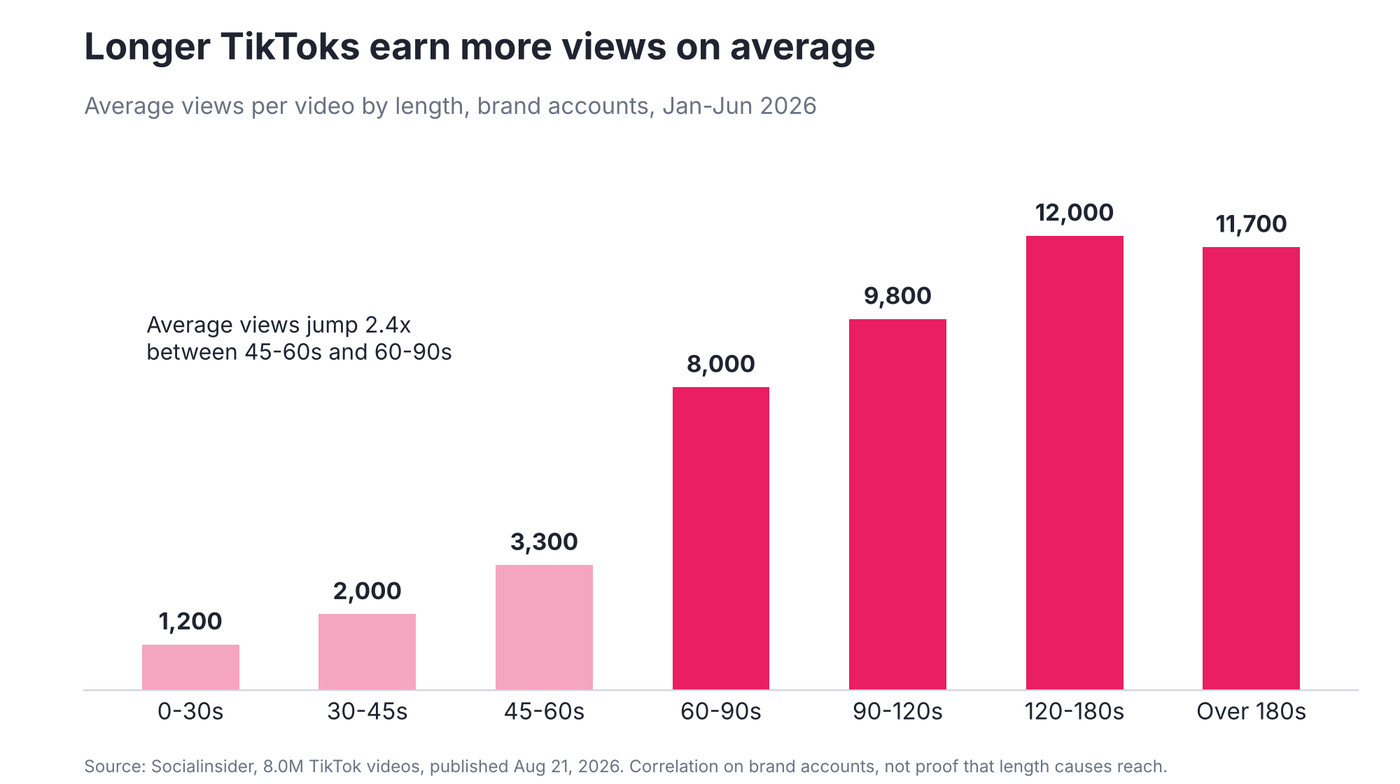
Do not read this as "TikTok favors long videos". Longer videos that hold attention can earn more total watch time, and the Creator Rewards one-minute rule pushes monetized creators toward longer formats. But engagement rate in the same data was highest for 0-30 second videos at 6.0%, so the right length is the one your idea needs to stay watchable. Cut the dead seconds first.
Best time to post: a weak signal, not a rule
Metricool found a strongest window of 6 p.m. to 9 p.m., peaking around 8 p.m. Buffer's study of more than 7.1 million posts (Sep 14, 2026) found its top slots were Sunday 9 a.m., Monday 1 p.m. and Sunday 1 p.m., and its authors say there is no universal best time and that other studies disagree. (Dataset: Buffer, 2026.) Use these as a starting test, then trust your own analytics.
TikTok algorithm myths versus evidence
Most myths survive because they are impossible to disprove from outside TikTok. The fairest way to treat them is to ask for a source. If there is none, label the claim as unconfirmed and do not build a strategy on it.
Claim | What the evidence shows | Verdict |
|---|---|---|
Followers decide your reach | TikTok says follower count is not a direct factor, though bigger audiences naturally see more posts. | Mostly false |
A new video goes to 200-500 people first | Repeated by creators; TikTok has not published test pool sizes. | Unconfirmed |
The "300 views" tier or a points system | No official source found. | Unsupported |
The first hour decides everything | Creators claim it, Metricool's data says 96% of reach comes within 10 days, and TikTok has published no one-hour rule. | Unconfirmed, and probably too narrow |
Hashtags are dead | TikTok lists hashtags as a video information signal, and Metricool found hashtag-driven traffic up 114%. Stuffing is still pointless. | False |
There is one best time to post | Studies disagree, and Buffer's own authors say there is no magic time. | Weak signal |
Shadowbans explain low views | A real mechanism exists: videos can be ineligible for the For You feed, and Content Check Lite lets you pre-check. "Shadowban" as a hidden punishment is not documented. | Mostly a mislabel |
AI-generated videos are suppressed | TikTok allows AI content but requires labels on realistic scenes and people, and bans misleading uses. | False as stated |
What four creator videos agree on, and where they split
I watched four 2026 creator videos in full and sorted their claims. None of them is TikTok, and two promote something (an agency and an affiliate tool), so I count their advice as practitioner opinion. Here is the sample.
Video | Main claims | How much to trust it |
|---|---|---|
Metricool, "TikTok Algorithm 2026: Explained by 2.3 Million Posts" (Jun 10, 2026) | About 70% of views come from For You, each post gets a roughly 10-day window, steady format beats posting volume, specific hashtags help, asking for likes backfires. | Vendor data, plausible, methodology partly in the press release |
Timote Chanut, "The New Rules of TikTok's Algorithm (2026)" (Oct 31, 2026) | Followers see a post first, completion needs to reach about 70%, recycle winners with three hooks, reply to comments in the first hour. | Agency pitch; the follower-first and 70% claims are unsourced |
dmscales, "The Entire TikTok Algorithm Explained in 120 Seconds" (May 3, 2026) | Cold test group of 200-500 people, waves 5 to 10 times larger, warm up a new account, post daily for two weeks then double down. | Creator model; thresholds are not official |
Robert Benjamin, "TikTok's NEW Algorithm Change Explained For July 2026" (Jul 7, 2026) | One post a day or fewer is fine, carousels of 4-6 slides, repost winners with a new cover and caption. | Promotes an affiliate tool; "new algorithm" is not confirmed by TikTok |
For the sample's most data-driven source, here is the Metricool video itself.
Where they agree
Three of the four stress a consistent niche or repeatable format, so TikTok can tell who should see you. Three also say search matters, with the topic keyword in the caption, on screen and spoken early in the video. Most agree on doubling down on what already worked and on watching completion and rewatch rather than raw views. These points line up with TikTok's own statement that finishing a video is a strong signal. (Creator consensus, partly consistent with official statements.)
Where they split
They split on who sees a video first (followers or a cold interest group), how often to post (3 to 5 times a week, daily for two weeks, one a day or fewer, or just a steady rhythm), and when to post (6-9 p.m. versus 3-6 p.m.). When four people in the same niche disagree on a number, the number is probably account-specific, not a rule. (Creator claims.)
TikTok, Instagram Reels and YouTube Shorts: same idea, different details
All three short-video feeds predict what each viewer will watch, so hook strength, completion and shares carry across platforms. Instagram's head Adam Mosseri said in Jan 2025 that the top three ranking signals are watch time, likes and sends, and that likes matter slightly more for connected content while sends matter slightly more for unconnected content. (Said by Instagram, reported by Social Media Today.)
I compare TikTok and YouTube in more detail in my guide to the YouTube Shorts algorithm, which covers how YouTube counts views and rewards original content. The short version: make one strong cut, then adapt the opening, caption and keywords for each platform instead of uploading an identical file everywhere.
How to diagnose a TikTok that stalled
Open the video's analytics and check these in order. Fixing the first problem you find usually matters more than anything further down the list.
What you see | Likely cause | What to try |
|---|---|---|
Very low views, almost no For You traffic | Possible eligibility problem, or the hook did not earn a test audience | Run Content Check Lite, review the community guidelines, then re-post a tighter version with a new opening |
Views stop early and the average watch time is short | Weak hook or slow start | Open on the payoff or the problem in the first seconds; cut any intro |
Good watch time but few shares or comments | Interesting, not discussable | Add a real question or a clear opinion people want to answer |
Views come mostly from followers | Content is not matching new viewers' interests | Put the topic keyword in caption, on-screen text and speech so TikTok can place it |
One hit, then flat results | No repeatable format | Make three variations of the winner with different hooks and compare completion |
Can you reset the TikTok algorithm?
Yes, partly. TikTok's Refresh your For You feed option returns your feed to something like what a brand-new user sees, and your new activity then rebuilds it. It does not change who you follow. (Confirmed by TikTok Newsroom, 2023.)
Open your profile: tap the profile icon, then the menu button.
Go to settings: choose Settings and privacy, then Content preferences.
Refresh: tap Refresh your For You feed and confirm. Menu wording can change by app version, and a refresh cannot be undone.
For lighter tuning, use Not interested, filter keywords or hashtags, and Manage Topics. These are gentler than a full refresh and work well when only one topic has gone wrong.
A 2027 plan that works with the algorithm
Pick one audience and one repeatable format. A consistent series makes it easier for TikTok to learn who should see you, and Metricool's data and three of four creators point the same way.
Win the opening. State the problem or payoff in the first seconds, with a visual that changes quickly. Watch time and finishing are the strongest signals TikTok names.
Write for search. Put the phrase your viewer would type in the caption, on-screen text and spoken line. This is a creator and vendor recommendation, not an official ranking rule, but it costs nothing.
Let the idea set the length. Use 60 seconds or more when the story needs it, especially if you want Creator Rewards, and stay short when it does not.
Ask a real question. Metricool found real questions earned about 26% more comments, and asking for likes correlated with fewer interactions.
Test three hooks on your best idea. Re-record or re-edit the same idea with different openings and compare completion, instead of judging by views alone.
Check eligibility and label AI. Run Content Check Lite on borderline posts, and label realistic AI-generated scenes or people.
Review weekly, not hourly. A post has about 10 days, so read results on that scale and double down on formats, not single videos.
Where Fliki fits
The algorithm rewards good ideas and strong openings, and the slow part for most creators is production. In Fliki's AI TikTok video generator you can turn a script into a vertical video with an AI voiceover, stock or AI visuals and auto captions, then edit each scene. If you need script ideas first, see my ChatGPT prompts for video scripts, and for the end-to-end process read how to make AI videos.
Use that speed carefully. Mass-producing near-identical clips is exactly what originality rules and the For You eligibility check are meant to filter, and TikTok's AI policy still applies. Spend the time you save on a sharper hook, a real point of view and variety. If you sell through TikTok Shop, see what AI can and cannot do for TikTok Shop video, and for monetization context read whether AI-generated videos can monetize.
What I expect for 2027, labeled as opinion
These are my expectations, not facts. I would expect more AI labeling and viewer controls, continued emphasis on original content, more visible variety and well-being changes pushed by regulators, and possible differences between regions if the US retraining is completed. I would also expect search-style discovery to keep growing, since multiple sources in this guide point that way. Re-check TikTok's newsroom each quarter, because the confirmed picture changes faster than articles do.
The bottom line
TikTok has told us the shape of the algorithm: it predicts interest, weights strong signals like finishing a video above weak ones, ignores follower count as a direct factor, and mixes in variety. It has not told us thresholds, test pool sizes or a posting schedule, and anyone selling those is selling a model. The practical plan for 2027 is simple: one audience, a fast opening, searchable wording, honest labeling and a steady review loop.
If you want to speed up the production side, you can try Fliki free and turn your next script into a captioned vertical video.
Written by Shivam Aggarwal, who works on content and marketing at Fliki, with research drawn from TikTok's own pages, public studies and four reviewed creator videos. Statistics, policies and creator terms were current as of November 2026. Verify TikTok's latest newsroom and Creator Rewards terms before you rely on them.
FAQs
Open your profile, tap the menu, choose Settings and privacy, then Content preferences, and tap Refresh your For You feed. TikTok says this returns your feed to something like a new user's experience, and your activity then rebuilds it. It does not change who you follow, and menu wording can vary by app version.
TikTok does not publish a schedule. It has said it makes frequent updates to its recommendation systems, and its core explanation of ranking signals has been stable since 2020. Be skeptical of any video announcing a new algorithm without citing a TikTok statement, and check the TikTok Newsroom for confirmed changes.
In January 2026, TikTok announced a US joint venture and said it will retrain, test and update the recommendation algorithm on US user data, secured in Oracle's US cloud, with ByteDance retaining 19.9%. TikTok has not published a completion date or details of what changed, so check the newsroom for updates.
Data shows longer videos earn more average views. Socialinsider found 60-90 second videos averaged 8,000 views versus 3,300 for 45-60 seconds, but this is brand-account correlation. TikTok names finishing a video as a strong signal, so the right length is whatever keeps viewers watching. The Creator Rewards program requires videos over one minute.
There is no universal best time. Metricool found 6 to 9 p.m. strongest, while Buffer's 7.1 million post study found Sunday 9 a.m. and Monday 1 p.m. on top, and its authors say no single time works for everyone. Use these as a first test, then compare with your own analytics.
TikTok has not said it suppresses AI content as such. It requires creators to label realistic AI-generated scenes or people, auto-labels content made with its own AI tools, and bans misleading uses such as fake real-world events or unauthorized likenesses. Mass-produced, unoriginal clips can still be ineligible for the For You feed.