Introduction
You post a Short and it gets 80 views. The next one gets 80,000. Nothing about your process changed, which is exactly why the YouTube Shorts algorithm feels like a black box, and why so many guides fill the gap with confident numbers that YouTube has never published.
Here is the short answer. The YouTube Shorts algorithm is a per-viewer recommendation system. It shows each Short to a small group of likely viewers, reads whether they watched or swiped away, and widens or narrows reach based on that response. YouTube does not publish ranking weights, test-batch sizes or viewed-percentage thresholds, and in 2026 it added an explicit push toward original content.
This guide separates three things that most articles blur together: what YouTube has actually said, what creators observe in their own channels, and what is folklore. You will also get a dated timeline of every rule change from 2024 to February 2027, a myths-versus-evidence table, a Studio diagnosis checklist, and a plan for 2027 that works with the system instead of against it.
How I researched this, and how to read the evidence labels
For this guide I went to the primary sources first: YouTube Help pages, the YouTube blog, and YouTube's own Creator Insider channel. I then watched 10+ videos, including interviews with YouTube's Shorts product lead and its head of growth and discovery, plus analysis from vidIQ, DecodingYT and others. I also read the top-ranking guides on this topic and noted where their numbers had no source.
Throughout the article, claims carry one of four labels so you can judge how much weight to give them:
Confirmed by YouTube: stated on an official YouTube page, with a date.
Said by YouTube staff: stated by a YouTube employee in an interview or video. Credible, but not documentation.
Creator observation: what a creator or analyst saw in their own data. Useful, but often a small sample.
Unsupported: repeated widely, with no traceable source.
How the YouTube Shorts algorithm actually works
It is a feed built for each viewer, not a leaderboard of videos
Todd Beaupre, YouTube's senior director of growth and discovery, described the core design in a Creator Insider conversation published on Sep 1, 2026. Recommendations are pulled for each viewer when they open the app, rather than pushed out video by video. YouTube generates a pool of candidate videos, then ranks them for that specific person using signals such as watch history, time of day and device. (Said by YouTube staff.)
Two practical consequences follow. First, a slow start with subscribers does not doom a video, because the system learns separately for subscribers, non-subscribers and new viewers. Second, a brand-new channel with no viewer history gets matched on topic and content understanding, and if nobody responds, impressions stop. There is no hidden quality score you can see, only viewer response.
The seed audience loop
The clearest description of how a single Short travels comes from Todd Sherman, who was YouTube's product lead for Shorts when he explained it in Aug 2023: the audience is the algorithm. YouTube finds a set of people who may enjoy your Short, and your reach grows or tapers depending on how that group responds. (Said by YouTube staff.)
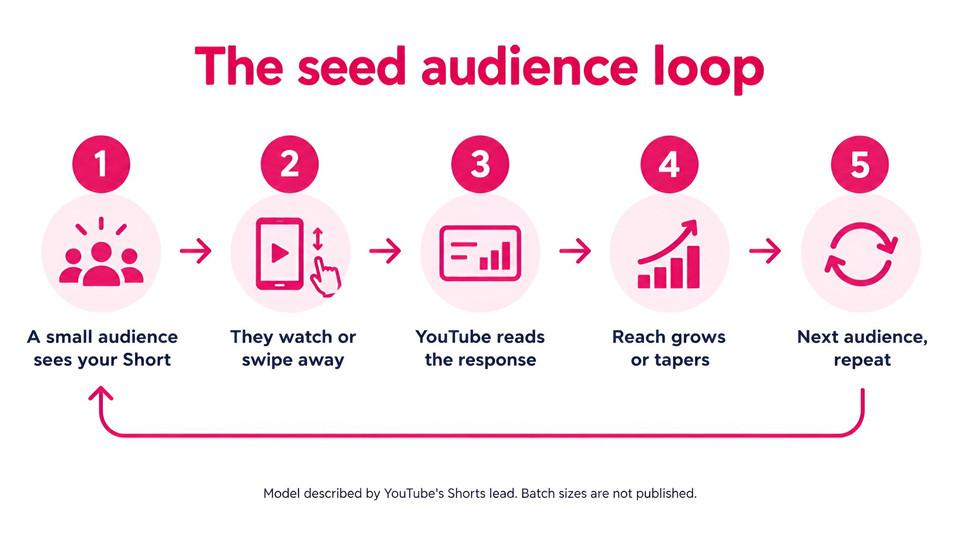
A second Creator Insider interview, with creator Jenny Hoyos in Dec 2024, adds that distribution tends to expand in waves while each new audience responds well, and stops when the response drops. The model is easy to remember, but note its limits. The size of the first audience, the response needed to expand, and the number of rounds are not published. Vendor guides that quote batch sizes of 300 or 1,000 views, or a fixed "viewed percentage" you must clear, cite no YouTube source.
What YouTube says the Shorts feed listens to
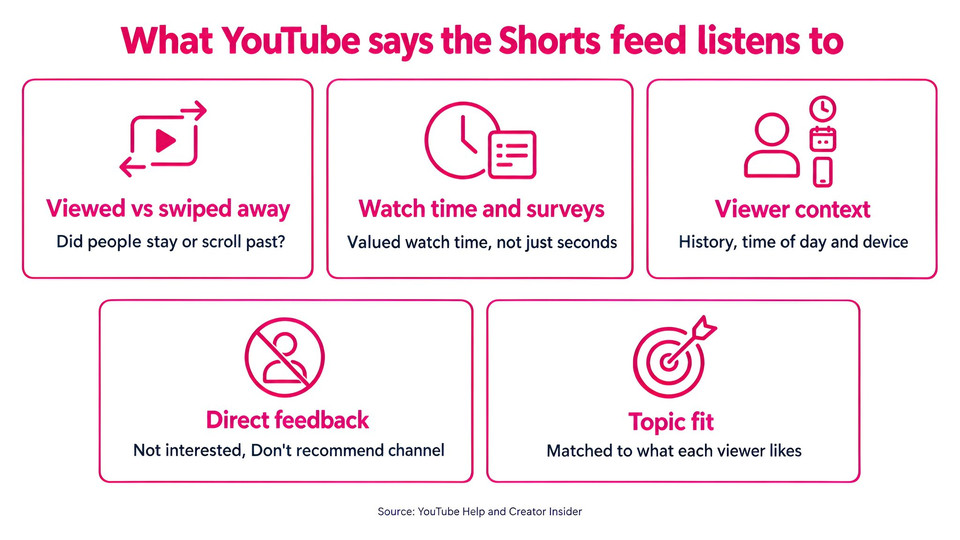
Viewed versus swiped away. YouTube Help defines "Shown in feed" as the number of times your Short appeared in the Shorts feed, and "How many chose to view" as the percentage of times viewers viewed your Short versus swiped away. (Confirmed by YouTube, as a metric.) Sherman called viewed versus swiped away a great metric. YouTube has not said this exact number is the ranking signal, but it is the clearest report of the choice the feed asks every viewer to make.
Watch time and satisfaction. Sherman said watch time is a proxy for what viewers value, and that the system goes beyond it with "valued watch time" estimated from surveys. Beaupre said no single metric works: clicks, absolute and relative watch time, likes, comments and survey responses are all used, and the weights vary by viewer and device. Sherman also said recommendations try to normalize for duration, so a 15-second Short is not automatically beaten by a 60-second one. (Said by YouTube staff.)
Context and recency. YouTube's Help page on how recommendations work says the Shorts feed, with its snackable and trendy nature, may tune up on the recency of content. It also lists things that do not count against you: experimenting with formats, uploading as unlisted before going public, and the fact that one weak video does not penalize your channel. (Confirmed by YouTube.)
Direct feedback. On Jun 25, 2026 YouTube retired the dislike button and said it would rely on the more precise "Not interested" and "Don't recommend this channel" controls. A Creator Insider update on Jul 3, 2026 explained that the overlap confused viewers and made the signal ambiguous. In practice, those two controls are now the strongest negative signals a viewer can send. (Confirmed by YouTube.)
Shorts and long-form run on separate systems
In a May 2025 post debunking Shorts myths, YouTube said it has built separate recommendation systems for each format and has not seen evidence of Shorts hurting long-form performance. It added that Shorts can drive traffic to long-form videos. (Confirmed by YouTube.) Beaupre made the same point in 2026: mixing Shorts and long-form on one channel is fine, and the system learns which format and topic each viewer wants. What YouTube has not published is any conversion rate from Shorts viewers to long-form viewers or subscribers, so be skeptical of any guide that gives one.
What changed in 2026, and what arrives in 2027
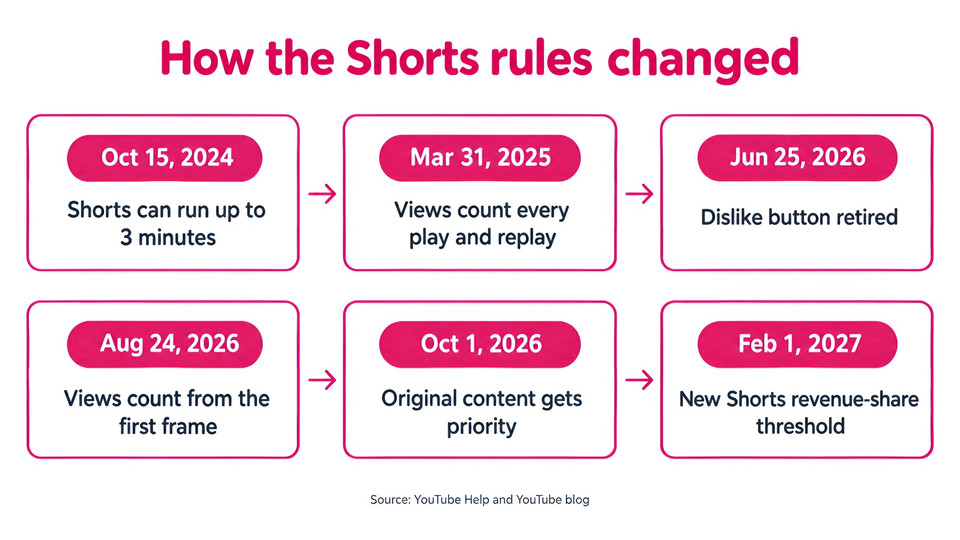
The biggest shifts for Shorts creators landed in the last 14 months. Here is the dated timeline, then the detail on the three that matter most.
Views now count from the first frame (Aug 24, 2026)
Shorts views already worked differently. From Mar 31, 2025, a Short's view counted every time it started to play or replayed, with no minimum watch time, and the older method was renamed "engaged views". On Aug 19, 2026, YouTube announced on its blog that from Aug 24, 2026 the same first-frame definition applies across every format, and that an engaged view means clicking to watch or watching past the initial seconds. (Confirmed by YouTube.)
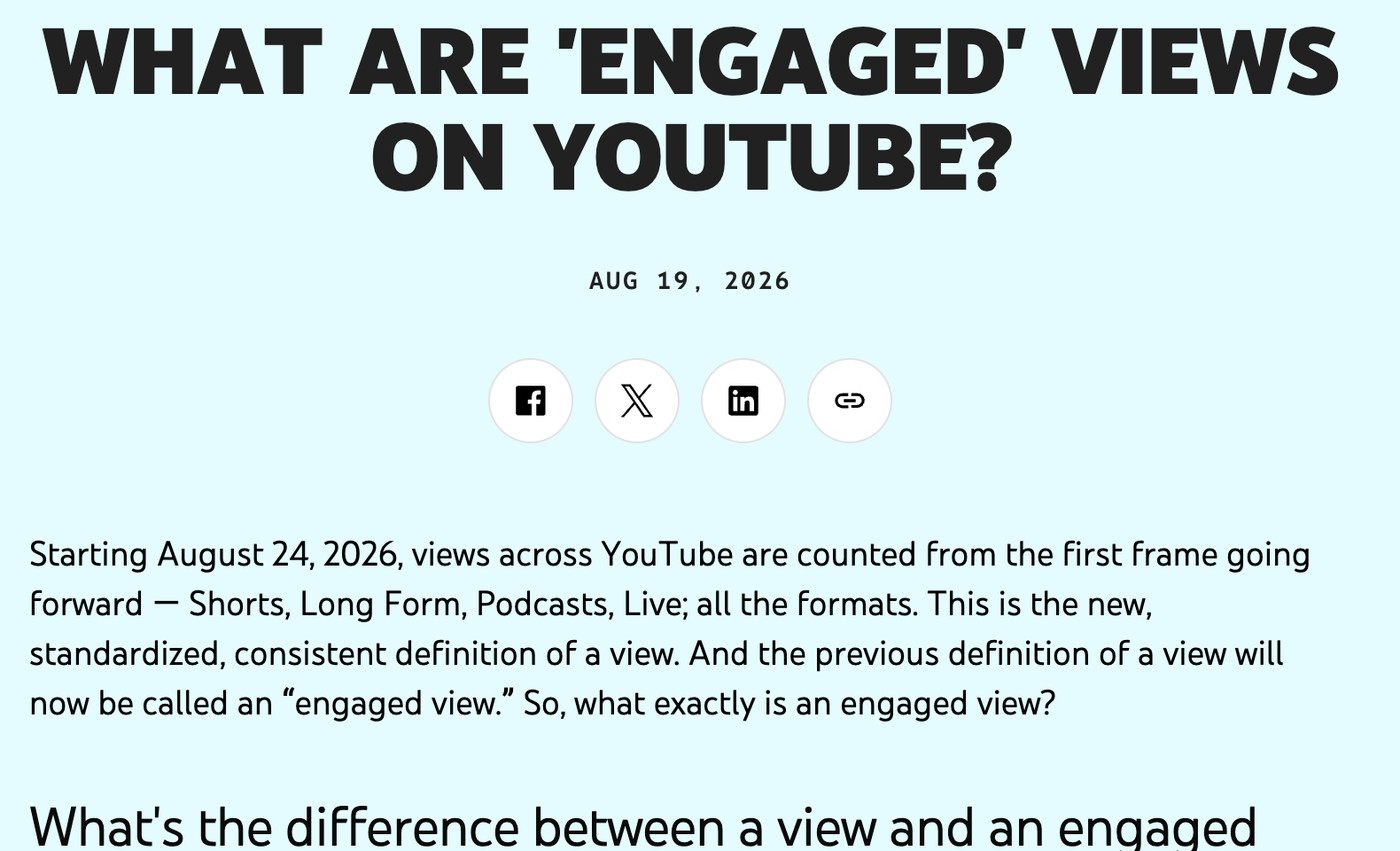
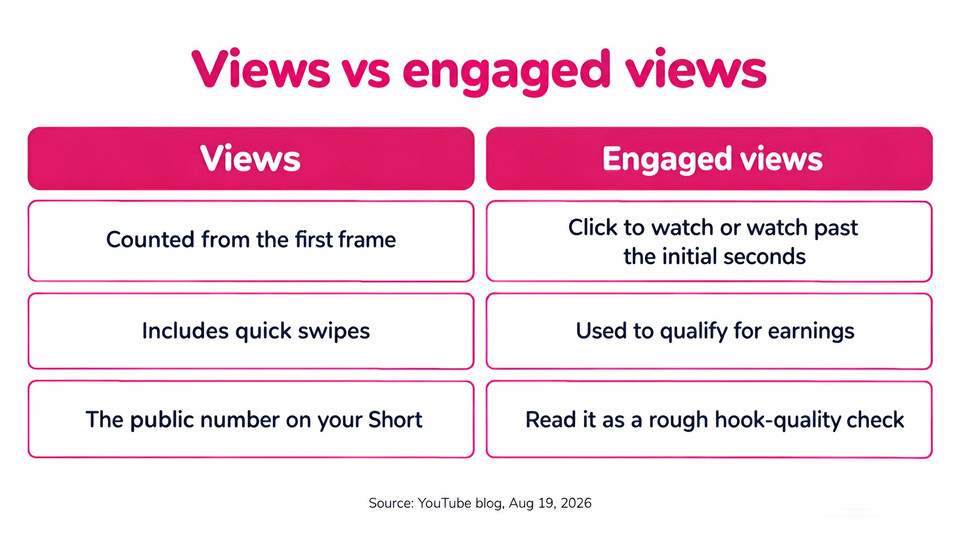
The same announcement says there is no change to recommendations, so this is a counting change and not an algorithm change. It does change what you read in Studio. Earnings and Partner Program qualification are tied to engaged views, so the public number can flatter you. vidIQ shared one channel's 2025 numbers as an illustration: about 40 million public Shorts views against 26 million engaged views. That is a single channel, not a benchmark, but it shows why the gap between the two numbers is worth watching. (Creator observation.)
Original content gets priority (Oct 1, 2026)
YouTube's TeamYouTube community team published "Prioritizing original content on Shorts" on Oct 1, 2026. As reported by trade coverage and summarized by vidIQ, YouTube is updating its recommendation systems to further prioritize original content and reduce the reach of re-uploaded content, and channels that mainly aggregate or re-upload other creators' videos without significant changes are likely to see less distribution. I could read the post's title and date on YouTube's site but not its full body, so treat the finer details as unconfirmed. There is no published threshold, lookback window or start date.
This sits on top of earlier rules. In July 2025 YouTube renamed "repetitious" content to "inauthentic" in the Partner Program guidelines. The spam policy targets using automated tools or AI to churn out high volumes of similar content with minimal changes, and asks creators to disclose AI-generated or meaningfully altered content. YouTube has also said AI use is not by itself disqualifying. The line is whether you add something of your own. Clipping your own long-form videos and fan channels with permission are the grey areas creators debate most, and creators have reported mistakes in automated enforcement, so keep your own records of source material and permissions. (Confirmed by YouTube for the policy wording; creator observation for how enforcement feels in practice.)
The Feb 1, 2027 Shorts revenue threshold
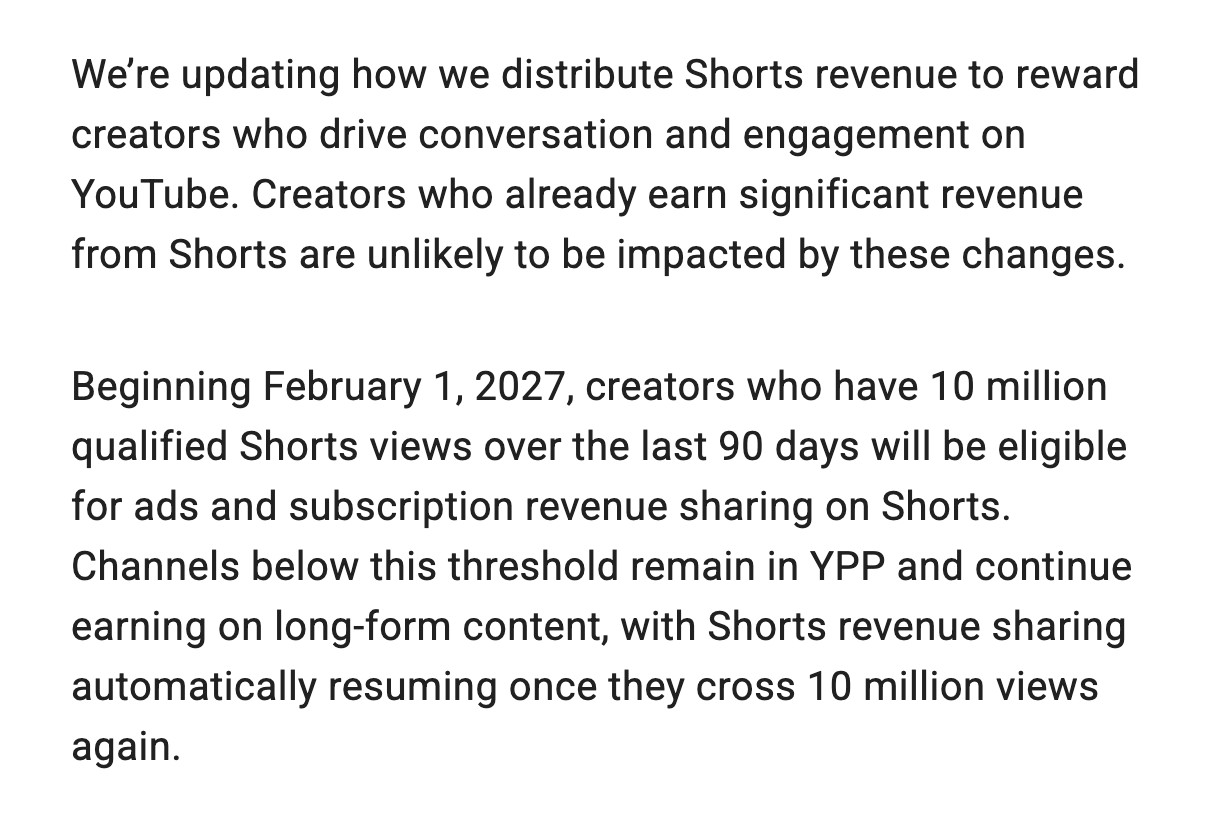
This one is about money, not reach, and it is easy to confuse the two. In its Aug 10, 2026 Partner Program update, YouTube said that beginning Feb 1, 2027, creators with 10 million qualified Shorts views over the last 90 days will be eligible for ads and subscription revenue sharing on Shorts. Channels below that threshold remain in the Partner Program and keep earning on long-form content, and Shorts revenue sharing resumes automatically once they cross 10 million again. New creators applying will need either 8,000 qualified watch hours in the last 365 days or 20 million qualified Shorts views in the last 90 days, and YouTube said the update does not affect creators already in the program. (Confirmed by YouTube.)
A separate YouTube article says qualified Shorts views must come from public Shorts and be engaged views. The Help page on recommendations also says the system does not prioritize videos based on whether they are monetized, so the threshold changes who gets paid, not who gets recommended. For the full requirements, see our guide to the new YouTube monetization requirements, and check YouTube's own page before you plan around any number.
Smaller changes worth knowing
Shorts can now run up to three minutes if uploaded on or after Oct 15, 2024, and YouTube's Help page says nothing about length affecting ranking. In 2026 YouTube also added AI remix tools to Shorts, including Reimagine in March and Gemini Omni remixing in May, with watermarks, metadata and a link back to the original. Creators can opt out of visual remixing. These tools make original, recognizable work more valuable, because remixes link back to the source.
Shorts algorithm myths versus evidence
Here are the claims you will see most often, checked against what YouTube and its staff have actually said. "Unsupported" does not mean false. It means nobody has shown a source.
Claim | Verdict | What the evidence says |
|---|---|---|
The first 3 seconds decide everything | Creator observation | YouTube's metric is viewed versus swiped away, with no seconds figure. Hoyos says the hook is close to the first frame, DecodingYT says 2 to 3 seconds. Both are creator views. |
There is a best time to post | Unsupported | Sherman said posting time is not something YouTube thinks about optimizing for (2023). Freshness matters mostly for news-style content. |
Hashtags boost reach | Unsupported for ranking | Sherman said hashtags are not required. Treat them as a small label, not a growth lever. See our Shorts hashtags guide for the rules. |
You need a 70% viewed percentage | Unsupported | No YouTube source. Vendor guides repeat the number without citing it. |
Loops boost ranking | Creator observation | YouTube staff said they do not optimize for two loops. Rewatching may still reflect interest. |
Every Short gets a fixed test batch of 300 to 1,000 views | Unsupported as a number | The seed-audience principle is confirmed by staff, but sizes and thresholds are not published. |
You must post daily | Unsupported | Sherman said there is no systems threshold for posting a set number of Shorts per day, and fewer, better videos beat many weak ones. |
Deleting and reposting a flop resets it | Warned against | Sherman said it risks being seen as spam in YouTube's systems. |
A shadowban is suppressing your channel | Unsupported | Help says one underperforming video does not penalize a channel. Repeatedly skipped recommendations can hurt long-term performance. |
Shorts hurt your long-form videos | Contradicted | YouTube said in May 2025 it has not seen evidence of this. |
Shorter Shorts always win, or longer always win | Unsupported | Staff said recommendations normalize for duration. A 2023 study shared by Marcus Jones found longer averages performed better, but that is correlation from older data. |
If you want the diagnosis for a specific stall, our guide on why Shorts suddenly stop getting views goes deeper on the symptoms.
What 11 creator and insider videos agree on, and where they split
The videos I used span YouTube's own channel, an ex-YouTube partner manager, and analysts. Here is what each adds.
Video | Who | What it adds |
|---|---|---|
YouTube Shorts Algorithm, Explained (Aug 2023) | Todd Sherman, YouTube | Audience is the algorithm, seed audience, no best time to post, do not repost. |
A deep conversation about Shorts (Dec 2024) | Hoyos and Sherman | Valued watch time, duration normalization, hook as the first frame. |
The YouTube Algorithms in 2025 (Jan 2025) | Todd Beaupre, YouTube | Per-viewer recommendations, no single metric, survey data. |
YouTube Algorithm 2026 (Sep 2026) | Todd Beaupre, YouTube | Separate learning for subscribers and new viewers, mixing formats is fine. |
Big Shorts Update (Jul 2026) | Rene Ritchie, YouTube | Dislike retired, "Not interested" and "Don't recommend" stay. |
What Counts as a View (Aug 2026) | vidIQ | First-frame views, engaged views, single-channel numbers. |
YouTube Literally Just Changed the Algorithm (Oct 2026) | vidIQ | Original-content priority and what counts as real added value. |
How to Escape Every Shorts View Jail (Oct 2026) | vidIQ | Case studies on changing topic or format when views stall. |
How to Make Viral Shorts in 2026 (Aug 2026) | DecodingYT | Swipe-away and average percentage viewed as targets, ten hook formats. |
Ex-YouTube Employee Explains the Algorithm (Jun 2026) | Gimbal Podcast | Distribution in waves, check new versus returning viewers. Mostly long-form. |
I Studied 5,500 Shorts (Jun 2023) | Marcus Jones, on a study by Paddy Galloway | Older, secondhand data on duration and swipe rates. Use with care. |
Where they agree
Almost every source points to the same core ideas. The opening decides whether someone stays, and viewed versus swiped away is the clearest way to see it. Satisfaction beats any single raw metric. Reach expands in waves while each audience responds well. Original, transformative work is rewarded. And you should judge each Short against your own similar Shorts, not against another channel. Beaupre's advice is to compare against your own videos of similar length and read the retention graph, then listen to the audience.
Where they split
Length is the clearest disagreement. Sherman says there is no ideal length and the system normalizes for duration, while the older Galloway-based data favors longer Shorts and vidIQ's example of a 15-second Short shows one extra second costing views. Loops are a second split: DecodingYT suggests aiming for an average percentage viewed near or above 100 percent through rewatching, while YouTube staff say they do not optimize for two loops. Likes and comments are a third. Hoyos reported no real correlation between them and views across her channel, while Sherman said all signals feed the models and likes and shares are simply sparser than watch signals. Last, vidIQ says to end Shorts with no sign-off at all, but I found no official statement either way, so test it yourself.
One caution on the "view jail" idea. Creators describe fixed plateaus at 1,000, 10,000 or 30,000 views, and the vidIQ case studies behind it cover two or three channels each. YouTube has not confirmed numeric thresholds. The useful part of the idea is the fix: when a channel stalls at a similar number across several Shorts, change the topic or format instead of posting more of the same.
What YouTube does not publish
It helps to know what is missing, because that is where fake precision creeps in. YouTube has not published the weights of its ranking signals, the size of a Short's first audience, the response needed to expand reach, a viewed-percentage cutoff, or the numeric thresholds behind view jail. It has not published a conversion rate from Shorts to long-form views or subscribers either. Any guide that states these as facts is describing inference or one dataset, and the honest version says so.
How to diagnose a Short in YouTube Studio
You do not need the exact formula to improve. You need a repeatable way to read the signals YouTube does show you.
Open your Shorts analytics. Check "Shown in feed" and "How many chose to view" for each Short.
Compare against yourself. Line up each Short with your own Shorts of similar length and topic, as Beaupre recommends, instead of against other channels.
Read the retention graph. A steep drop at the start points to the hook. A drop in the middle points to a slow section.
Change one thing. Test a new opening, or a tighter middle, or a different topic, not all three at once.
Test with enough Shorts. One Short proves nothing. As my own rule of thumb, wait for several Shorts per variant before you trust a difference. A small test of five Shorts per group is a starting point only, as we noted in our guide on getting more views on Shorts.
What you see in Studio | Likely meaning | What to try |
|---|---|---|
Lower "chose to view" than your other Shorts | The opening is not earning the stay | Rewrite the first frame and first line, and test one new hook. |
Good start, then a drop in retention mid-Short | A slow or repetitive middle | Cut the weakest section and add a visual change. |
Several Shorts stall at a similar view count | You may have hit the ceiling of your topic or format | Change the topic or format, not the volume. |
Large gap between views and engaged views | Many people bounce right away (vidIQ's reading, not YouTube's) | Treat it as a rough hook-quality hint and compare across Shorts. |
Near-zero views across many similar uploads | Possible originality or spam risk | Make fewer Shorts with a clearly different angle each time. |
The "What you see" and "What to try" columns are my reading of the evidence above, and the middle column is interpretation, not an official YouTube explanation.
Can you reset the YouTube Shorts algorithm?
This is one of the most searched questions about the topic, and it has two answers depending on who is asking. As a viewer, YouTube Help says you can tune your feed. Use "Not interested" on a Short, use "Don't recommend this channel", delete or pause your watch history so it stops shaping recommendations, and use the Shorts feed limit if you want less of the format. Your Google Account activity can also influence recommendations, and you can manage it from your account's activity page. Since the dislike button was retired in June 2026, the first two are the main negative controls.
As a creator, there is no reset button for your channel, and no sign that one is needed. YouTube says a weak video does not penalize a channel overall. Deleting and reposting is the one move YouTube staff have specifically warned about.
A 2027 plan that works with the algorithm
Make originality your default. With the Oct 1, 2026 change, re-uploads and lightly edited aggregation are the highest-risk strategy. Add commentary, a point of view, or your own footage, and keep records of permissions for anything you reuse.
Decide whether the money threshold matters to you. If you plan to earn from Shorts ads from Feb 1, 2027, track qualified Shorts views, which means public Shorts and engaged views, across a rolling 90 days. If you do not, optimize for audience and long-form support first.
Fix the first frame before anything else. Every credible source agrees the opening decides who stays. Write three alternative openings for each idea and test them across separate Shorts.
Mix formats on purpose. YouTube says mixing Shorts and long-form is fine. Use Shorts to introduce a topic and long-form to go deeper, without expecting a guaranteed funnel.
Build a workflow that increases variety, not volume. Quality and iteration beat hitting a daily count.
That last step is where a tool like Fliki can help, and where it can hurt you if it is misused. You can turn a script into a vertical Short with an AI voiceover and word-by-word captions in minutes, and the AI YouTube Shorts generator speeds up the repetitive parts. YouTube has said AI use is not itself disqualifying, but templated, high-volume output with minimal changes is what its spam and inauthentic content rules target. So spend the time you save on the parts viewers feel: a sharper hook, a real point of view, and a different angle every time. Our guides on YouTube AI demonetization and whether AI-generated videos get monetized cover the policy risk in more detail, and our viral Shorts strategy guide covers the creative side.
The bottom line
The YouTube Shorts algorithm in 2027 is less mysterious than the guides suggest and less precise than the hacks claim. YouTube shows each Short to a small group, reads viewed versus swiped away along with satisfaction signals, and widens or narrows reach per viewer. It has stated that original content gets priority, that views now count from the first frame, and that Shorts revenue sharing changes on Feb 1, 2027. It has not published thresholds, batch sizes or best posting times, so treat anyone who quotes them as guessing. Make original Shorts, fix the opening, read your own Studio data, and test one change at a time. If you want a faster way to produce scripted, captioned Shorts, you can try Fliki free.
Written by Shivam Aggarwal, who works on content and marketing at Fliki, with research drawn from YouTube's own pages and 11 creator and insider videos. Policy details and dates were current as of November 2026. Check YouTube's own pages before you rely on thresholds or deadlines.
FAQs
It shows each Short to a small group of likely viewers, reads whether they watched or swiped away along with satisfaction signals, and widens or narrows reach based on that response. YouTube has not published the weights, batch sizes or thresholds.
YouTube's Shorts lead said in 2023 that posting time is not something the system is optimized around. Freshness matters mostly for news-style content, so test your own schedule instead of trusting a universal rule.
As a viewer, use Not interested, Don't recommend this channel, and manage or pause your watch history. As a creator there is no reset button, and YouTube says one weak video does not penalize your channel.
Since Mar 2025 a Shorts view counts when the Short starts or replays. YouTube extended first-frame counting to all formats from Aug 24, 2026. An engaged view requires watching past the initial seconds, and monetization is tied to engaged views.
From Feb 1, 2027, YouTube says creators need 10 million qualified Shorts views in the last 90 days to share in Shorts ad and subscription revenue. Channels below that stay in the Partner Program and keep long-form earnings.
YouTube says AI use is not disqualifying by itself, but mass-produced, templated content with minimal changes falls under its spam and inauthentic content rules. Since Oct 1, 2026 original content is prioritized and re-uploads are likely to see less reach.