
Introduction
You have probably felt it already. You sit down to make one video, type "best ai video generator" into Google, and twenty minutes later you have fourteen tabs open and somehow less clarity than when you started. HeyGen, Synthesia, and Fliki keep showing up at the top of every list, every review, every comparison thread. They all promise studio-quality video without a camera, a studio, or a voice actor. So which one actually deserves your money and your attention?
Here is the honest answer up front: none of these tools is "the best." They are built for three different kinds of people. Pick the wrong one and you will spend months fighting a tool that was never designed for your job. Pick the right one and the work that used to take a week starts taking an afternoon. This guide cuts through the marketing and shows you exactly who each tool is for, where each one quietly falls short, and how to choose based on the videos you actually need to make.
The 30-second verdict
If you are short on time, here is the shape of it.
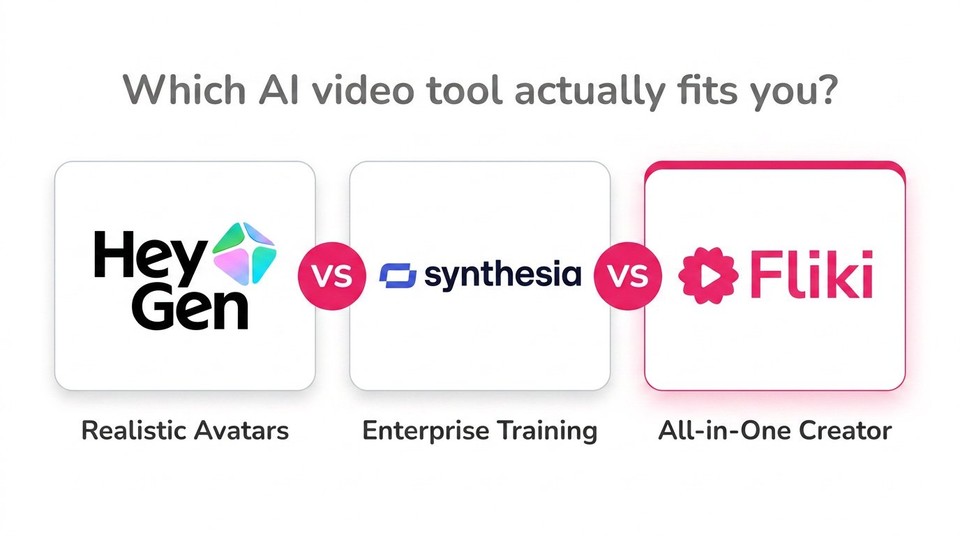
Choose HeyGen if your priority is a hyper-realistic talking avatar, especially for sales outreach, product demos, and personalized video at scale. Choose Synthesia if you run corporate training, onboarding, or compliance content inside a large organization and need things like LMS export and enterprise security. Choose Fliki if you are a creator, marketer, or small team who wants to turn scripts, blog posts, and ideas into finished videos and voiceovers fast, without learning a complicated editor, and without paying enterprise prices.
The rest of this article explains why, with the trade-offs nobody puts in their pricing page.
Start here: why the star ratings contradict each other
Before a single feature, you need one piece of context that reframes everything: these tools earn wildly different ratings depending on where you look, and that gap is the most useful signal in the entire comparison.
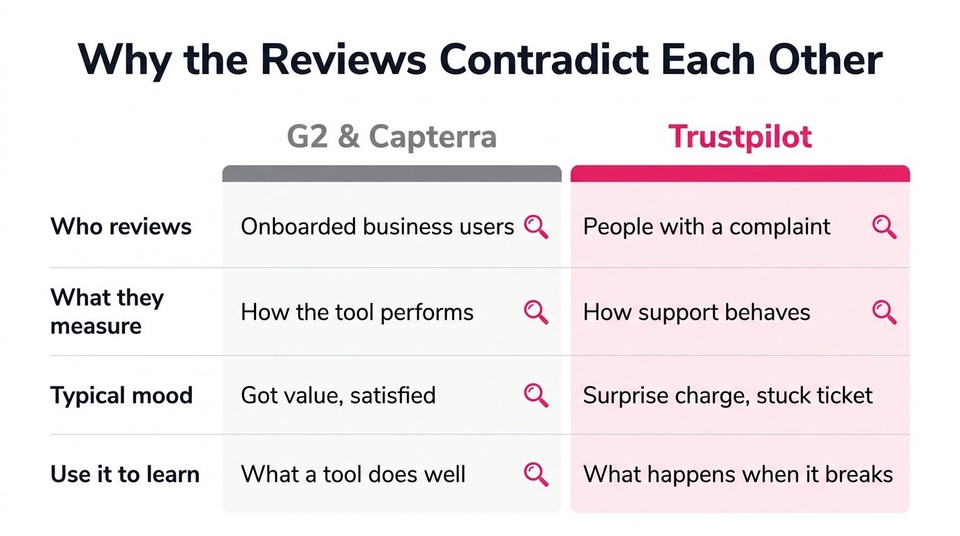
Take HeyGen. On G2 it sits around 4.8 out of 5 across roughly 1,500 reviews. On Trustpilot it sits closer to 2.4 out of 5 across a comparable number. Same product, opposite verdicts. Synthesia shows a milder version of the same split, strong on G2 (around 4.6 from more than 2,500 reviews) and noticeably rockier on Trustpilot.
This is not random, and it is not one site lying. G2 and Capterra skew toward business users who were onboarded properly, got value, and reviewed the product as a tool. Trustpilot skews toward people who arrived specifically to vent about a surprise charge, a cancellation, or a stuck support ticket. They are measuring different moments in the customer lifecycle. The practical move: read G2 and Capterra to learn what a tool does well, and read Trustpilot to learn how it behaves when something goes wrong. Do both before you put a card down. Now, with that lens, here is each tool.
HeyGen: the avatar realism leader with a credit-system problem
HeyGen earns its reputation. It was named G2's fastest-growing product of 2025, and across review sites the praise is strikingly consistent: the avatars and lip-sync are the best most users have ever seen. Reviewers describe logging in with nothing but a script and walking away with a polished talking-head video, no camera, no studio, no editing skills required. For cold sales outreach, product demos, and personalized video at scale, that realism is the entire pitch, and it delivers.
Then you read the one-star reviews, and a clear pattern emerges. It is almost never about output quality. It is about money and trust.
The dominant complaint is the credit system. HeyGen advertises "unlimited" video on paid plans, but the most realistic features are metered in premium credits, and those drain fast. The newest avatar tier consumes roughly 20 credits per minute, so an entry plan's monthly allotment works out to about ten minutes of premium footage. Users report failed renders that still burn credits, and on team plans all seats share a single credit pool, which means adding people does not add capacity. A recurring Trustpilot theme is buyers on annual plans seeing "unlimited" translation minutes quietly capped, with support slow to make it right.
To its credit, HeyGen publicly owned the confusion in early 2026, admitting that even its own testing found the credit and feature system hard to understand, then rolling out clearer labels and pre-generation cost estimates. That is the right response. But if you are choosing today, go in expecting to budget credits carefully and to test the support experience before you commit to a year.
Best for: creators and sales teams whose product is a realistic on-camera presenter, and who will watch credit usage closely.
Synthesia: the enterprise training engine with a moderation catch
Synthesia is the most corporate of the three, and in its world that is a compliment. It recently raised funding at a roughly four-billion-dollar valuation, and its user base is overwhelmingly learning-and-development teams producing training, onboarding, and internal communications at scale. The single most repeated word in its reviews is speed. Instructional designers describe cutting production from days to hours, in some cases generating videos around 90 percent faster than their old workflow.
Reviewers also single out two things rivals struggle to match. First, support and education: the Synthesia Academy, live sessions, and responsive chat get sincere praise, and this is where Synthesia consistently beats both Fliki and HeyGen in head-to-head review data. Second, the newest avatar generation is realistic enough that viewers reportedly ask whether the presenter is a real person. For executive communications and polished courseware, that credibility matters.
The complaints cluster just as tightly. The number-one frustration surfaced on Reddit is content moderation. Because Synthesia's avatars are built on real actors' likenesses, the platform screens content aggressively, and users report ordinary business material, and especially medical or scientific content, getting flagged or blocked with no clear reason and a slow, opaque appeals process. The second complaint is the limit hiding behind the price: plans are capped by annual video minutes, and the entry tier's roughly ten minutes a month evaporates when each training video runs three to five minutes. The third is customization. On lower tiers, control over avatar gestures, outfits, and expressiveness is restricted, and a true custom "digital twin" avatar is a paid add-on that has historically cost around a thousand dollars a year and can take several days to process.
Best for: mid-size and enterprise L&D teams that need consistent, multilingual, LMS-ready training and can work within Synthesia's content rules.
Fliki: the all-in-one content engine with honest trade-offs
Fliki is built for a different person entirely: the creator or lean marketing team shipping content constantly, who does not want a talking-head avatar to be the center of every video. It is the only one of the three that is genuinely a text-to-video and text-to-speech platform in one place, and that shapes how the whole thing feels to use.
This is where reviews tilt in Fliki's favor in a specific way. With a Capterra rating around 4.7, users repeatedly praise how accurately it turns a prompt or a blog URL into a watchable video, automatically pulling relevant stock footage and music so you are not assembling a clip from scratch. The workflows people mention loving are exactly the ones the avatar-first tools do not have: paste a blog post, type an idea, or drop in a slide deck and get a usable draft back. For faceless YouTube, social media, and voiceover-led content, that pipeline is the draw, and the free tier is generous enough to truly test it.
Now the honest part, because pretending Fliki is flawless would insult your intelligence, and the review sites would call the bluff anyway. The most common criticism is that even the ultra-realistic voices can sound slightly artificial on certain lines, and that the stock media library can feel thin for some niches. Like both rivals, Fliki runs on credits, and reviewers note that credits get spent while you iterate and preview, not only on final export, so heavy trial-and-error eats into your allowance. A few users have also reported slow support replies. None of this is unique to Fliki, every tool here draws the same categories of complaint, but you deserve to know it going in. The practical fix is to tighten your script before generating and to audition voices on the free plan first.
Where Fliki clearly pulls ahead is breadth and value. Its voice library spans 2,000+ voices across 80+ languages, it handles voiceover, AI avatars, and translation inside one subscription, and it does not herd you toward an enterprise contract to unlock useful features. For someone juggling a content calendar, replacing three separate tools with one is the real saving.
Best for: creators, podcasters, and small marketing teams who publish often across formats and value speed and range over photoreal avatars.
Head to head on what actually decides your week
Feature lists are easy to fake. Here is how the three compare on the things reviewers say actually shape their day.
Avatar realism
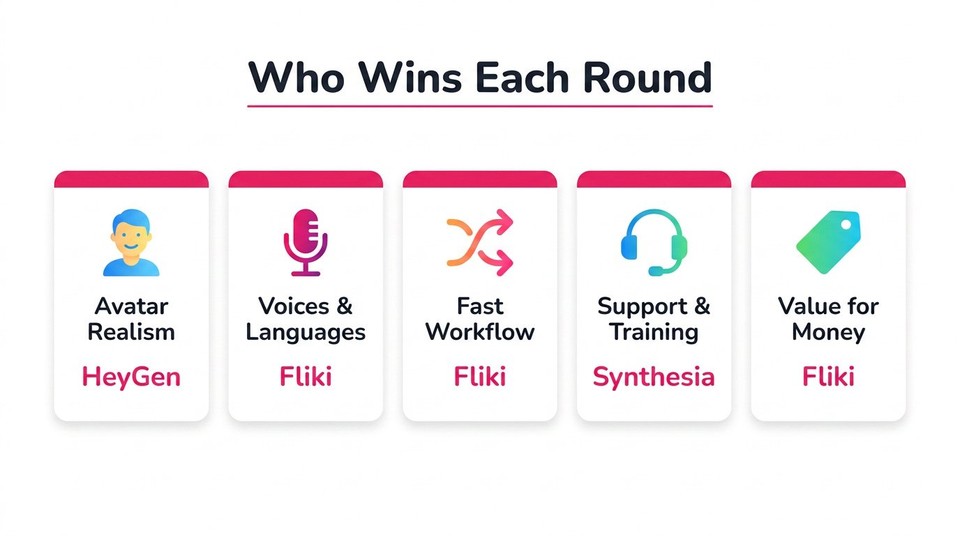
HeyGen wins, and the reviews back it up without much argument. Synthesia's newest avatars are close behind and arguably more consistent for business presenters. Fliki's avatars are capable but are not chasing a photorealism trophy, they are one tool inside a wider kit. If a believable human face carrying the entire video is the job, this is HeyGen's category to lose.
Voices and languages
This is Fliki's strongest head-to-head. All three cover many languages, but Fliki treats voice as a first-class product rather than an avatar accessory, with the deepest voice library of the three and dedicated dubbing and translation tools. HeyGen's voice cloning is strong in English, though reviewers note artifacts in some other languages. Synthesia's cloning is well regarded for training narration. If voice variety and localization volume matter most to you, Fliki leads.
Workflow and ease of use
HeyGen and Synthesia are avatar-first: build a scene, place a presenter, write their lines. That is intuitive when a talking head is the goal and clunky when it is not. Fliki is content-first: it starts from your script, article, or idea, which is why creators describe the shortest path from "I have something to say" to "I have a video." Reviewers across all three praise ease of setup, but they are praising different things, polished individual scenes versus a fast end-to-end pipeline.
The credit trap (all three have one)
This is the unifying lesson from the reviews, and it is worth more than any feature. Every one of these tools has a limit that ambushes buyers. HeyGen's is premium credits that drain on the best features. Synthesia's is an annual video-minute cap that runs out faster than the monthly price implies. Fliki's is credit consumption during iteration. None of them is "unlimited" the way a homepage suggests. The correct response to all three is identical: estimate your real monthly output and test it on a free plan before paying for a year. Fliki at least publishes a credit estimator on its pricing page so you can model your usage before spending anything.
Support and trust
Read the Trustpilot reviews for all three and the same fault lines appear: slow responses and awkward refunds when something breaks. This is an industry-wide pattern in fast-growing AI tools, not a single villain. Synthesia's education and support resources earn the warmest reviews of the group. The safest play is to fire a pre-sales question at each tool's support team and judge the reply speed and quality before you hand over money.
Pricing at a glance
Prices shift often in this space, so treat these as directional and confirm on each official page before buying.
|
HeyGen |
Synthesia |
Fliki |
|
|---|---|---|---|
|
Free plan |
Yes, watermarked |
Yes, watermarked |
Yes, watermarked |
|
Entry paid plan |
~$29/mo (Creator) |
~$18-29/mo (Starter) |
~$9-28 (Basic/Standard) |
|
Review snapshot |
G2 ~4.8, Trustpilot ~2.4 |
G2 ~4.6, Trustpilot ~4.0 |
G2 ~4.7, Trustpilot ~4.4 |
|
Users love |
Avatar realism, lip-sync |
Speed, support, training |
Text-to-video range, voices, value |
|
Most-cited complaint |
Credit system "unlimited" confusion |
Content moderation, minute caps |
Voice realism, iteration credits |
|
Built for |
Realistic presenters |
Enterprise L&D |
All-in-one creator content |
So which one should you actually pick?
Forget the feature counts and find yourself in one of these.
You are a content creator or solo marketer. You publish faceless videos, social clips, and explainers, and you care about speed, voice variety, and not torching your budget. Fliki is the natural fit, and the reviews from creators echo it. Starting from a script or idea and getting a captioned, voiced video back is the workflow you live in, and the marketing and social media use case is built around it.
You run sales, demos, or personalized outreach where the avatar is the star. You want a digital presenter realistic enough to carry the message alone, and possibly lip-synced translation. HeyGen earns its premium here. Just budget for the credit consumption that comes with its best avatar features, and test support before going annual.
You manage learning and development at a mid-size or large company. You produce training at scale, answer to security and compliance teams, and need content living inside an LMS. Synthesia is purpose-built for this, and its enterprise tier is where the real strength sits. If your training also needs to ship in many languages on a leaner budget, it is worth trialing Fliki's education and e-learning workflow before signing an enterprise contract, just be ready for Synthesia's content rules either way.
You are a small team that needs a bit of everything. Some social content, the occasional avatar video, voiceovers, and localized versions, without paying for three separate subscriptions. This is where an all-in-one tool quietly saves the most, and it is the strongest case for Fliki over the specialists.
The bottom line
HeyGen, Synthesia, and Fliki are not really fighting over the same job, even though they share a search results page. The reviews make the divide clear. HeyGen is the avatar realism leader that asks you to master its credit system. Synthesia is the enterprise training engine that asks you to live with its content moderation. Fliki is the all-in-one creator workflow that trades photoreal avatars for speed, voice depth, and range.
The honest conclusion is the unglamorous one: there is no universal winner, only the right fit for the videos you actually make, and a free plan is the only review that counts as your own. If you are a creator or lean team who wants to publish more, faster, across formats and languages without an enterprise invoice, Fliki was built for exactly that. Test the full workflow free, make one real video, and let the finished result, not anyone's feature list, settle it.