
Introduction
You finished editing the reel. You think it's good. You really do.
And then you hover over the share button, and your stomach turns a little. What if your followers hate it? What if it tanks and the algorithm punishes the next three posts? What if your most loyal viewers think you've finally lost the plot?
If that hesitation feels familiar, trial reels on Instagram were built for you. They're a sandbox. A focus group. A way to send a reel out into the world, watch how strangers react, and only then decide if your real audience deserves to see it.
I've been digging into how creators are actually using this feature, what Instagram engineers are saying about how it works under the hood, and where most people are wasting it on tests that teach them nothing. This guide pulls all of that together so you can stop guessing and start running experiments that grow your account.
What are trial reels on Instagram?
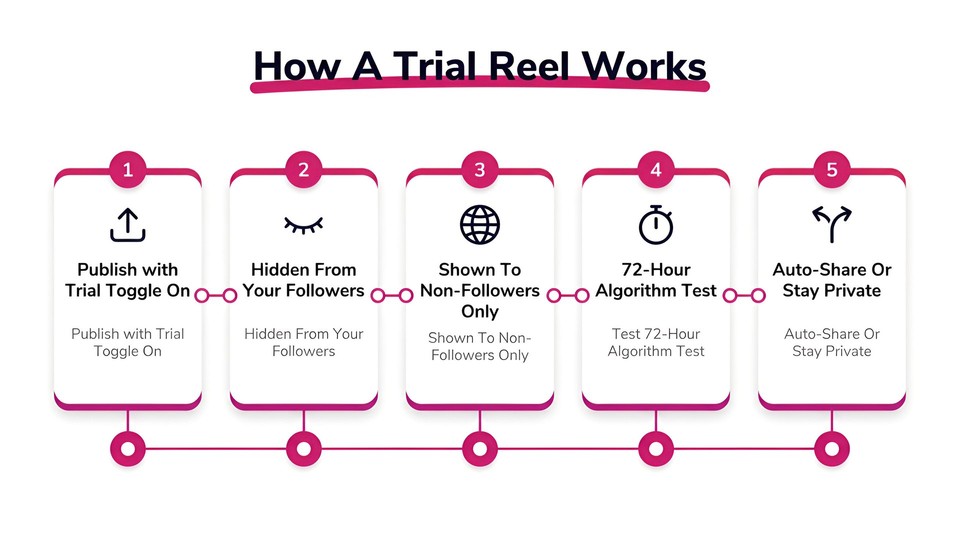
A trial reel is a regular reel with one extra toggle flipped on before you post. That toggle tells Instagram to hide the reel from your followers and instead serve it only to non-followers through the Reels feed and Explore. You won't see it on your profile grid. Your followers won't see it in their feed or in their Reels tab. It lives in a private "Drafts and trial reels" section of your profile that only you can access.
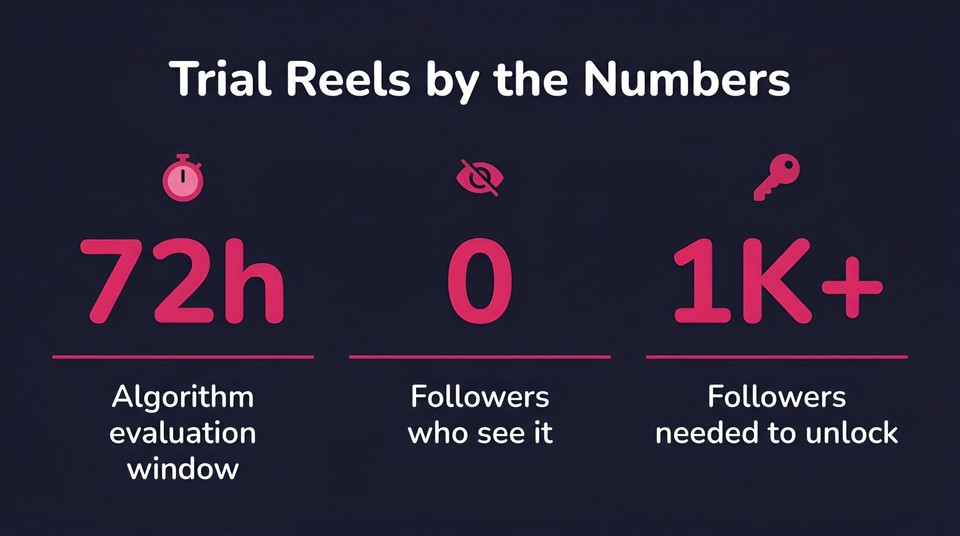
After 72 hours, Instagram makes a decision based on how strangers responded. If the reel cleared an internal performance threshold, it can be auto-shared to your followers and pinned to your grid. If it didn't, it stays hidden and you've learned something for free, without sacrificing the trust of the audience you've already built.
Adam Mosseri, the head of Instagram, has been openly recommending the feature in his own posts. In one clip he describes it as a way to "skip the entire connected ranking system and instead go directly to unconnected recommendations, which means you avoid overwhelming your followers with excessive content." That last line is the whole point. Trial reels separate the experiment from the audience.
How trial reels actually work behind the scenes
Most articles stop at "Instagram shows it to non-followers." That's true, but it skips the part that actually matters for your strategy.
When you publish a trial reel, Instagram drops it into the same unconnected recommendation system that powers the Explore page and the public Reels feed. It distributes the video in waves to people who don't follow you, watching watch time, replays, shares, saves, comments, and the ratio of positive signals to passive views. If early reception is strong, distribution widens. If it isn't, distribution slows down.
The 72-hour window is a fixed evaluation period. The clock starts the moment you publish, and it does not pause if you change settings. Instagram compares your reel's performance against similar content in your niche, not a flat number. A cooking reel competes against cooking reels. A finance explainer competes against finance explainers. This is why a reel with only a few hundred views can still clear the bar if it outperforms comparable content, and why a reel with bigger raw numbers can fail if its category is more competitive.
Two important nuances most guides skip. First, your followers can still occasionally encounter a trial reel if someone shares it with them in DMs, or if they land on a page that aggregates reels by audio, location, or filter. Instagram is not encrypting the reel, just controlling its main distribution. Second, trial reels are ranked separately from your normal reels in the algorithm. A trial reel that flops will not drag down the performance of your next regular post. This is the safety net that makes the feature so powerful.
Who can use trial reels?
You'll need a professional account, which means switching to either a Creator or Business account. Personal accounts are not eligible. Most creators also report needing at least 1,000 followers for the toggle to appear, and Instagram has confirmed eligibility requirements in its Help Centre.
If you're below that threshold or the toggle is missing, check that your app is on the latest version, that your account is registered as Creator or Business, and that you're in a region where the feature has rolled out. The "instagram trial reels not showing" issue is almost always one of those three things.
How to post a trial reel on Instagram
The actual mechanics are straightforward. The discipline around them is what separates creators who grow from creators who guess.
Open the camera and create a reel the way you always do. Trim, add captions, set your cover. When you reach the final share screen, look for the Trial toggle near the audience settings. Flip it on. Hit share.
That's it. The reel will not appear on your profile grid. To find it again, go to your profile, tap the Reels tab, then tap the "Drafts and trial reels" card. From there you can view performance after 24 hours and decide what to do with it.
Inside the trial reel's insights you'll see views, likes, comments, shares, saves, accounts reached, replays, watch time, and average watch time. Watch time and average watch time are the two metrics most creators undervalue, and they're the ones that map most closely to what the Reels algorithm actually rewards.
At any point, you can share the reel with everyone manually, or set it to auto-share if Instagram determines it's performing well within the first 72 hours. The default is manual. Toggle the auto-share option only if you trust your editing instincts enough to be hands-off.
The mistake almost every creator makes with trial reels
Most people try the feature once, post a reel that looks just like the rest of their content, watch it get 80 views, feel discouraged, and never touch it again. That's not a failure of the feature. That's a failure to set up an experiment.
A trial reel is not "a reel that gets less reach." It's a hypothesis test. Without a question, you don't have a test, you have a quieter version of normal posting.
Before you publish, write down the one variable you want to learn about and the result you'd consider a win. Examples:
"Does an ASMR opening hold attention better than a talking-head opening for my niche?"
"Does trending audio outperform original audio when the visual is identical?"
"Does a 22-second cut retain more viewers than a 45-second cut of the same story?"
Then make every other element identical. Same caption, same hashtags, same location tag, same cover frame, same posting time within a reasonable window. The cleaner the test, the more usable the answer.
How to read trial reel performance the right way
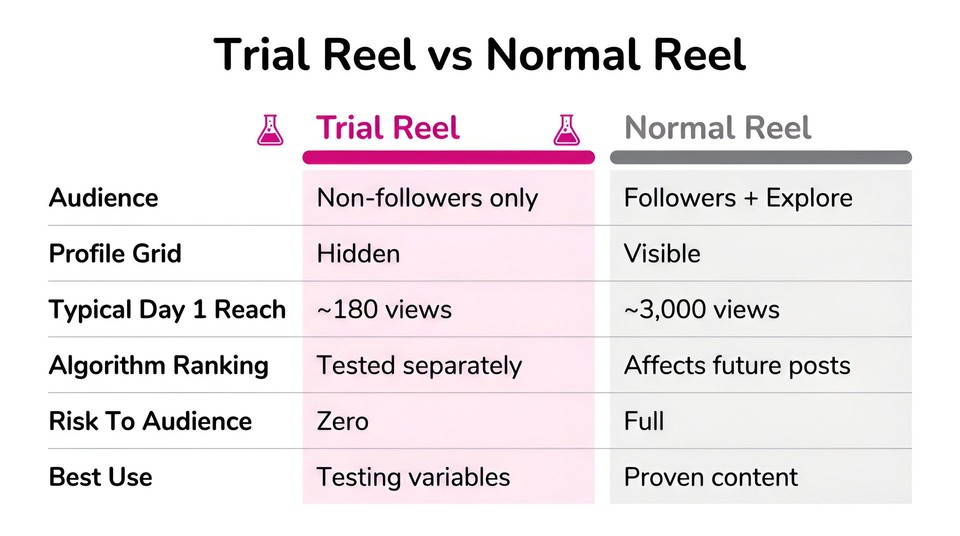
Here's the single most important calibration in this whole guide: do not compare trial reels to your normal reels. Compare trial reels to other trial reels.
Trial reels reach non-followers exclusively, and non-follower reach is structurally slower and smaller than the warm reach you get from your existing audience. A normal reel of yours might pull 3,000 views in its first day. The same reel posted as a trial might pull 180. That's not a failure. That's the format. Mosseri has said this explicitly: "It's going to get less reach, almost always. So what you need to do is compare trial reels to other trials."
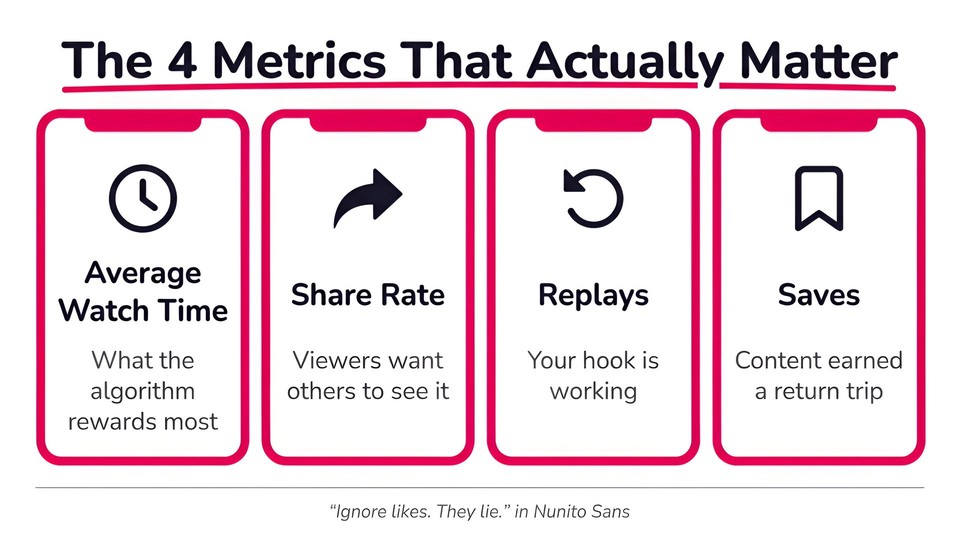
Use average watch time and share rate as your North Stars. Likes feel good but tell you very little about whether content is working. Watch time tells you the algorithm wants to keep showing this. Shares tell you viewers want other people to see it. Together they predict what will actually grow your account.
A clean testing framework you can run this week
The creators getting the most out of trial reels treat them like a quarterly research budget, not a daily lottery. Here's a framework you can copy.
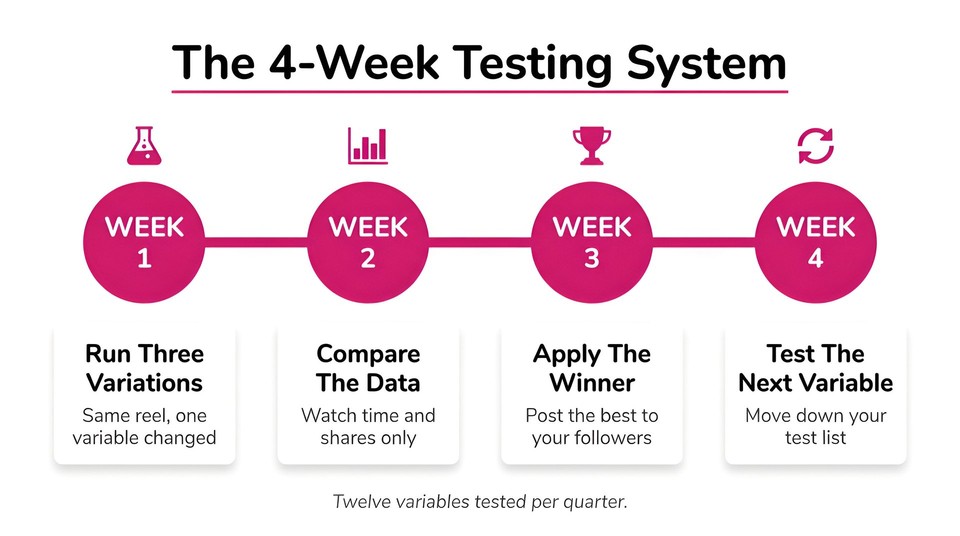
Week one. Pick a single variable. Hooks, length, audio, captions, or visual style. Run three variations of the same reel as trial reels. Space them at least 24 hours apart so they don't cannibalize each other's non-follower pools.
Week two. Look at the data side by side. Average watch time, shares, replays, comments. Pick the winner.
Week three. Apply the winner to a normal reel posted to your followers. See if the lesson transfers. (Sometimes it does not, and that itself is data.)
Week four. Run the next variable test. Move forward with one decision made for you, instead of three you're still arguing about in your head.
By the end of a quarter you'll have tested twelve variables. That's an enormous amount of structural learning about your own niche, and almost no creators are doing it.
12 trial reel experiments worth running
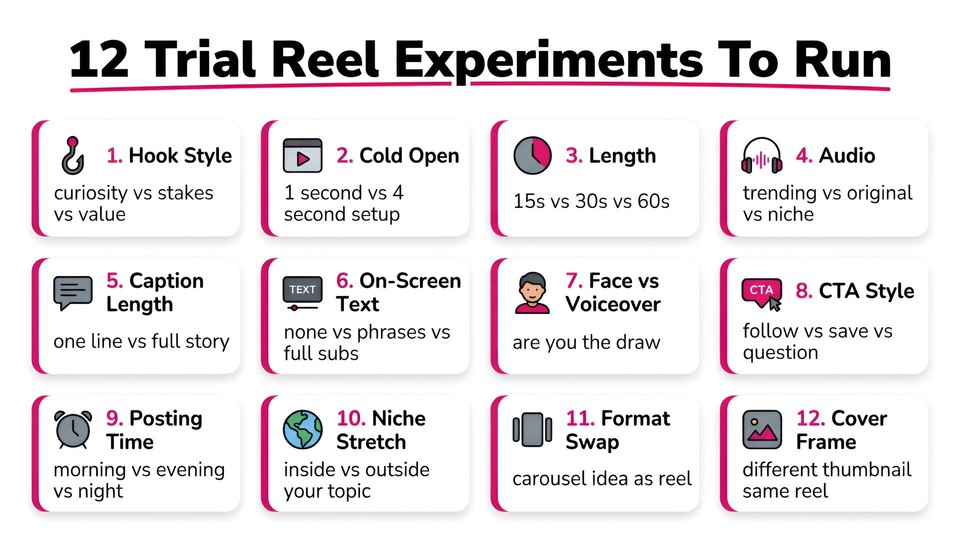
If you need a starting point, pick from this list. Each test isolates a single decision most creators agonize over.
Hook style. Compare a "value first" hook ("These three tools save me hours a week") against a "curiosity hook" ("There's a free tool that does this in three seconds") against a "stakes hook" ("If you're still doing this manually, please stop"). Identical body, identical CTA.
Cold open vs. setup. Same reel, one with a one-second cold open and one with a four-second setup. See which keeps people through the three-second drop-off.
Length test. Cut the same story into a 15-second, 30-second, and 60-second version. Average watch time, not views, decides the winner.
Audio test. Identical visuals, three different audio tracks: trending, niche-favorite, original voice. Particularly revealing in non-music niches.
Caption length. A one-line caption vs. a story-style caption vs. a question-only caption.
On-screen text density. No text, key phrases only, or full subtitles. Especially important if you suspect your audience watches without sound.
Face on camera vs. voiceover. Same script. Are you the draw, or is the information the draw?
CTA style. "Follow for more," "Save this for later," or a question-based CTA in the final beat.
Posting time. The same reel posted at three different times on three different days. Trial reels are perfect for this because the test is independent of your follower behavior.
Niche stretch. Post one reel inside your usual topic and one slightly outside. See if the algorithm is willing to find a new audience for the second.
Format swap. Take a static carousel idea and turn it into a reel. Or take a vlog and convert it into a tighter how-to format.
Thumbnail / cover frame. Same reel, same caption, different cover frame. Cover frame influences taps from your grid, but for trial reels it influences how viewers behave when they pause-scroll.
Where Fliki fits in your trial reel workflow
The bottleneck for most creators is not ideas. It's production. Cutting three versions of the same reel sounds reasonable until you're doing it at 11 pm, voicing each one slightly differently and re-rendering twice.
This is where AI video tools earn their keep. Fliki's Instagram Reels Maker turns a script or a blog outline into a reel with AI voiceover, captions, b-roll, and music in a few minutes. For trial reel testing specifically, the workflow looks like this: write one master script, generate three versions in different voices, lengths, or styles using text to video, and post each as a trial reel. The thing that used to take a whole evening becomes a 20-minute task. If you'd rather start from a list of formats, the reel ideas guide and how to make Instagram reels walkthrough on the Fliki blog are good jumping-off points.
The reason this matters for trial reels is volume. The framework above only works if you can produce variations without burning out. AI takes the production cost of testing down far enough that experimentation becomes a habit instead of a project.
The bigger picture
Instagram has been moving towards a system where reach is earned by content quality and not by follower count for a while now. Trial reels are the cleanest expression of that shift so far. They give you a way to test ideas against the same recommendation engine that decides whether anything goes viral, while shielding your existing audience from the noise of the test.
If you treat trial reels as a one-off curiosity, they'll feel underwhelming. If you treat them as a recurring research practice, with clear questions and clean variables, they become the most underrated growth tool on the platform.
You already have the ideas. Trial reels are how you stop guessing which one to bet on.