
Introduction
If you have spent even an hour reading about AI lately, you have probably bumped into both terms and quietly wondered if they mean the same thing. A digital twin and an AI avatar both live on a screen. Both are "virtual." Both get called the future of, well, everything. So it would be reasonable to assume they are two words for one idea.
They are not. And the gap between them is bigger than the marketing makes it sound.
Here is the short version before we dig in. A digital twin is a living virtual copy of a physical thing, a jet engine, a factory floor, a human heart, that updates itself with real-world data so you can monitor and predict how the real thing behaves. An AI avatar is a synthetic on-screen persona, usually a face and a voice, that delivers your message in a video. One is built to understand a machine. The other is built to communicate as a human. Once you see that split, the confusion clears up fast.
Let's walk through both properly, look at where people get them mixed up, and figure out which one actually matters for what you are trying to do.
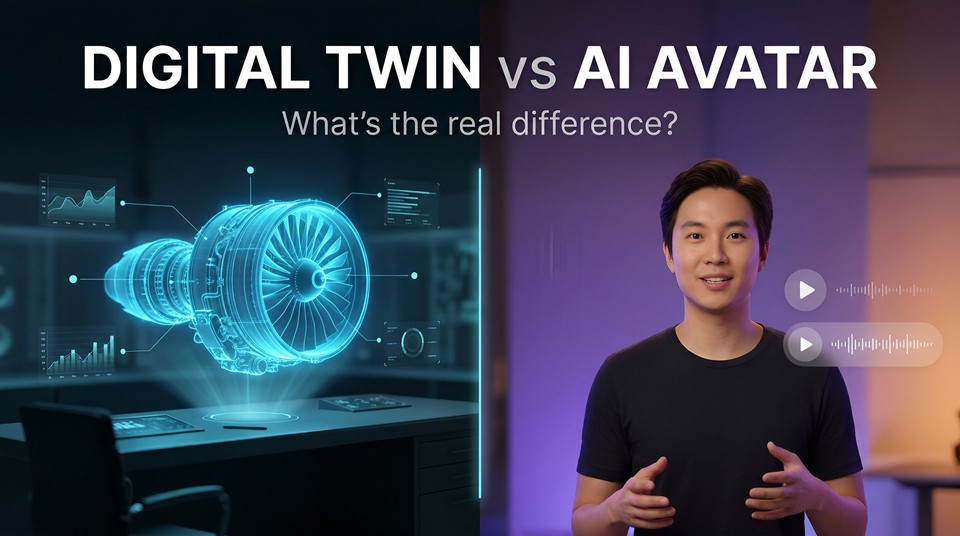
Digital twin vs AI avatar at a glance
Feature | Digital twin | AI avatar |
|---|---|---|
Core purpose | Mirror, monitor, and predict a physical system | Present and communicate a message on screen |
What it copies | A physical object, process, or environment | A human face, voice, and persona |
Data it runs on | Live IoT sensor data, two-way feedback loop | Images, video, and voice samples used once to train it |
Where it lives | Engineering, manufacturing, healthcare, smart cities | Marketing, training, social media, customer education |
Underlying tech | IoT, physics-based simulation, machine learning | Generative AI, neural rendering, text to speech, lip sync |
The end goal | Better decisions and fewer real-world failures | Faster, cheaper, scalable video content |
What is a digital twin?
A digital twin is a virtual representation of a physical object or system that stays in sync with its real-world counterpart through a constant stream of data. IBM defines a true digital twin as one that covers an asset’s full lifecycle, continually updates with real-time data, and leverages simulation, machine learning, and reasoning to support better decision-making.
The keyword in that definition is real-time. A regular 3D model or a one-off simulation is a snapshot. A digital twin is a relationship. Sensors on the physical asset feed performance data, temperature, vibration, energy output, pressure, into the virtual model, and that model updates to reflect what the real thing is doing right now. Many setups also send signals back the other way, nudging the physical asset to run more efficiently. That two-way loop is what separates a digital twin from a fancy CAD file.
The idea is older than most people realize. The concept traces back to NASA's space program, where ground engineers built mirrored systems to troubleshoot spacecraft from 200,000 miles away. The Apollo 13 rescue leaned on exactly this thinking. The term itself was formalized by Dr. Michael Grieves around 2002 and later named "digital twin" by NASA's John Vickers. Today the technology shows up everywhere physical performance matters. Manufacturers run them to catch equipment failures before a line goes down. Energy companies model wind turbines and gas turbines to squeeze out more output. As CIO reports, twins now range from a single component all the way up to an entire production facility, and even into healthcare, where researchers model organs to test treatments.
So when you hear digital twin, picture an engineer staring at a dashboard, watching a virtual engine breathe in time with a real one. It is analytical. It is invisible to the public. Its job is to know.
What is an AI avatar?
An AI avatar is a digital character, powered by artificial intelligence, that can read a script, speak in a lifelike voice, move with natural gestures, and act as the on-screen presenter of your content. Instead of pointing a camera at yourself, you type or paste your words, pick a presenter, and the AI generates a video of that persona delivering your message.
This is where a tool like Fliki lives. With an AI avatar generator, you can choose from a library of stock presenters, generate a brand new avatar from a text prompt, or build a personalized one from your own photo or a short video clip. The avatar then speaks your script with accurate lip sync across more than 80 languages, which is why the same presenter can sell to a customer in English, then Spanish, then Japanese without you reshooting a single frame.
The job of an AI avatar is the opposite of a digital twin's. It is not trying to understand a machine. It is trying to hold a viewer's attention. A talking AI avatar is front-facing by design, built to feel human, to narrate a course, explain a product, or carry a social video. Under the hood it runs on generative AI, neural rendering, and text to speech rather than IoT sensors and physics models.
Crucially, an avatar's data flows one way. You feed it a face and a voice once, it learns to reproduce them, and from then on it generates. There is no live sensor feed, no feedback loop back to a physical object. It performs. It does not monitor.
The core differences that actually matter
If the table above gave you the map, here is the terrain. Four differences do most of the heavy lifting.
Purpose. A digital twin exists to reduce risk and improve performance in the physical world. An AI avatar exists to communicate a message in the digital world. One prevents a turbine from failing. The other helps you publish a video by Friday.
What gets copied. A digital twin copies behavior, how a system performs under heat, load, or stress over time. An AI avatar copies appearance and identity, a face, a voice, a way of speaking. A twin is interested in physics. An avatar is interested in personality.
The data relationship. This is the cleanest line between them. A digital twin demands a continuous, live connection to its physical source, which is why it leans on IoT and a steady sensor diet. An AI avatar is trained once and then runs on its own. After setup, your real face can be on a beach in Bali while your avatar films a product launch.
Who sees it. Digital twins are usually internal tools for engineers, planners, and operations teams. AI avatars are external by nature, made to be watched by your audience, your customers, your students. A twin succeeds when it is accurate. An avatar succeeds when it is engaging.
Hold those four lines, purpose, copy, data, audience, and you will never confuse the two again, no matter how a vendor markets them.
So why do people keep mixing them up?
Honest answer: the marketing world borrowed the phrase. As AI avatars got more realistic, brands started describing a hyper-personalized avatar of a real person as that person's "digital twin." You will see ads promising to "create your own digital twin" that turns out to be a talking head video made from your likeness. It is a great hook, and you can see why it sticks. The avatar looks like you, sounds like you, and shows up so you do not have to.
But there is a real distinction worth keeping. A "digital human" or personalized avatar replicates how you look and sound. A genuine digital twin replicates how something behaves and stays bonded to live data from the real thing. Your AI avatar does not know your heart rate, your schedule, or your mood. It is a brilliant performer, not a live mirror.
The cleanest way to hold it in your head: a digital twin is a copy of a system's behavior, while an AI avatar is a copy of a person's presence. When a product blends the two, say, an avatar that responds in real time to a live data source, you are watching the categories start to overlap. For most use cases today, though, they remain very different tools solving very different problems.
Which one do you actually need?
This part is simpler than it looks, because the two almost never compete for the same job.
You need a digital twin if you work with physical assets and the stakes are operational. Are you trying to predict when a machine will fail, simulate a factory before building it, test a design without breaking real hardware, or model a city's traffic? That is twin territory. It is an engineering investment, usually tied into IoT infrastructure and specialist platforms.
You need an AI avatar if your challenge is content, communication, or scale. Are you trying to turn scripts into training videos, localize marketing into a dozen languages, keep a social channel fed without filming yourself daily, or put a consistent brand face on every explainer? That is avatar territory, and it is far more accessible. You do not need sensors or a data engineering team. You need a script and a tool.
For the overwhelming majority of creators, marketers, educators, and small business owners reading this, the honest recommendation is the avatar. A digital twin solves problems most people will never have. An AI avatar solves the problem nearly everyone has, which is making more good video in less time.
How to create your own AI avatar (the easy part)
If the avatar is what you actually came for, the good news is you can have one talking on screen in a few minutes. The workflow with Fliki looks like this:
Start a new project and paste your script, or just give a prompt and let the text to video engine draft one for you.
Open the avatar panel and pick a presenter, generate one from a prompt, or upload your own photo or short clip to build a personalized avatar.
Choose a voice from the AI voice library, or clone your own so the avatar truly sounds like you.
Generate. Your avatar delivers the script with natural lip sync, ready to export and publish.
That is the whole loop. No camera, no studio, no reshoots when you decide to add a sentence. And because the same avatar and voice can run across more than 80 languages, one recording effort can become content for the entire world.
The bottom line
A digital twin and an AI avatar are easy to confuse and almost impossible to substitute for each other. One is a live, data-fed virtual replica of a physical system, built so engineers can monitor and predict the real world. The other is a synthetic presenter, built so you can speak to your audience at scale without ever picking up a camera. Different purpose, different data, different domain, different outcome.
Once you know which problem you are solving, the choice makes itself. If you are protecting a turbine, you want a twin. If you are growing an audience, you want an avatar, and you can start building one today.