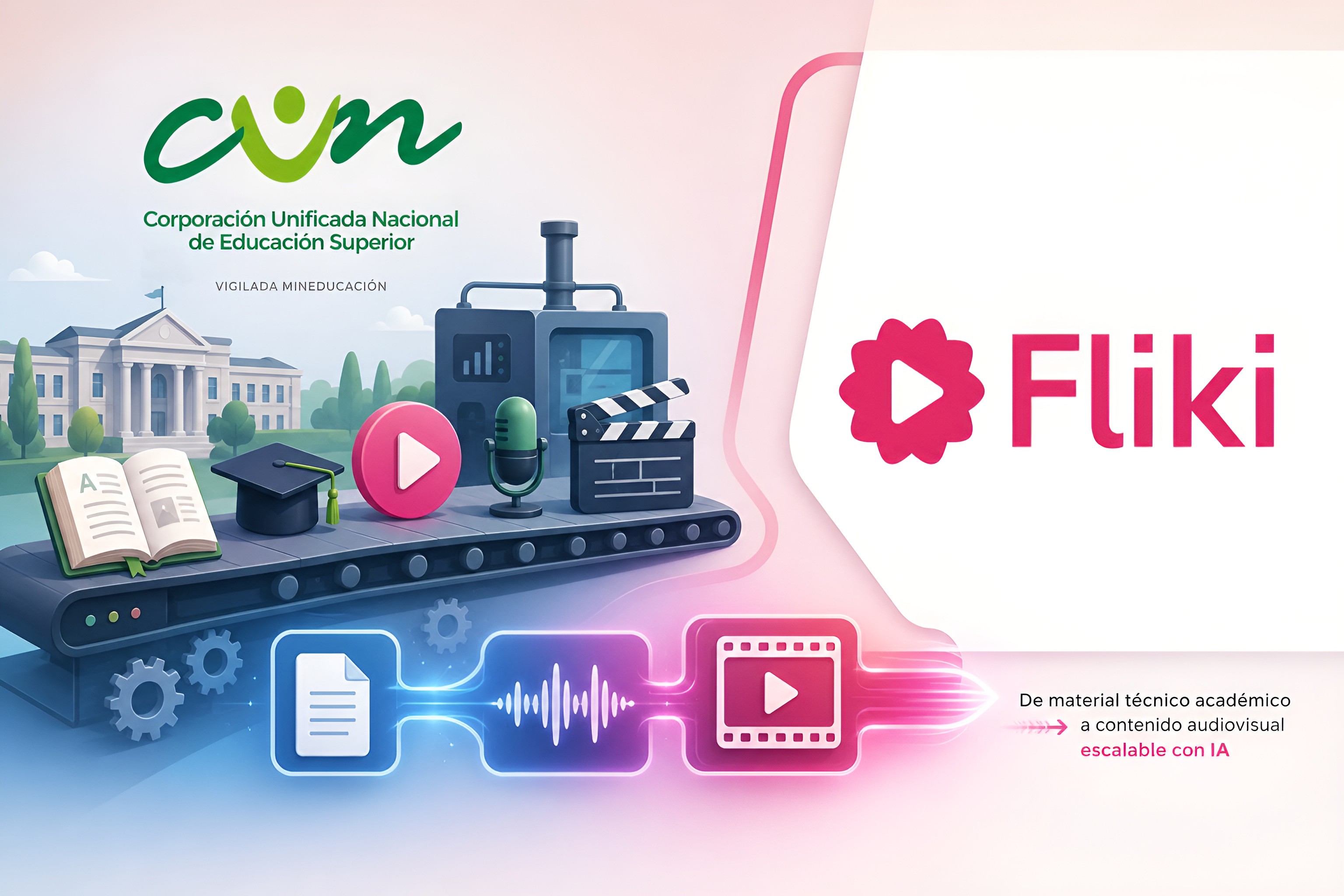
CUN is a higher-education institution running large-scale virtual learning programs. Its Fábrica de Contenidos produces videos, podcasts, and multimedia resources for every academic unit across the institution's online courses.
Industry | Education & E-learning |
Team | Fábrica de Contenidos (Content Factory) |
Primary use cases | Training & e-learning, internal communication videos, product/concept explainers |
Contact | Iron Fuentes, CUN |
Industry Context
Universities and e-learning providers are under increasing pressure to convert dense, technical academic material into video and audio formats that virtual learners actually engage with. Traditionally, that has meant a heavyweight production chain - instructional designers writing, voice talent recording, editors assembling, and project managers coordinating between them - repeated for every module, in every course, every term. As programs scale to national or multilingual delivery, the production pipeline becomes the bottleneck rather than the curriculum itself.
The Challenge
CUN's Fábrica de Contenidos was producing academic content at meaningful volume, but the underlying workflow was struggling to keep pace with the institution's ambitions:
Time-intensive production. Every module required manual voice recording, editing, and coordination across multiple specialist roles - slow by design.
Heavy role dependency. Production was concentrated in a small group of technically trained team members, creating capacity ceilings and single points of failure.
Coordination overhead. Shipping a single learning unit meant aligning instructional designers, voice talent, editors, and reviewers - every handoff added days.
Inconsistent quality at scale. With multiple voices, editors, and recording sessions involved, maintaining a unified voice and visual standard across hundreds of modules was difficult.
Slow cycle times. Turning a technical academic document into a finished audiovisual asset took weeks - too slow for the institution's roadmap of expanding virtual programs.
The Solution
The team adopted Fliki as the core production engine inside the Fábrica de Contenidos, replacing the manual record-edit-coordinate chain with an AI-powered text-to-video and voiceover workflow:
Technical documents → audiovisual assets, fast. Academic source material now flows directly into Fliki to generate high-quality voiceovers and video content for each module - no separate recording session required.
Standardized voice and visual quality. A consistent Fliki-generated voice and template system gives every course the same production standard, removing the variance that came with multiple human voice artists and editors.
Non-technical contributors empowered. Subject-matter experts and operational team members can now participate directly in content creation, instead of waiting on a small group of specialists.
Parallel production across units. With production no longer gated by recording schedules, the team can build multiple academic units simultaneously.
Scalable foundation for new formats. The same pipeline now supports videos, podcasts, and multimedia learning materials, all from the same source documents.
"Fliki is not just a tool for us - it is a key component in redefining how educational content is created, making it faster, more accessible, and more engaging." - Iron Fuentes, CUN
The Results
Fliki turned CUN's content factory from a sequential, specialist-driven pipeline into a parallelized, standardized production system:
~60% faster production. Overall time to produce a content unit dropped by roughly 60% versus the previous manual workflow.
3× parallel output. Capacity moved from 1 unit per cycle to 3 or more units produced simultaneously.
100% quality standardization. A unified voice and video standard is now applied across every virtual course in the institution.
8+ learning modules per subject deployed faster, with the same team headcount.
Weeks-to-days turnaround. Academic content delivery cycles compressed dramatically, letting the institution ship updates and new modules in step with academic calendars.
Broader team participation. Non-technical team members now contribute directly to content output, removing the long-standing specialist bottleneck.
What's next for CUN's Fábrica de Contenidos
The team is now scaling the content factory to support national-level academic programs, with AI-driven processes embedded throughout the production chain. On the roadmap with Fliki:
Personalized learning experiences generated from shared source material.
Automated microlearning modules produced at higher volume and finer granularity.
Multilingual education delivery, extending the same content into multiple languages without rebuilding the production pipeline.
Who CUN recommends Fliki to
Based on CUN's experience, Fliki is particularly well-suited to:
Universities and e-learning providers producing high volumes of course modules, voiceovers, and multimedia resources.
Instructional design teams trying to standardize quality across many courses and many contributors.
Content factories and L&D organizations that need to shift from sequential, specialist-bound production to parallel, AI-driven workflows.
Education institutions planning multilingual or national-scale expansion without proportional growth in production headcount.
"Fliki has empowered non-technical team members to participate in content creation, democratizing production and accelerating delivery cycles. We've been able to scale our content factory while maintaining consistency and improving the learning experience for students." - Iron Fuentes, CUN