
Introduction
You filmed it. You edited it. You picked the trending audio everyone is using. Then you tapped Share, walked away, and came back three days later to find your Reel sitting at 412 views.
Sound familiar?
Here is the part nobody tells you. Your Reel did not flop because the content was bad. It flopped because almost no one saw it in the first thirty minutes. And on Instagram, the first thirty minutes decide everything.
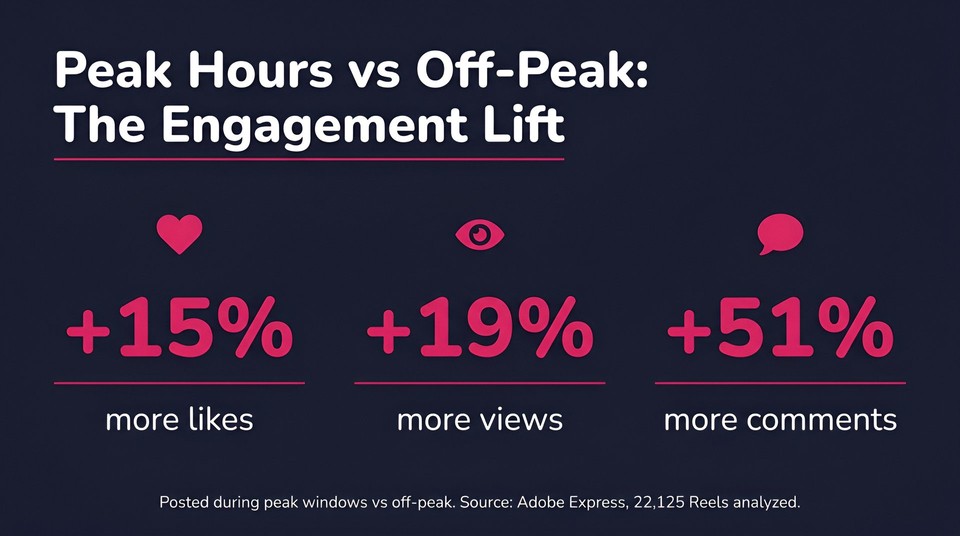
Instagram's algorithm runs on momentum. When you publish during peak activity, your audience reacts fast. The algorithm reads that rapid engagement as proof your video deserves bigger distribution, and it pushes you onto Explore, Reels feeds, and Suggested. Post into a sleepy feed, and your Reel barely gets a chance to breathe.
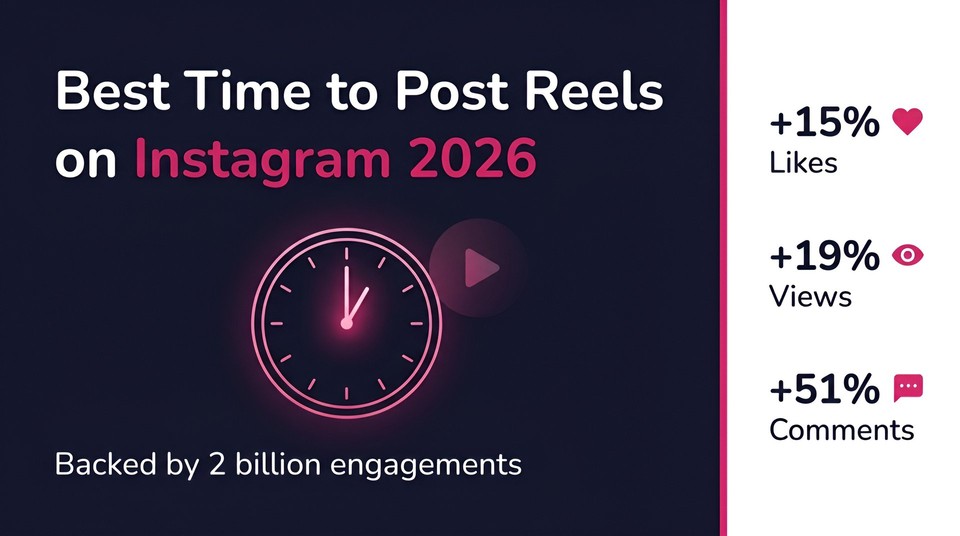
This guide pulls the most credible 2026 data we could find, including Sprout Social's analysis of 2 billion engagements, Adobe Express's study of 22,125 Reels from 200 top creators, and findings from Buffer and Later. We translate it into a posting schedule you can actually execute, plus the niche windows for nine industries, the trick for global audiences, and three ways to find your unique sweet spot. By the end, you will know exactly when to hit publish.
The quick answer: best time to post Reels on Instagram in 2026
If you only read one section, read this one.
The strongest engagement windows for Instagram Reels right now are:
Monday: 2 p.m. to 4 p.m.
Tuesday: 1 p.m. to 7 p.m.
Wednesday: 12 p.m. to 9 p.m. (with a late spike at 11 p.m.)
Thursday: 12 p.m. to 2 p.m.
Friday: no strong window, late morning if you must
Saturday and Sunday: lowest overall engagement, save your best for the workweek
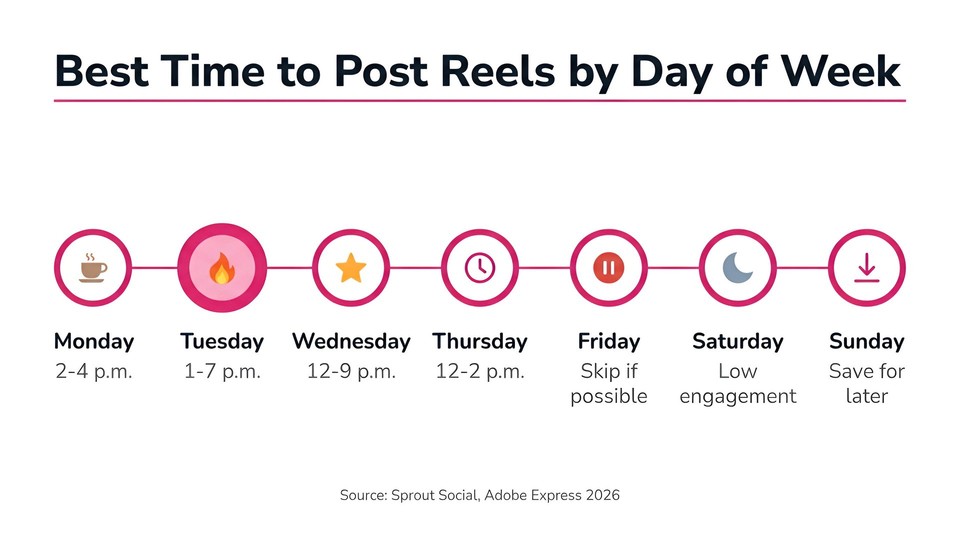
The single most consistent global window for getting best reach on Instagram is Wednesday between 12 p.m. and 3 p.m. Post here when in doubt. Everything else in this guide refines that baseline for your audience, niche, and time zone.
Why timing decides whether your Reel takes off
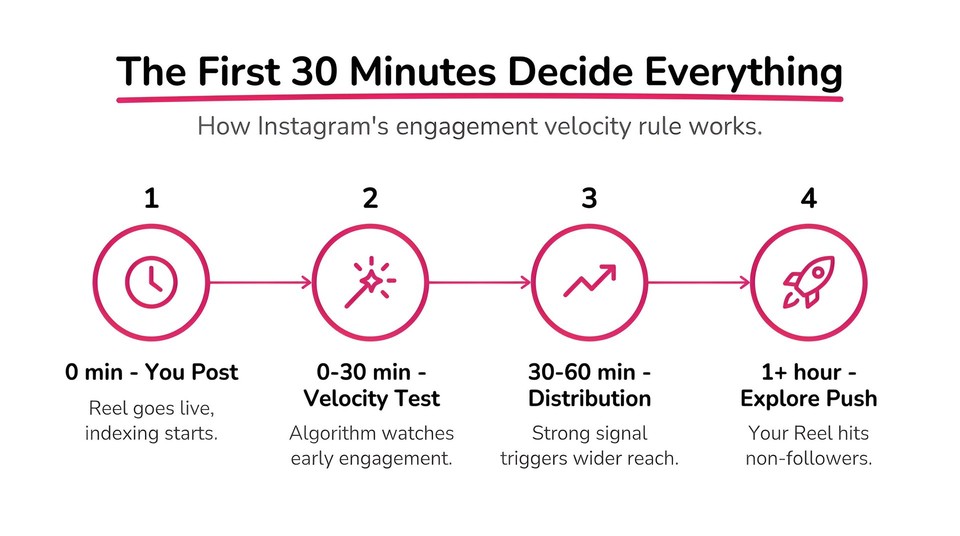
Instagram's recommendation system is built around two ideas. The first is relevance. The second is recency. The Head of Instagram, Adam Mosseri, has repeatedly confirmed that Reels are designed for entertainment and discovery, which means they are pushed mostly to people who do not follow you yet. To earn that push, you have to give the algorithm a reason to trust your video.
That reason is engagement velocity. Engagement velocity is how quickly your Reel collects likes, comments, shares, saves, and rewatches in its first hour. The algorithm watches this number obsessively. If a video gathers fifty strong interactions in thirty minutes, it gets escalated. If it collects fifty in three days, it is treated as old news.
This is why timing matters more than format. Sprout Social's 2026 data concluded that the algorithm prioritizes when your audience is active over what format you publish. A perfectly edited Reel posted at 4 a.m. on Sunday will lose to an average Reel posted at 1 p.m. on Tuesday almost every single time.
The implication for your strategy is simple. You can squeeze far more value out of the content you already make by changing only one variable: the publish time. No new edits, no new gear, no new ideas. Just better timing. That is the cheapest form of growth on Instagram, and it is free.
Best time to post Reels on Instagram, day by day
Industry studies disagree on small details, but the patterns line up clearly when you stack them. Below is the consensus window for each day, blending Sprout Social's engagement data with Adobe Express's creator study and findings from Buffer and Later.
Best time to post Reels on Monday
Sweet spot: 2 p.m. to 4 p.m.
Mondays are about momentum. People are easing back into the week, hitting their post-lunch slump, and reaching for a distraction. Reels published in the early afternoon catch them mid-scroll. Skip the early morning entirely. Adobe found Monday Reels collect strong likes (around 918,000 average among top creators), which makes Monday an underrated launch day for your week's hero content.
Best time to post Reels on Tuesday
Sweet spot: 1 p.m. to 7 p.m.
Tuesday is the longest engagement window of the week. Six full hours of high attention. Adobe's data flagged Tuesday at noon as the single best slot for views, while Sprout found Tuesday afternoons consistently outperform almost every other workday block. If you only post one Reel a week, post it Tuesday.
Best time to post Reels on Wednesday
Sweet spot: 12 p.m. to 9 p.m., with a second spike at 11 p.m.
Wednesday is hump day in the literal algorithmic sense. People are tired, distracted, and scrolling. Sprout's data shows nine straight hours of strong activity, and Buffer's 2026 numbers crowned Wednesday and Thursday as the best days of the week. Use Wednesday for content that needs maximum reach, like product launches, announcements, and lead-generation Reels.
Best time to post Reels on Thursday
Sweet spot: 12 p.m. to 2 p.m.
The window narrows. By Thursday afternoon, attention drifts toward the weekend. Aim for the lunch rush and avoid late afternoon. Thursday is a great slot for educational content where viewers want to save and share for later.
Best time to post Reels on Friday
Sweet spot: there isn't a strong one. If you must post, aim for late morning.
Sprout Social explicitly labeled Friday as a day with no significant peak windows. Buffer ranked Friday as one of the lowest engagement days. The exception is Adobe's data, where Friday is the most popular posting day among top creators (one in five Reels). The disconnect tells you something important: lots of people post on Friday, but engagement is thin. Lower competition for attention is offset by lower attention overall.
Best time to post Reels on Saturday and Sunday
Sweet spot: skip if you can.
Weekends consistently produce the lowest engagement across studies. The exception is Adobe's data, where Saturday Reels earned the highest average likes per Reel (942,000), but that is concentrated among large creators with already-loyal audiences. For most creators and brands, the weekend is a holding pattern, not a launch day.
The hour-by-hour view: when your audience is actually scrolling
Beyond the weekday pattern, three time-of-day windows show up across every major study:
The morning commute (6 a.m. to 9 a.m.). People scroll while they drink coffee, wait for trains, or settle in at their desks. Engagement is moderate but reliable.
The lunch rush (11 a.m. to 2 p.m.). The strongest single block in most data sets. Office workers, students, and remote employees all break for the same window. This is where reach lives.
The evening wind-down (6 p.m. to 9 p.m.). Users relax, scroll, and watch Reels in bed. Engagement is high, but competition is brutal because nearly every brand publishes here.
A surprising fourth window appeared in Later's 2025 to 2026 data: very early morning (3 a.m. to 6 a.m.). Their analysis of 975,000 Reels found Reels posted in this stretch earned the strongest 24-hour engagement, likely because the algorithm has time to index your video before peak hours hit. The lesson: schedule late so the algorithm can warm up your Reel before your audience wakes up.
Best time to post Reels by industry
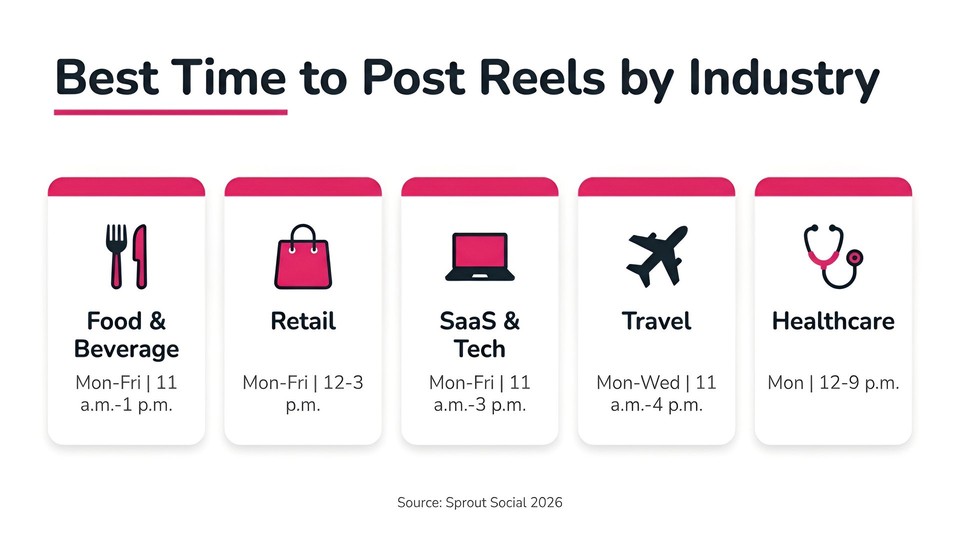
The biggest mistake creators make is treating Instagram timing like one global truth. Your audience is not "everyone on Instagram." It is a specific niche with specific habits. Sprout Social's 2026 data broke this down across nine industries:
Food and beverage: Monday to Friday, 11 a.m. to 1 p.m. Catch the lunch crave.
Retail and ecommerce: Monday to Friday, 12 p.m. to 3 p.m. Lunch break shopping is real.
Travel and hospitality: Monday to Wednesday, 11 a.m. to 4 p.m. Workday escape mode.
SaaS and software: Monday to Friday, 11 a.m. to 3 p.m. Pre-meeting scrolls.
Healthcare: Monday 12 p.m. to 9 p.m., midweek 11 a.m. to 5 p.m.
Finance: Tuesday early morning (3 a.m. to 11 a.m.) and late evening on Wednesdays. Markets-driven attention.
Nonprofits: Tuesday to Thursday, 11 a.m. to 4 p.m.
Education: Tuesdays and Wednesdays at 11 a.m., plus Saturday 3 p.m. to 8 p.m.
Government and civic: Tuesday to Thursday, 1 p.m. to 5 p.m.
Notice the pattern. Every industry except finance and education concentrates around the midweek lunch window. If you only remember one rule, remember that one.
If your content does not fit cleanly into any bucket, ask yourself a simpler question: when does my audience take a break? Match your publish times to those breaks, not to a generic table.
How to handle a global audience
If your followers stretch across continents, you have three real options.
Anchor to your highest-value time zone. Pick the country or region that drives the most revenue, sign-ups, or follows, and post for their local peak. Trying to please everyone usually pleases no one.
Stagger your content. Publish two to three Reels per topic spaced eight to twelve hours apart, hitting Americas afternoon, then Europe afternoon, then Asia Pacific afternoon. This works well for evergreen tutorials and product showcases, less so for trending audio, which decays fast.
Pre-schedule for 5 a.m. local time. Later's 2026 data found content posted between 3 a.m. and 6 a.m. consistently captured the highest 24-hour engagement, because the algorithm has time to test your video on small audiences before the morning rush. If you only have time for one experiment, try this one.
A small but underrated tactic: check your follower analytics by country. If 40% of your audience is in India and you live in Los Angeles, your "lunch rush" is at 11 p.m. local time. Schedule accordingly.
How to find your own best time to post Reels
Generic data is a starting point, never a finish line. Your followers are unique, and the only timing that truly matters is theirs. Here are three reliable ways to find it.
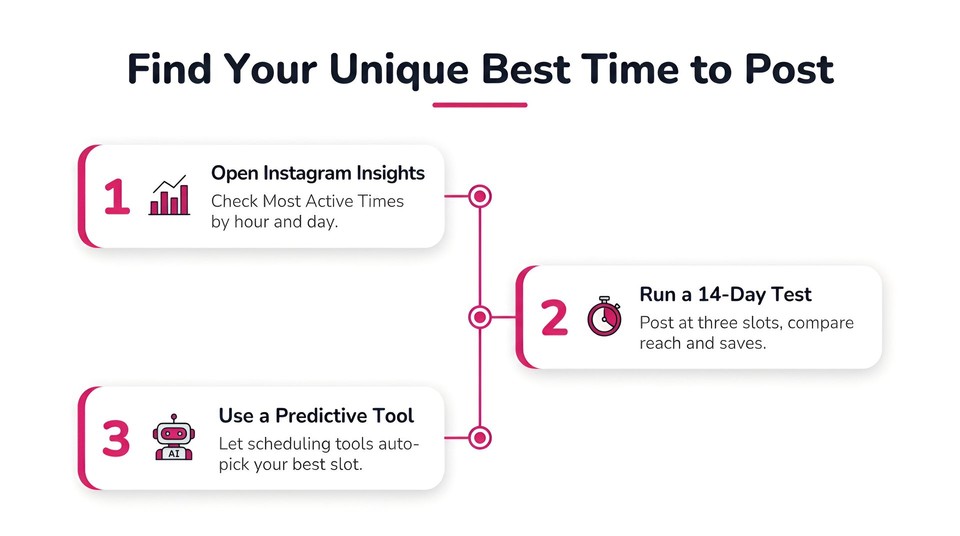
Method 1: Use Instagram Insights (free)
Switch to a Creator or Business account. Open your profile, tap Insights, and select Total Followers. Scroll to "Most Active Times." Instagram shows you, by hour and by day, exactly when your followers open the app. Post thirty to sixty minutes before that peak so your Reel is fully indexed when the wave hits.
Method 2: Run a 14-day timing test
Pick three time slots: one morning, one lunchtime, one evening. Post the same content style at each slot for two weeks, holding everything else constant (caption length, hashtag count, audio choice). Compare reach, watch time, and saves. The winner is your slot. Document it in a simple spreadsheet so you can repeat the experiment quarterly.
Method 3: Use a scheduling tool with predictive timing
Tools like Sprout Social's ViralPost, Later, and Buffer use machine learning on your historical data to recommend slots automatically. They are not perfect, but they remove the guesswork on a busy week and make consistent posting much easier.
Make timing easier with the right workflow
Posting at the right time only works if you have something to post. Most creators bottleneck on production, not strategy. They know the perfect window is Tuesday at 1 p.m., but they do not have a Reel ready.
Speed up your pipeline. Use AI tools to script faster, voice over without a microphone, and produce captions automatically. Fliki's AI Reel Generator turns a blog post, prompt, or script into a finished Instagram-ready Reel in minutes, complete with auto-captions tuned for silent-scroll viewers. If you want a deeper walkthrough, the How to Make AI Reels guide covers the entire workflow from idea to upload, and the faceless reels guide is perfect if you want to grow without showing your face. For brands posting at scale, Bulk Video Creator lets you generate dozens of Reels in one batch, ideal for testing posting times against the same content idea.
The faster you can ship, the more you can experiment, and the more your timing strategy compounds. Try Fliki free here and start publishing during your peak windows this week.
Five mistakes that quietly kill your Reel's reach
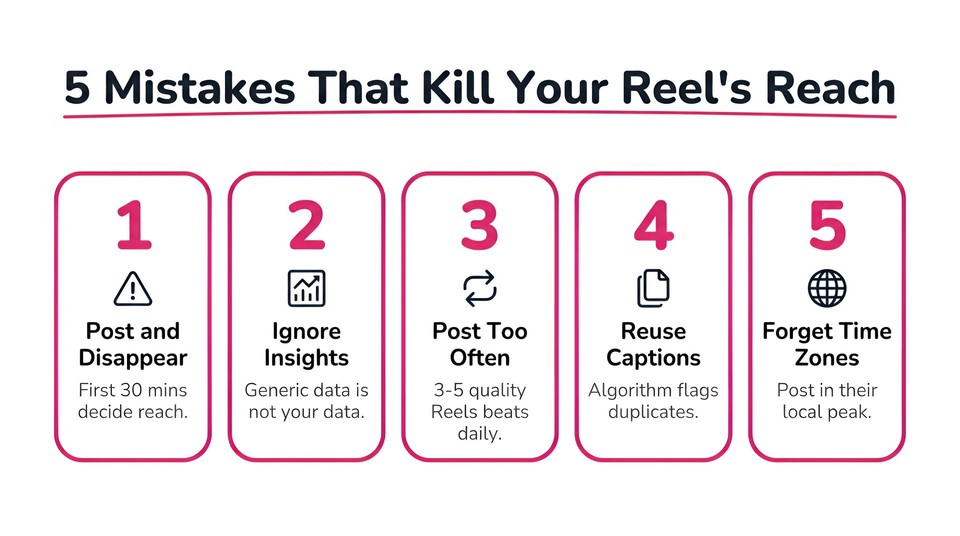
Posting and disappearing. The first thirty minutes are critical. Stay in the app, reply to comments, and engage with similar Reels to signal activity to the algorithm.
Ignoring your insights. Generic data is a baseline, not a strategy. Your audience does not live in a textbook.
Posting too often. More Reels does not mean more reach. Three to five high-quality Reels per week outperform daily filler.
Re-using captions and hashtags across slots. The algorithm flags duplicates. Vary your hooks even when the content is similar.
Forgetting time zones. If your top market lives in another country, your "best time" is their best time, not yours.
Avoid these five and you will outpace eighty percent of competitors who treat timing as an afterthought
Bring it all together
The best time to post Reels on Instagram in 2026 is not a single moment. It is a layered strategy: midweek afternoons as the global baseline, your industry's specific window as the next refinement, and your own audience insights as the final answer.
Start with the schedule above. Run the 14-day test. Watch your insights. Adjust monthly.
If you want to remove the production bottleneck so you can actually publish on time, try Fliki's AI Reel Generator and turn ideas into Reels in minutes. Better timing plus faster output is the combination that compounds, and it is the difference between a Reel that vanishes at 412 views and one that puts you on Explore.
FAQs
If you must pick a single window, choose Wednesday between 12 p.m. and 3 p.m. local time. It is the most consistent peak across every major 2026 study.
Sprout Social's data shows the algorithm treats Reels and feed posts the same way for timing purposes. What matters is when your audience is online. Reels just feel more time-sensitive because their reach decays faster than carousels.
Three to five Reels per week is the sweet spot for most creators. More than that and you cannibalize your own reach. Less than that and the algorithm forgets you.
No. Instagram's algorithm tags reposts. Instead, repurpose the same idea with a different hook and post it during a stronger window.
For most niches, yes. The exceptions are entertainment, sports, education, and some lifestyle brands. Always check your insights before assuming.
The midweek afternoon window has stayed remarkably stable. The bigger 2026 shift is the rise of very early morning slots (3 a.m. to 6 a.m.) for scheduled content, thanks to algorithmic indexing time.